
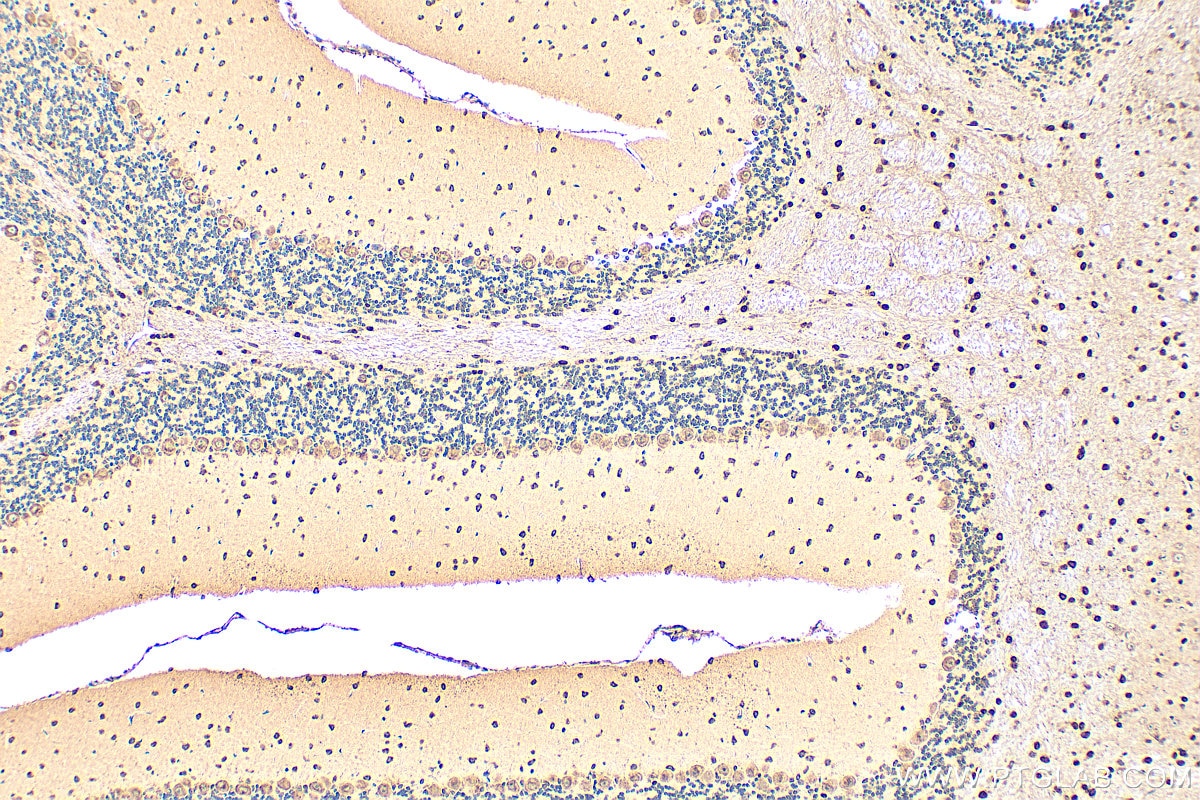
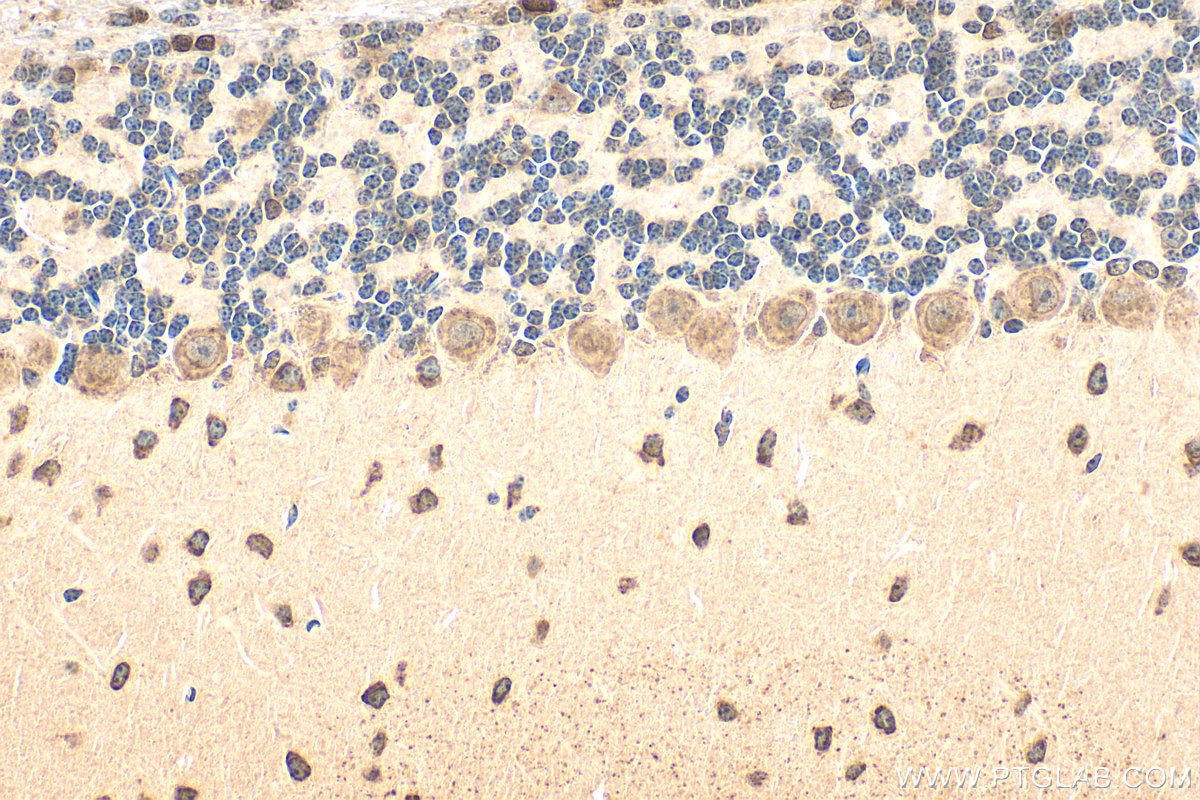
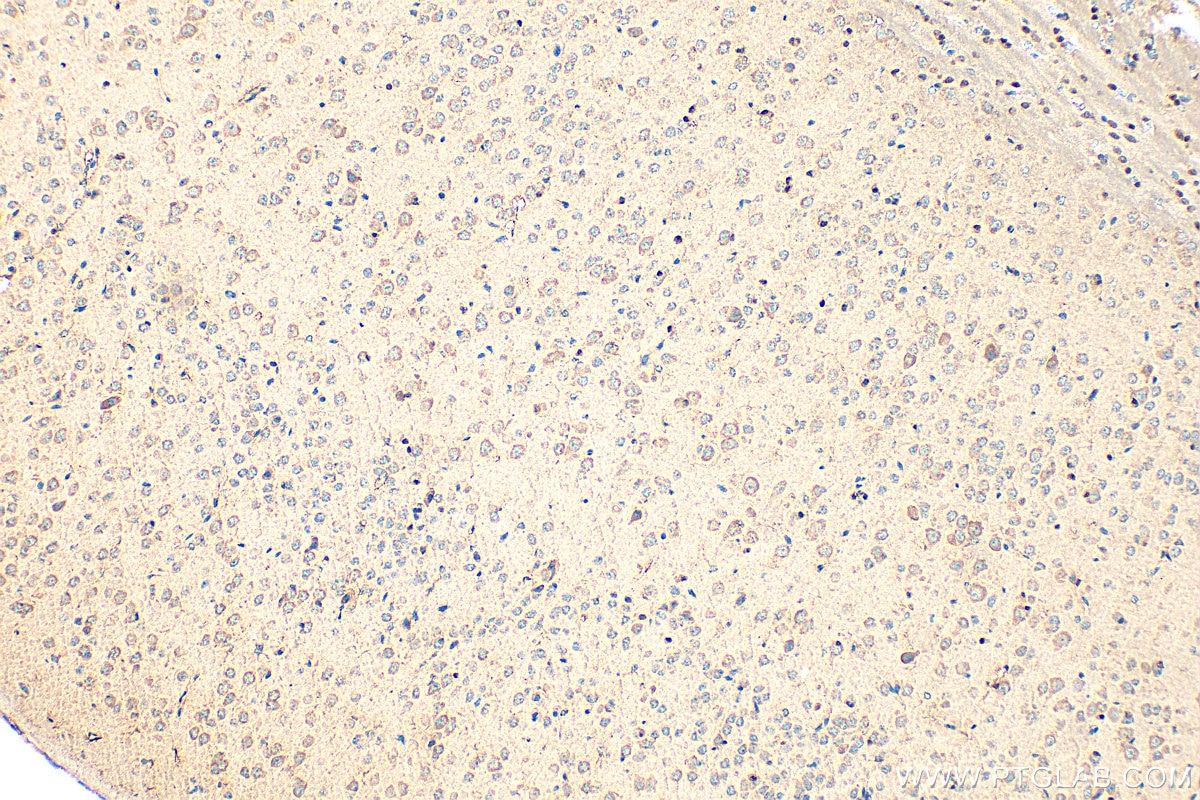
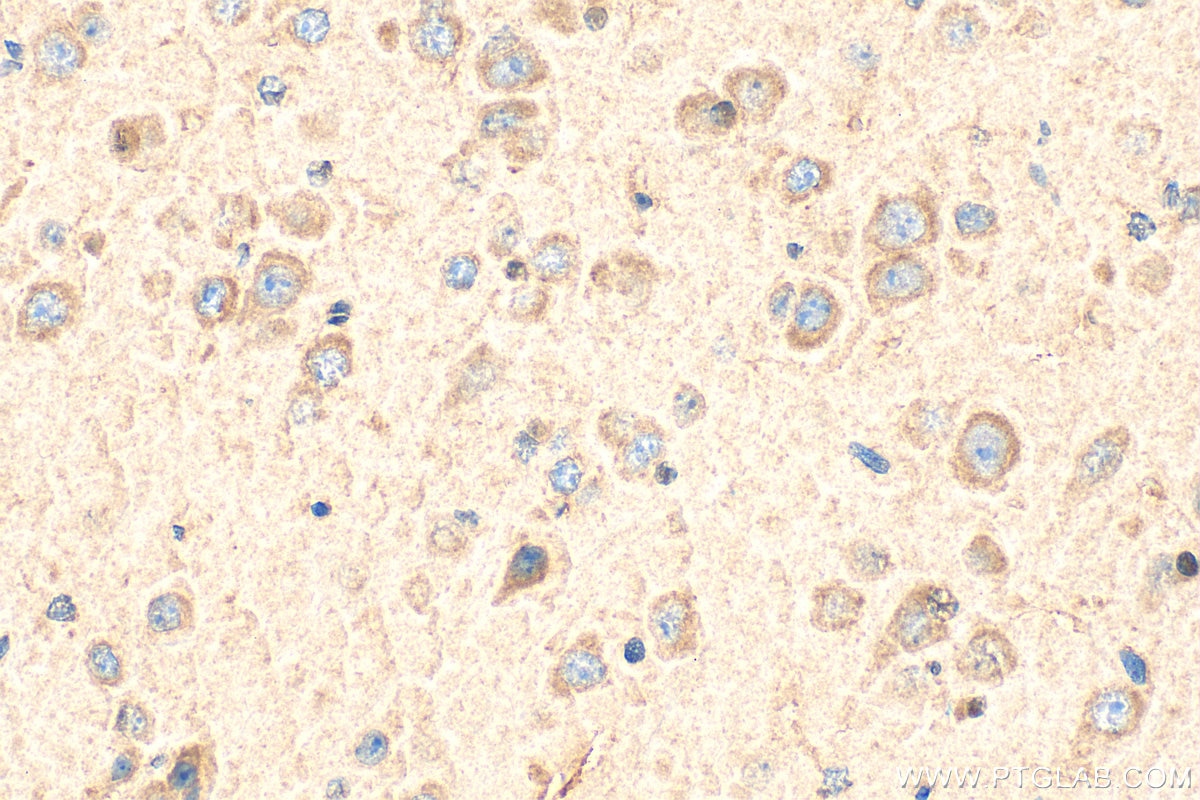

Tested Applications
| Positive IHC detected in | mouse brain tissue, mouse cerebellum tissue Note: suggested antigen retrieval with TE buffer pH 9.0; (*) Alternatively, antigen retrieval may be performed with citrate buffer pH 6.0 |
Recommended dilution
| Application | Dilution |
|---|---|
| Immunohistochemistry (IHC) | IHC : 1:50-1:500 |
| It is recommended that this reagent should be titrated in each testing system to obtain optimal results. | |
| Sample-dependent, Check data in validation data gallery. | |
Product Information
19681-1-AP targets CACNA1B in WB, IHC, ELISA applications and shows reactivity with human, mouse, rat samples.
| Tested Reactivity | human, mouse, rat |
| Cited Reactivity | human, rat |
| Host / Isotype | Rabbit / IgG |
| Class | Polyclonal |
| Type | Antibody |
| Immunogen |
Peptide Predict reactive species |
| Full Name | calcium channel, voltage-dependent, N type, alpha 1B subunit |
| Calculated Molecular Weight | 262 kDa |
| GenBank Accession Number | NM_000718 |
| Gene Symbol | CACNA1B |
| Gene ID (NCBI) | 774 |
| RRID | AB_10638918 |
| Conjugate | Unconjugated |
| Form | Liquid |
| Purification Method | Antigen affinity purification |
| UNIPROT ID | Q00975 |
| Storage Buffer | PBS with 0.02% sodium azide and 50% glycerol, pH 7.3. |
| Storage Conditions | Store at -20°C. Stable for one year after shipment. Aliquoting is unnecessary for -20oC storage. 20ul sizes contain 0.1% BSA. |
Background Information
CACNA1B, also named as CACH5, CACNL1A5 and BIII, belongs to the calcium channel alpha-1 subunit (TC 1.A.1.11) family. Voltage-sensitive calcium channels (VSCC) mediate the entry of calcium ions into excitable cells and are also involved in a variety of calcium-dependent processes, including muscle contraction, hormone or neurotransmitter release, gene expression, cell motility, cell division and cell death. CACNA1B gives rise to N-type calcium currents. N-type calcium channels belong to the 'high-voltage activated' (HVA) group and are blocked by omega-conotoxin-GVIA (omega-CTx-GVIA) and by omega-agatoxin-IIIA (omega-Aga-IIIA). They are however insensitive to dihydropyridines (DHP), and omega-agatoxin-IVA (omega-Aga-IVA). CACNA1B may play a role in directed migration of immature neurons.
Protocols
| Product Specific Protocols | |
|---|---|
| IHC protocol for CACNA1B antibody 19681-1-AP | Download protocol |
| Standard Protocols | |
|---|---|
| Click here to view our Standard Protocols |
Publications
What published studies show
The CACNA1B Polyclonal antibody (Cat# 19681-1-AP) has 4 total citations. These appear in Cell Death & Disease, Molecular Neurobiology, Frontiers in Pharmacology, and Journal of Receptors and Signal Transduction Research. The research fields span breast cancer metastasis and cell migration, neuropathic pain, N-type calcium channel modulation, and sigma-1 receptor signaling. All cited applications were Western blot.
| Species | Application | Title |
|---|---|---|
Cell Death Dis Cav2.2-NFAT2-USP43 axis promotes invadopodia formation and breast cancer metastasis through cortactin stabilization
| ||
J Recept Signal Transduct Res CACNA1B facilitates breast cancer cell growth and migration by regulating cyclin D1 and EMT: the implication of CACNA1B in breast cancer. |
Reviews
What customers say
The single review for 19681-1-AP is a 5-star rating from a researcher who used the antibody for Western Blot on liver tissue at a 1:1000 dilution. The reviewer simply noted that it "works good for WB," indicating satisfactory performance without further elaboration. Overall, the feedback is positive but brief.
The reviews below have been submitted by verified Proteintech customers who received an incentive for providing their feedback.
MALLIKARJUNA (Verified Customer) (11-13-2025) | works good for WB
|





