
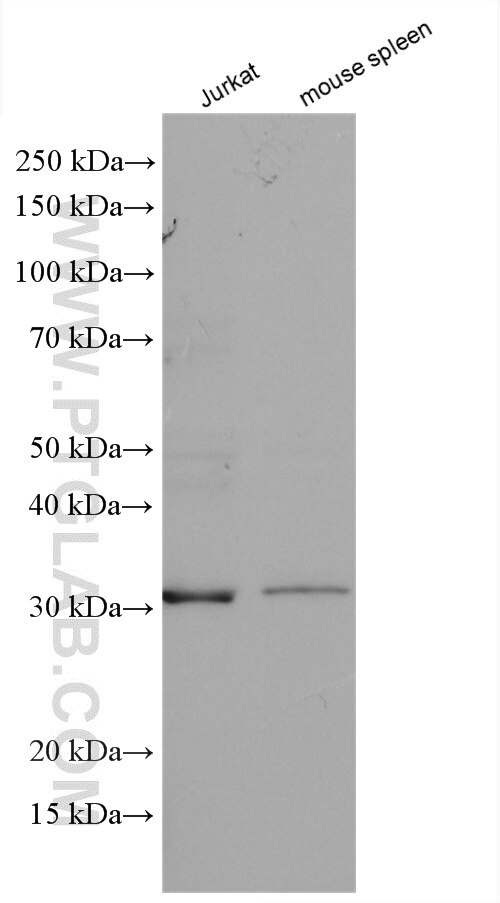
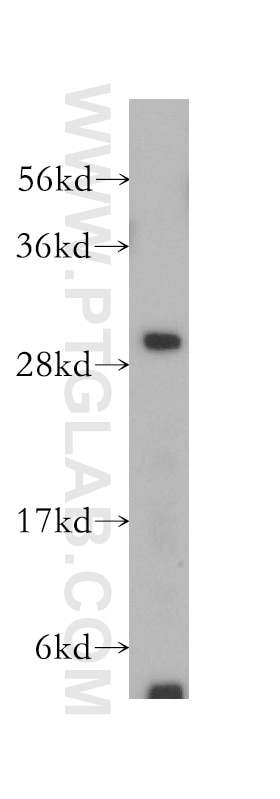

Tested Applications
| Positive WB detected in | Jurkat cells, K-562 cells, mouse spleen tissue |
Recommended dilution
| Application | Dilution |
|---|---|
| Western Blot (WB) | WB : 1:500-1:1000 |
| It is recommended that this reagent should be titrated in each testing system to obtain optimal results. | |
| Sample-dependent, Check data in validation data gallery. | |
Product Information
12220-1-AP targets CREG1 in WB, IHC, IF, ELISA applications and shows reactivity with human, mouse, rat samples.
| Tested Reactivity | human, mouse, rat |
| Cited Reactivity | human, mouse, rat, bovine |
| Host / Isotype | Rabbit / IgG |
| Class | Polyclonal |
| Type | Antibody |
| Immunogen |
CatNo: Ag2901 Product name: Recombinant human CREG1 protein Source: e coli.-derived, PGEX-4T Tag: GST Domain: 1-220 aa of BC008628 Sequence: MAGLSRGSARALLAALLASTLLALLVSPARGRGGRDHGDWDEASRLPPLPPREDAARVARFVTHVSDWGALATISTLEAVRGRPFADVLSLSDGPPGAGSGVPYFYLSPLQLSVSNLQENPYATLTMTLAQTNFCKKHGFDPQSPLCVHIMLSGTVTKVNETEMDIAKHSLFIRHPEMKTWPSSHNWFFAKLNITNIWVLDYFGGPKIVTPEEYYNVTVQ Predict reactive species |
| Full Name | cellular repressor of E1A-stimulated genes 1 |
| Calculated Molecular Weight | 220 aa, 24 kDa |
| Observed Molecular Weight | 32 kDa |
| GenBank Accession Number | BC008628 |
| Gene Symbol | CREG1 |
| Gene ID (NCBI) | 8804 |
| RRID | AB_2084095 |
| Conjugate | Unconjugated |
| Form | Liquid |
| Purification Method | Antigen affinity purification |
| UNIPROT ID | O75629 |
| Storage Buffer | PBS with 0.02% sodium azide and 50% glycerol, pH 7.3. |
| Storage Conditions | Store at -20°C. Stable for one year after shipment. Aliquoting is unnecessary for -20oC storage. 20ul sizes contain 0.1% BSA. |
Background Information
REG1 (Cellular repressor of E1A-stimulated genes 1) shares limited sequence similarity with E1A and binds both the general transcription factor TBP and the tumor suppressor pRb in vitro(PMID:9710587). The monomers of CREG can associate into dimers and the dimerization is observed not only in the crystal but also in solution(PMID:16344469).The cellular repressor of E1A-stimulated genes (CREG) is a secreted glycoprotein that inhibits cell proliferation and/or enhances differentiation. CREG is widely expressed in adult tissues such as the brain, heart, lungs, liver, intestines and kidneys in mice(PMID:20857207).
Protocols
| Product Specific Protocols | |
|---|---|
| WB protocol for CREG1 antibody 12220-1-AP | Download protocol |
| Standard Protocols | |
|---|---|
| Click here to view our Standard Protocols |
Publications
What published studies show
The anti-CREG1 antibody (Cat# 12220-1-AP) has 10 total citations across journals including Nature, Advanced Science, FASEB Journal, Cell Signaling, International Immunopharmacology, Carcinogenesis, and others. Research fields span bone biology and osteoporosis, metabolic regulation (obesity, insulin resistance), viral signaling, placental exosome transport, skeletal muscle adaptation, and renal cell carcinoma progression. Applications cited include WB, IF, and IHC in human, mouse, rat, and bovine species.
| Species | Application | Title |
|---|---|---|
Nature A CRISPR screen defines a signal peptide processing pathway required by flaviviruses. | ||
Adv Sci (Weinh) IL-33-Induced TREM2+ Macrophages Promote Pathological New Bone Formation Through CREG1-IGF2R Axis in Ankylosing Spondylitis | ||
Int J Biol Macromol CREG1 promotes bovine placental trophoblast cells exosome release by targeting IGF2R and participates in regulating organoid differentiation via exosomes transport
| ||
Int Immunopharmacol CREG1 alleviates bone loss in osteoporosis by enhancing the osteogenic differentiation of BMSCs through mitophagy | ||
Int J Mol Sci TLR4-Mediated Inflammatory Responses Regulate Exercise-Induced Molecular Adaptations in Mouse Skeletal Muscle. | ||
Cell Signal CREG1 promotes bone formation via targeting RAB7 to activate autophagy in osteoporosis. |



