
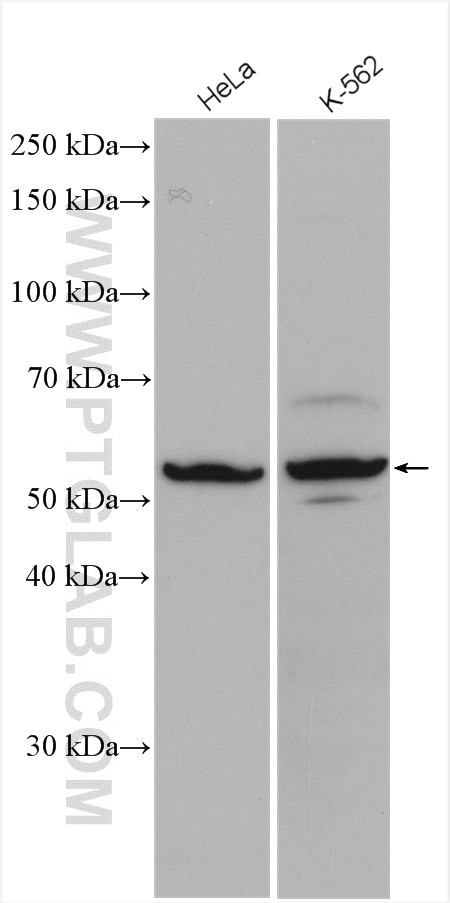
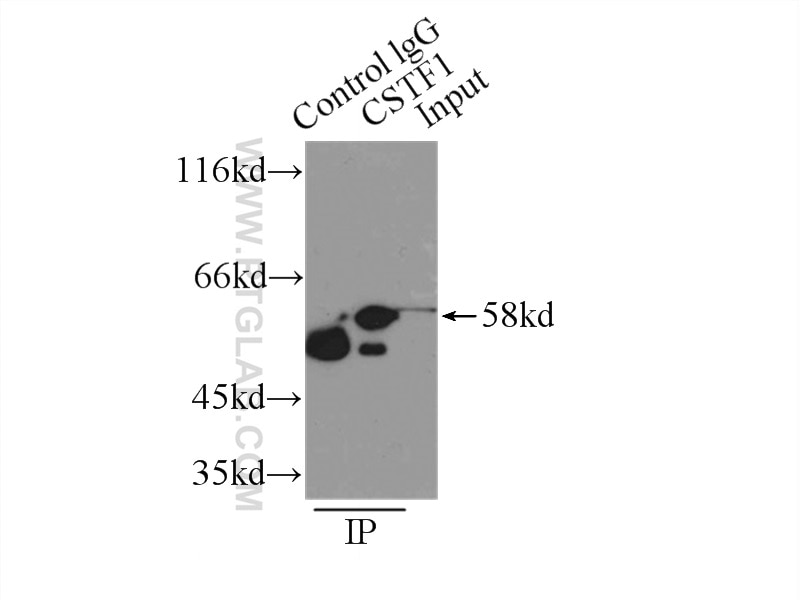

Tested Applications
| Positive WB detected in | HeLa cells, K-562 cells |
| Positive IP detected in | NIH/3T3 cells |
Recommended dilution
| Application | Dilution |
|---|---|
| Western Blot (WB) | WB : 1:500-1:1000 |
| Immunoprecipitation (IP) | IP : 0.5-4.0 ug for 1.0-3.0 mg of total protein lysate |
| It is recommended that this reagent should be titrated in each testing system to obtain optimal results. | |
| Sample-dependent, Check data in validation data gallery. | |
Product Information
10064-2-AP targets CSTF1 in WB, IP, ELISA applications and shows reactivity with human, mouse, rat samples.
| Tested Reactivity | human, mouse, rat |
| Cited Reactivity | human, mouse, rat |
| Host / Isotype | Rabbit / IgG |
| Class | Polyclonal |
| Type | Antibody |
| Immunogen |
CatNo: Ag0109 Product name: Recombinant human CSTF1 protein Source: e coli.-derived, PGEX-4T Tag: GST Domain: 143-419 aa of BC001011 Sequence: KSAMPIEVMMNETAQQNMENHPVIRTLYDHVDEVTCLAFHPTEQILASGSRDYTLKLFDYSKPSAKRAFKYIQEAEMLRSISFHPSGDFILVGTQHPTLRLYDINTFQCFVSCNPQDQHTDAICSVNYNSSANMYVTGSKDGCIKLWDGVSNRCITTFEKAHDGAEVCSAIFSKNSKYILSSGKDSVAKLWEISTGRTLVRYTGAGLSGRQVHRTQAVFNHTEDYVLLPDERTISLCCWDSRTAERRNLLSLGHNNIVRCIVHSPTNPGFMTCSDDF Predict reactive species |
| Full Name | cleavage stimulation factor, 3' pre-RNA, subunit 1, 50kDa |
| Calculated Molecular Weight | 48.3 kDa |
| Observed Molecular Weight | 50 kDa |
| GenBank Accession Number | BC001011 |
| Gene Symbol | CSTF1 |
| Gene ID (NCBI) | 1477 |
| RRID | AB_2261145 |
| Conjugate | Unconjugated |
| Form | Liquid |
| Purification Method | Antigen affinity purification |
| UNIPROT ID | Q05048 |
| Storage Buffer | PBS with 0.02% sodium azide and 50% glycerol, pH 7.3. |
| Storage Conditions | Store at -20°C. Stable for one year after shipment. Aliquoting is unnecessary for -20oC storage. 20ul sizes contain 0.1% BSA. |
Background Information
Cleavage stimulation factor (CstF) , a heterotrimeric protein with subunits of 77, 64, and 50 kD (CstF-77, -64, and -50), is a polyadenylation factor that helps to specify the site of processing. CstF recognizes the G+U-rich element, a sequence located downstream of the cleavage site. CstF-50 subunit interacts with the COOH-terminal domain of the RNAP II largest subunit (CTD). This subunit may be responsible for the interaction of CSTF with other factors to form a satable complex on the pre-mRNA, and multiple WD domains are required for protein interactions.
Protocols
| Product Specific Protocols | |
|---|---|
| IP protocol for CSTF1 antibody 10064-2-AP | Download protocol |
| WB protocol for CSTF1 antibody 10064-2-AP | Download protocol |
| Standard Protocols | |
|---|---|
| Click here to view our Standard Protocols |
Publications
What published studies show
The CSTF1 polyclonal antibody (Cat# 10064-2-AP) has 7 citations published in journals including Molecular Cell, Cancer Letters, Oncogene, EMBO Journal, Cell Reports, iScience, and Andrology. Research fields span mRNA 3′ end processing and polyadenylation, transcriptional regulation, colorectal and lung cancer biology, chromatin accessibility, and spermatogenesis/reproductive biology.
| Species | Application | Title |
|---|---|---|
Mol Cell Mediator regulates transcriptional termination through crosstalk with pre-mRNA 3' end processing factors | ||
Cancer Lett YTHDF1 regulates GID8-mediated glutamine metabolism to promote colorectal cancer progression in a m6A-dependent manner | ||
Oncogene p53 inhibits mRNA 3' processing through its interaction with the CstF/BARD1 complex. | ||
EMBO J The 3' ends of human pre-snRNAs are produced by RNA polymerase II CTD-dependent RNA processing. | ||
Cell Rep LINC00921 reduces lung cancer radiosensitivity by destabilizing NUDT21 and driving aberrant MED23 alternative polyadenylation | ||
iScience Chromodomain helicase DNA-binding domain 2 maintains spermatogonial self-renewal by promoting chromatin accessibility and mRNA stability |



