
Product Information
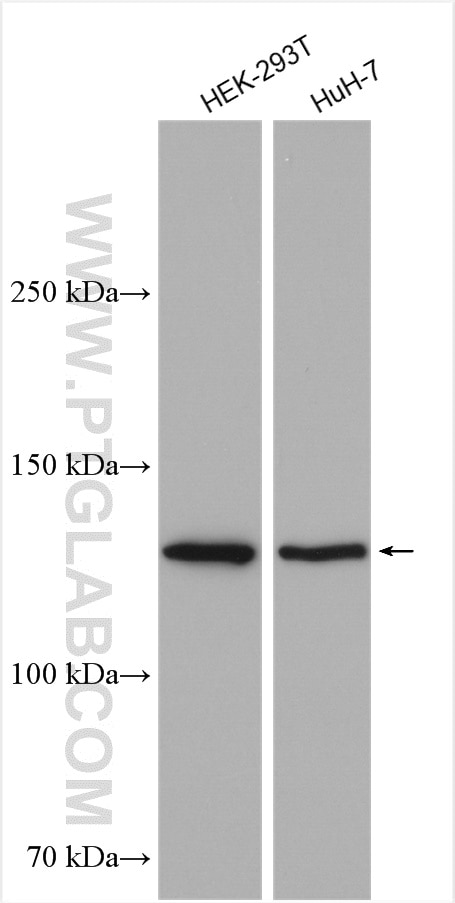
28814-1-PBS targets DHX30 in WB, Indirect ELISA applications and shows reactivity with human samples.
| Tested Reactivity | human |
| Host / Isotype | Rabbit / IgG |
| Class | Polyclonal |
| Type | Antibody |
| Immunogen |
CatNo: Ag29885 Product name: Recombinant human DHX30 protein Source: e coli.-derived, PET28a Tag: 6*His Domain: 336-501 aa of BC014237 Sequence: QVRQGKVTRQGKFKPNSVTYRTKSGNILLHKSTINREATRLRSRWLTYFMAVKSNGSVFVRDSSQVHPLAVLLLTDGDVHIRDDGRRATISLSDSDLLRLEGDSRTVWLLKELRRALGRMVERSLRSELAALPPSVQEEHGQLLALLAELLRGPCGSFDVRKTADD Predict reactive species |
| Full Name | DEAH (Asp-Glu-Ala-His) box polypeptide 30 |
| Calculated Molecular Weight | 501 aa, 56 kDa |
| Observed Molecular Weight | 134 kDa |
| GenBank Accession Number | BC014237 |
| Gene Symbol | DHX30 |
| Gene ID (NCBI) | 22907 |
| RRID | AB_2881216 |
| Conjugate | Unconjugated |
| Form | Liquid |
| Purification Method | Antigen affinity purification |
| UNIPROT ID | Q7L2E3 |
| Storage Buffer | PBS only, pH 7.3. |
| Storage Conditions | Store at -80°C. |
Background Information
The DHX30 protein is a crucial member of the DEAH-box RNA helicase family, localized in both the cytoplasm and mitochondria. As a key regulator of RNA metabolism, it hydrolyzes ATP to unwind RNA secondary structures or RNA-protein complexes, thereby playing a central role in fundamental cellular processes such as ribosome biogenesis, mitochondrial translation initiation, and the regulation of mRNA stability. This protein is particularly prominent in the nervous system, where mutations in its encoding gene have been clearly identified as one of the genetic factors leading to neurodevelopmental disorders (such as autism spectrum disorder and intellectual disability), primarily affecting neuronal differentiation and synaptic function. In recent years, studies have also found that DHX30 is abnormally expressed in various cancer tissues, suggesting its potential involvement in tumor development and progression, making it a promising tumor biomarker and therapeutic target.


