

Tested Applications
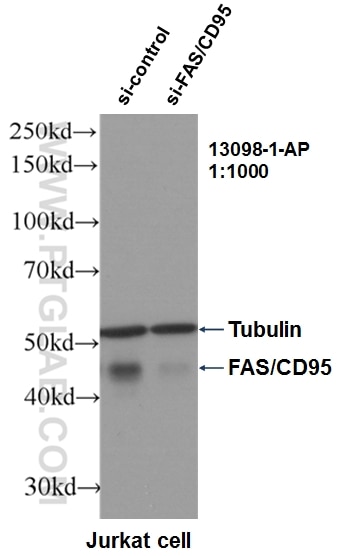
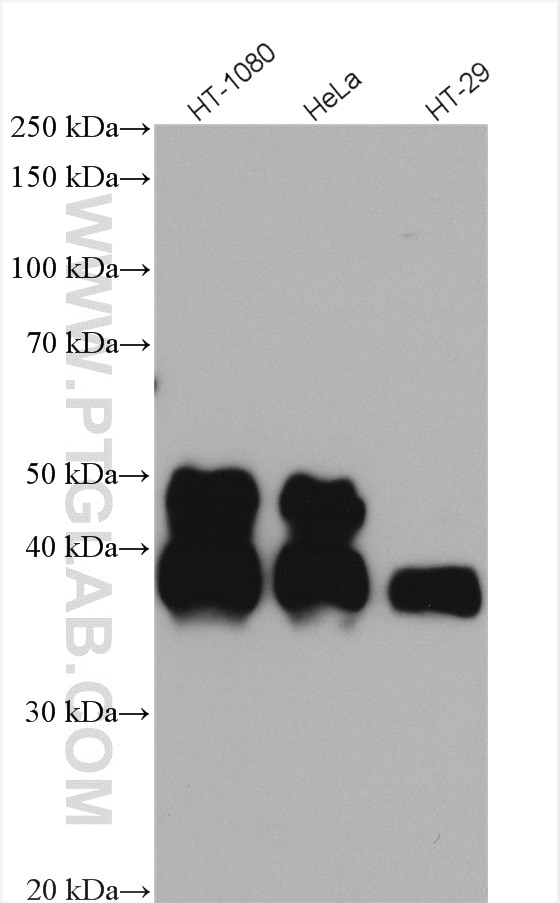
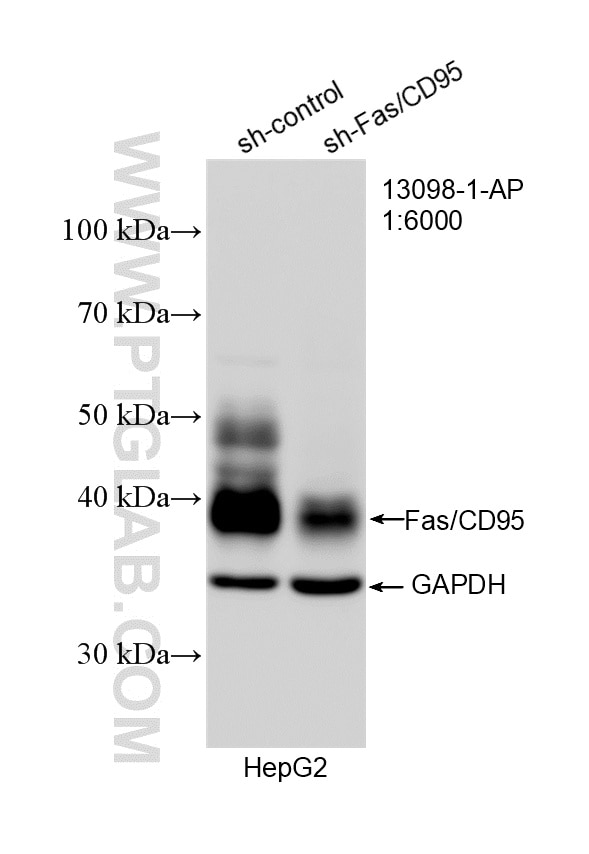
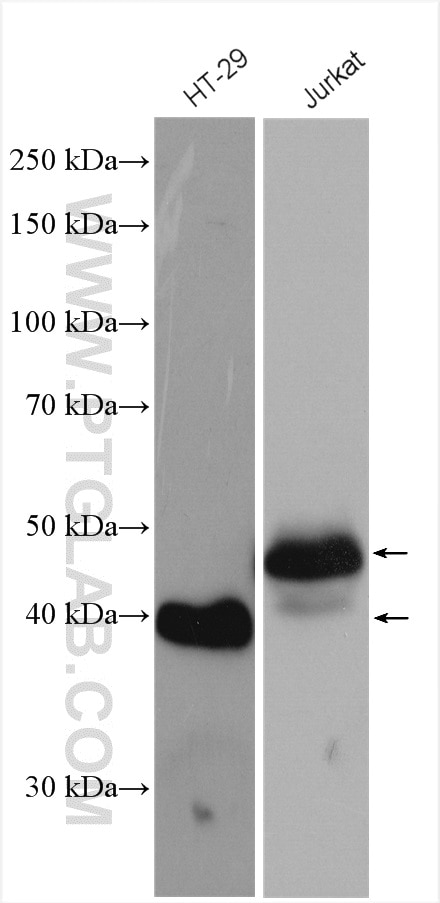
| Positive WB detected in | HT-1080 cells, HepG2 cells, HT-29 cells, Jurkat cells, HeLa cells |
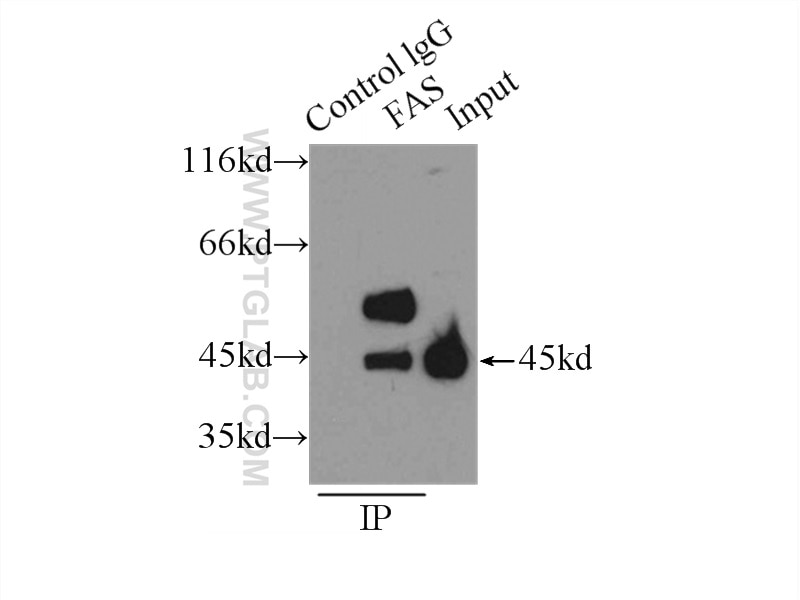
| Positive IP detected in | HeLa cells |
Recommended dilution
| Application | Dilution |
|---|---|
| Western Blot (WB) | WB : 1:1000-1:6000 |
| Immunoprecipitation (IP) | IP : 0.5-4.0 ug for 1.0-3.0 mg of total protein lysate |
| It is recommended that this reagent should be titrated in each testing system to obtain optimal results. | |
| Sample-dependent, Check data in validation data gallery. | |
Product Information
13098-1-AP targets Fas/CD95 in WB, IHC, IF, IP, CoIP, CHIP, ELISA applications and shows reactivity with human samples.
| Tested Reactivity | human |
| Cited Reactivity | human, monkey, hamster, goat, sheep |
| Host / Isotype | Rabbit / IgG |
| Class | Polyclonal |
| Type | Antibody |
| Immunogen |
CatNo: Ag3718 Product name: Recombinant human FAS protein Source: e coli.-derived, PGEX-4T Tag: GST Domain: 156-335 aa of BC012479 Sequence: ECTLTSNTKCKEEGSRSNLGWLCLLLLPIPLIVWVKRKEVQKTCRKHRKENQGSHESPTLNPETVAINLSDVDLSKYITTIAGVMTLSQVKGFVRKNGVNEAKIDEIKNDNVQDTAEQKVQLLRNWHQLHGKKEAYDTLIKDLKKANLCTLAEKIQTIILKDITSDSENSNFRNEIQSLV Predict reactive species |
| Full Name | Fas (TNF receptor superfamily, member 6) |
| Calculated Molecular Weight | 35-38 kDa |
| Observed Molecular Weight | 38-45 kDa |
| GenBank Accession Number | BC012479 |
| Gene Symbol | Fas/CD95 |
| Gene ID (NCBI) | 355 |
| RRID | AB_2278042 |
| Conjugate | Unconjugated |
| Form | Liquid |
| Purification Method | Antigen affinity purification |
| UNIPROT ID | P25445 |
| Storage Buffer | PBS with 0.02% sodium azide and 50% glycerol, pH 7.3. |
| Storage Conditions | Store at -20°C. Stable for one year after shipment. Aliquoting is unnecessary for -20oC storage. 20ul sizes contain 0.1% BSA. |
Background Information
Fas (CD95/APO-1) is a transmembrane glycoprotein belonging to the tumor necrosis factor (TNF) receptor superfamily. It can mediate apoptosis by ligation with an agonistic anti-Fas antibody or Fas ligand. Stimulation of Fas results in the aggregation of its intracellular death domains, leading to the formation of the death-inducing signaling complex (DISC). FAS-mediated apoptosis may have a role in the induction of peripheral tolerance, in the antigen-stimulated suicide of mature T-cells, or both. The molecular mass of native Fas is 38 kDa, the high molecular weight form (40-55 kDa) of Fas is due to glycosylation.
Protocols
| Product Specific Protocols | |
|---|---|
| IP protocol for Fas/CD95 antibody 13098-1-AP | Download protocol |
| WB protocol for Fas/CD95 antibody 13098-1-AP | Download protocol |
| Standard Protocols | |
|---|---|
| Click here to view our Standard Protocols |
Publications
What published studies show
The Fas/CD95 Polyclonal antibody (Cat# 13098-1-AP) has accumulated 153 citations across journals including Cell, Nature Communications, Cell Research, Gut, Advanced Science, Oncogene, Cancer Letters, Frontiers in Immunology, and FASEB Journal. Research fields span oncology (colorectal, lung, breast, liver, gastric cancers), apoptosis signaling, lipid metabolism/NAFLD, inflammation, immunology, cardiovascular disease, neurology, and natural product pharmacology.
| Species | Application | Title |
|---|---|---|
Cell Res DNA damage triggers tubular endoplasmic reticulum extension to promote apoptosis by facilitating ER-mitochondria signaling. | ||
Nat Commun A neutrophil mimicking metal-porphyrin-based nanodevice loaded with porcine pancreatic elastase for cancer therapy | ||
Exp Mol Med Targeting the IL-1β/IL-1Ra pathways for the aggregation of human islet amyloid polypeptide in an ex vivo organ culture system of the intervertebral disc. | ||
Metabolism AGEs exacerbates coronary microvascular dysfunction in NoCAD by activating endoplasmic reticulum stress- mediated PERK signaling pathway. |
Reviews
What customers say
Both reviewers rated this antibody 4 out of 5 stars and used it at a 1:1000 dilution for Western Blot. One user tested it on ovarian cancer and melanoma cell lines, noting some non-specific binding but confirming the target band was easy to identify. The other validated it for both WB and immunofluorescence on human and mouse cell lines, reporting good performance overall. In summary, users find it reliable at standard dilution with clear target detection, though minor background may occur in certain cell types.
The reviews below have been submitted by verified Proteintech customers who received an incentive for providing their feedback.
Macarena Lucia (Verified Customer) (11-16-2021) | Some unspecific binding but the target is very easy to identify.
|
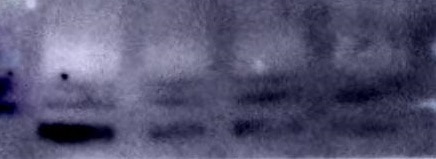
Kishor (Verified Customer) (06-23-2019) | This antibody works good at 1:1000 dilution in WB for mouse and human cells.
 |






