
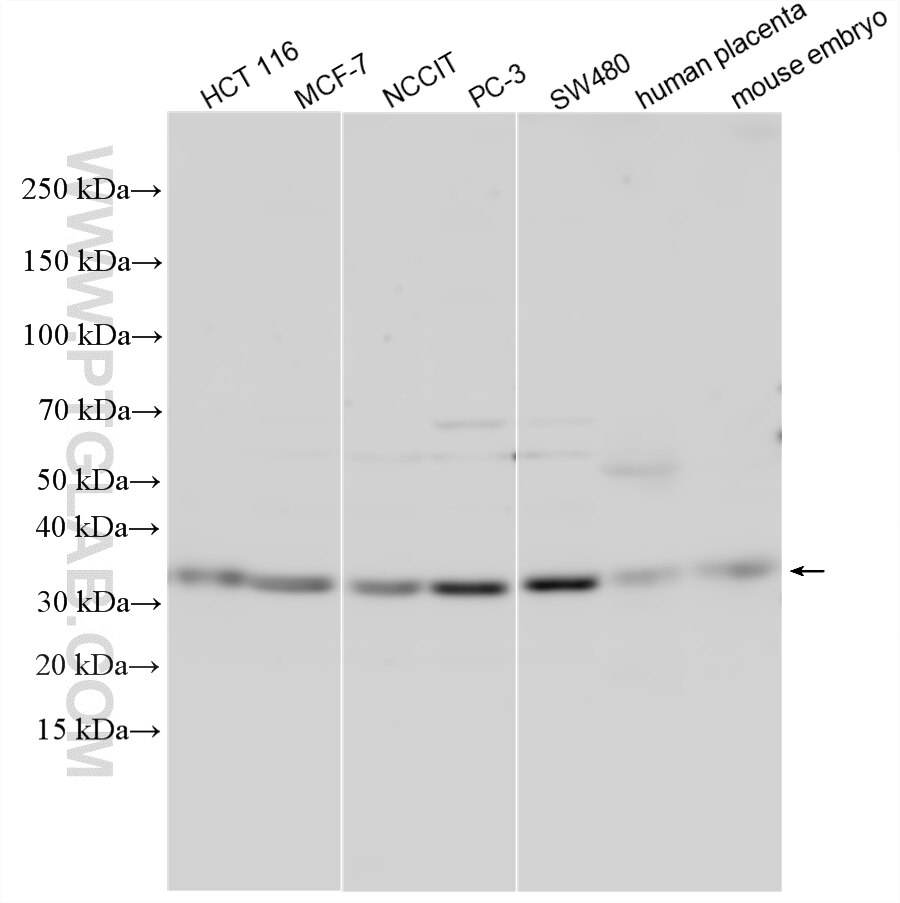

Tested Applications
| Positive WB detected in | HCT 116 cells, MCF-7 cells, NCCIT cells, PC-3 cells, SW480 cells, human placenta tissue, mouse embryo tissue |
Recommended dilution
| Application | Dilution |
|---|---|
| Western Blot (WB) | WB : 1:500-1:2000 |
| It is recommended that this reagent should be titrated in each testing system to obtain optimal results. | |
| Sample-dependent, Check data in validation data gallery. | |
Product Information
27542-1-AP targets HES1 in WB, ELISA applications and shows reactivity with human, mouse, rat samples.
| Tested Reactivity | human, mouse, rat |
| Cited Reactivity | human, mouse, rat |
| Host / Isotype | Rabbit / IgG |
| Class | Polyclonal |
| Type | Antibody |
| Immunogen |
CatNo: Ag26393 Product name: Recombinant human HES1 protein Source: e coli.-derived, PGEX-4T Tag: GST Domain: 1-277 aa of BC039152 Sequence: MPADIMEKNSSSPVAASVNTTPDKPKTASEHRKSSKPIMEKRRRARINESLSQLKTLILDALKKDSSRHSKLEKADILEMTVKHLRNLQRAQMTAALSTDPSVLGKYRAGFSECMNEVTRFLSTCEGVNTEVRTRLLGHLANCMTQINAMTYPGQPHPALQAPPPPPPGPGGPQHAPFAPPPPLVPIPGGAAPPPGGAPCKLGSQAGEAAKVFGGFQVVPAPDGQFAFLIPNGAFAHSGPVIPVYTSNSGTSVGPNAVSPSSGPSLTADSMWRPWRN Predict reactive species |
| Full Name | hairy and enhancer of split 1, (Drosophila) |
| Calculated Molecular Weight | 30 kDa |
| Observed Molecular Weight | 30-35 kDa |
| GenBank Accession Number | BC039152 |
| Gene Symbol | HES1 |
| Gene ID (NCBI) | 3280 |
| Conjugate | Unconjugated |
| Form | Liquid |
| Purification Method | Antigen affinity purification |
| UNIPROT ID | Q14469 |
| Storage Buffer | PBS with 0.02% sodium azide and 50% glycerol, pH 7.3. |
| Storage Conditions | Store at -20°C. Stable for one year after shipment. Aliquoting is unnecessary for -20oC storage. 20ul sizes contain 0.1% BSA. |
Background Information
HES1 (hairy and enhancer of split 1) is a basic helix-loop-helix (bHLH) transcriptional repressor that serves as a mammalian homolog of the Drosophila Hairy and Enhancer of split proteins and functions as a canonical downstream target of Notch signaling. It represses genes that require bHLH proteins for their transcription, and unlike most bHLH factors that bind E-box motifs, HES1 preferentially recognizes N-box elements (CACNAG) through a unique proline residue in its basic domain. Its repressor activity depends on three conserved domains: the bHLH region, a central Orange domain, and a C-terminal WRPW motif that mediates interaction with the Groucho/TLE corepressor. Functionally, HES1 is expressed at high levels in undifferentiated neural precursor cells and its expression declines upon differentiation, where it regulates cell fate decisions by antagonizing proneural bHLH proteins such as Mash1 and inhibiting MyoD1 and ASH1 to suppress myogenesis.
Protocols
| Product Specific Protocols | |
|---|---|
| WB protocol for HES1 antibody 27542-1-AP | Download protocol |
| Standard Protocols | |
|---|---|
| Click here to view our Standard Protocols |
Publications
What published studies show
The HES1 Polyclonal antibody (Cat# 27542-1-AP) has a total of 5 citations published across five journals: Lipids Health Dis, Cell Mol Life Sci, J Nutr Biochem, iScience, and Am J Cancer Res. The associated research fields include Notch signaling in asthma-related lipid metabolism, thrombosis prevention, colorectal cancer stem cell biology, osteogenic mineralization for bone defect repair, and cancer invasion/stemness regulation.
| Species | Application | Title |
|---|---|---|
Lipids Health Dis Exposure to PM2.5 affects blood lipid levels in asthmatic rats through notch signaling pathway. | ||
Cell Mol Life Sci Cathepsin K deficiency prevented stress-related thrombosis in a mouse FeCl3 model | ||
J Nutr Biochem ZNF217-activated Notch signaling mediates sulforaphane-suppressed stem cell properties in colorectal cancer | ||
iScience Adelmidrol: A novel osteogenic mineralization regulator for bone defect repair via activating the Notch pathway with drug-loaded hydrogel. | ||
Am J Cancer Res MOGS promotes stemness acquisition and invasion via enhancing NOTCH1-glycosylation dependent NOTCH pathway in colorectal cancer |


