
Recombinant Human Biglycan protein (rFc Tag)
Species
Human
Purity
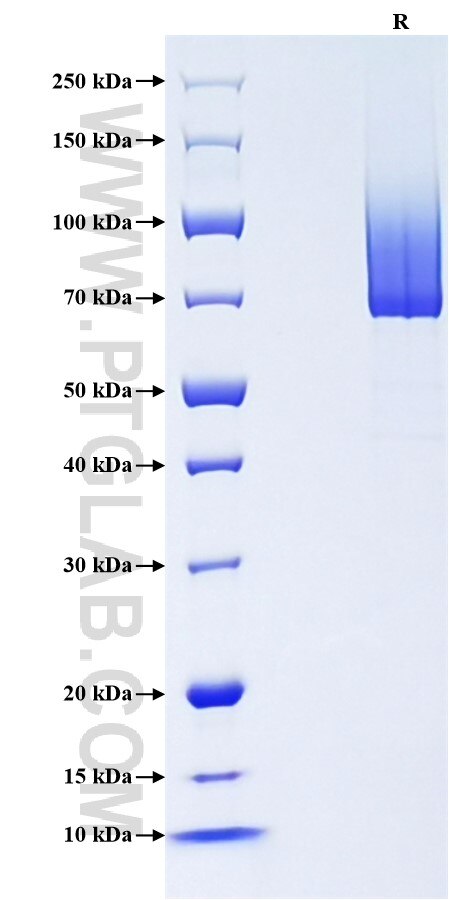
>90 %, SDS-PAGE
Tag
rFc Tag
Activity
not tested
Cat no : Eg2972
Validation Data Gallery
Product Information
| Purity | >90 %, SDS-PAGE |
| Endotoxin | <0.1 EU/μg protein, LAL method |
| Activity |
Not tested |
| Expression | HEK293-derived Human Biglycan protein Leu17-Lys368 (Accession# P21810) with a rabbit IgG Fc tag at the C-terminus. |
| GeneID | 633 |
| Accession | P21810 |
| PredictedSize | 65.8 kDa |
| SDS-PAGE | 68-100 kDa, reducing (R) conditions |
| Formulation | Lyophilized from 0.22 μm filtered solution in PBS, pH 7.4. Normally 5% trehalose and 5% mannitol are added as protectants before lyophilization. |
| Reconstitution | Briefly centrifuge the tube before opening. Reconstitute at 0.1-0.5 mg/mL in sterile water. |
| Storage Conditions |
It is recommended that the protein be aliquoted for optimal storage. Avoid repeated freeze-thaw cycles.
|
| Shipping | The product is shipped at ambient temperature. Upon receipt, store it immediately at the recommended temperature. |
Background
Biglycan is a member of the small leucine-rich proteoglycan (SLRP) family. It consists of a core protein of 42 kDa containing leucine-rich repeats (LRRs), to which two chondroitin/dermatan sulfate side chains are covalently bound. The tissue-specific chondroitin- or dermatan-sulfate glycosaminoglycan chains of biglycan are attached to amino acid residues at the N-terminus of the core protein. Biglycan is a ubiquitous component of the connective tissue matrix and may act as a signaling molecule. Upregulation of biglycan has been reported in multiple types of solid cancer.
References:
1.Schaefer L. et al. (2008). J Biol Chem. 283(31):21305-21309.
2.Bianco P. et al. (1990). J Histochem Cytochem. 38(11):1549-1563.
3.Iozzo RV. (1999). J Biol Chem. 274(27):18843-18846.
4.Nastase MV. et al. (2012). J Histochem Cytochem. 60(12):963-975.
5.Zhao SF. et al. (2020). Oncol Lett. 19(3):1673-1682.