
Recombinant Human CD59 protein (rFc Tag)
Species
Human
Purity
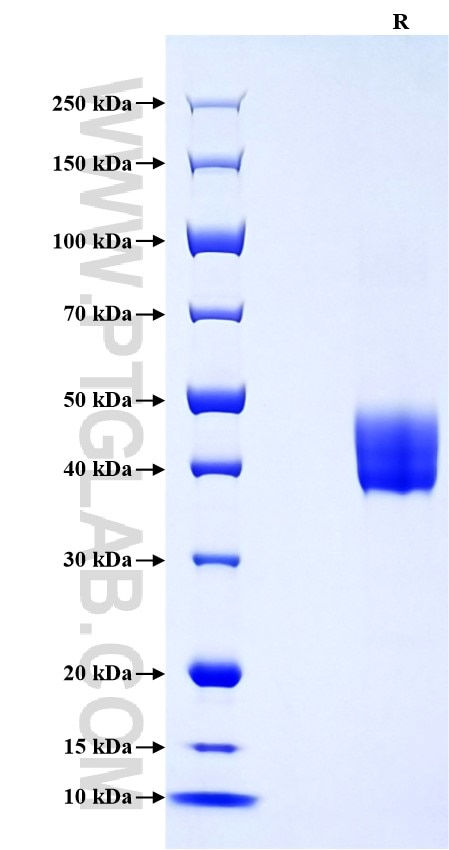
>90 %, SDS-PAGE
Tag
rFc Tag
Activity
not tested
Cat no : Eg1758
Validation Data Gallery
Product Information
| Purity | >90 %, SDS-PAGE |
| Endotoxin | <0.1 EU/μg protein, LAL method |
| Activity |
Not tested |
| Expression | HEK293-derived Human CD59 protein Leu26-Asn102 (Accession# P13987-1) with a rabbit IgG Fc tag at the C-terminus. |
| GeneID | 966 |
| Accession | P13987-1 |
| PredictedSize | 35.2 kDa |
| SDS-PAGE | 38-48 kDa, reducing (R) conditions |
| Formulation | Lyophilized from 0.22 μm filtered solution in PBS, pH 7.4. Normally 5% trehalose and 5% mannitol are added as protectants before lyophilization. |
| Reconstitution | Briefly centrifuge the tube before opening. Reconstitute at 0.1-0.5 mg/mL in sterile water. |
| Storage Conditions |
It is recommended that the protein be aliquoted for optimal storage. Avoid repeated freeze-thaw cycles.
|
| Shipping | The product is shipped at ambient temperature. Upon receipt, store it immediately at the recommended temperature. |
Background
CD59, also named as MIC11, MIN1, MIN2, MIN3, MSK21, MIRL, MACIF, HRF20 and 1F5 antigen, is a cell surface molecule glycoprotein with MW 18-25 kDa. It acts as a determinant of proximal-distal cell identity. CD59 acts by binding to the C8 and/or C9 complements of the assembling membrane attack complex (MAC), thereby preventing incorporation of the multiple copies of C9 required for complete formation of the osmolytic pore. It is involved in signal transduction for T-cell activation complexed to a protein tyrosine kinase.
References:
1. Imre Farkas, et al. (2002) J Physiol. 539(Pt 2):537-45.
2. S A Rollins, et al. (1990) J Immunol. 144(9):3478-83.
3. Emanuela Marcenaro, et al. (2003) Eur J Immunol. 33(12):3367-76.
4. Xi-He Xie, et al. (2012) Cell Immunol. 274(1-2):1-11.