
Recombinant Human CLU protein (His Tag)
Species
Human
Purity
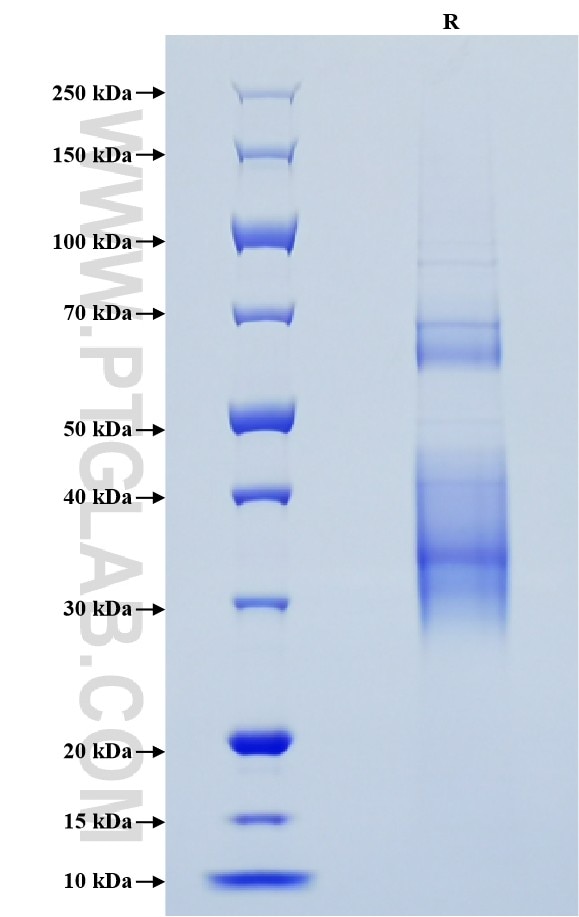
>90 %, SDS-PAGE
Tag
His Tag
Activity
not tested
Cat no : Eg0225
Validation Data Gallery
Product Information
| Purity | >90 %, SDS-PAGE |
| Endotoxin | <0.1 EU/μg protein, LAL method |
| Activity |
Not tested |
| Expression | HEK293-derived Human CLU protein Asp23-Glu449 (Accession# P10909) with a His tag at the C-terminus. |
| GeneID | 1191 |
| Accession | P10909 |
| PredictedSize | 54.5 kDa |
| SDS-PAGE | 28-45 kDa and 60-70 kDa, reducing (R) conditions |
| Formulation | Lyophilized from 0.22 μm filtered solution in PBS, pH 7.4. Normally 5% trehalose and 5% mannitol are added as protectants before lyophilization. |
| Reconstitution | Briefly centrifuge the tube before opening. Reconstitute at 0.1-0.5 mg/mL in sterile water. |
| Storage Conditions |
It is recommended that the protein be aliquoted for optimal storage. Avoid repeated freeze-thaw cycles.
|
| Shipping | The product is shipped at ambient temperature. Upon receipt, store it immediately at the recommended temperature. |
Background
Clusterin (also known as apolipoprotein J) is a 75-80 kDa heterodimeric glycoprotein produced by a wide array of tissues and found in most biological fluids. It is encoded by one single gene and cleaved posttranslationally into α and β subunits prior to secretion from the cell. Many functions have been described for clusterin, including regulating apoptosis, transporting lipids, controlling cell interactions, and regulating complement. Increased plasma clusterin levels have been associated with the severity, pathology, and progression of Alzheimer's disease.
References:
1. Rosenberg ME, et al. (1995) Int J Biochem Cell Biol. 27(7):633-45.
2. Wilson MR, et al. (2000) Trends Biochem Sci. 25(3):95-8.
3. Jones SE, et al. (2002) Int J Biochem Cell Biol. 34(5):427-31.
4. Thambisetty M, et al. (2010). Arch Gen Psychiatry. 67(7):739-48.
5. Schrijvers EM, et al. (2011) 305(13):1322-6.