
Recombinant Human Cystatin S/CST4 protein (mFc Tag)
Species
Human
Purity
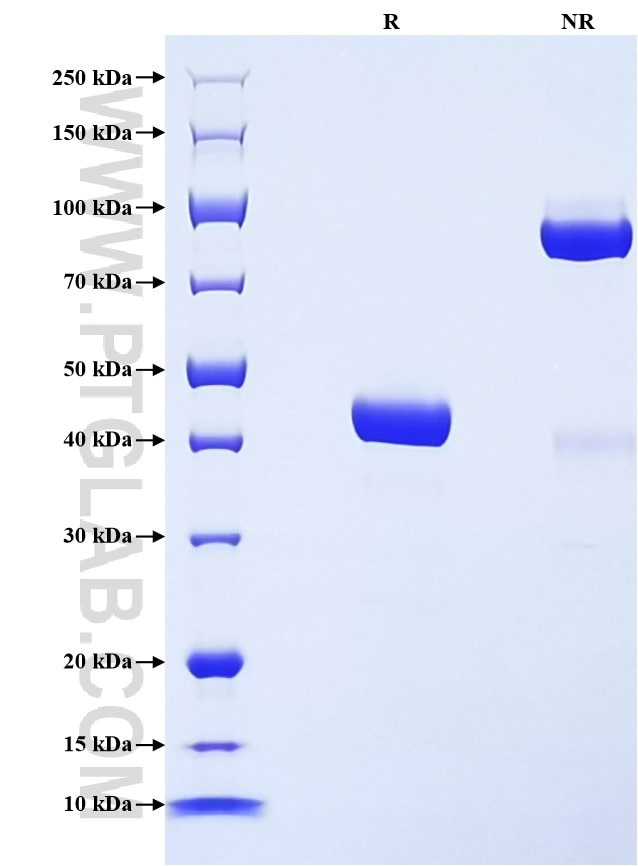
>90 %, SDS-PAGE
Tag
mFc Tag
Activity
not tested
Cat no : Eg3637
Validation Data Gallery
Product Information
| Purity | >90 %, SDS-PAGE |
| Endotoxin | <0.1 EU/μg protein, LAL method |
| Activity |
Not tested |
| Expression | HEK293-derived Human Cystatin S protein Ser21-Ala141 (Accession# P01036) with a mouse IgG Fc tag at the C-terminus. |
| GeneID | 1472 |
| Accession | P01036 |
| PredictedSize | 40.8 kDa |
| SDS-PAGE | 40-47 kDa, reducing (R) conditions |
| Formulation | Lyophilized from 0.22 μm filtered solution in PBS, pH 7.4. Normally 5% trehalose and 5% mannitol are added as protectants before lyophilization. |
| Reconstitution | Briefly centrifuge the tube before opening. Reconstitute at 0.1-0.5 mg/mL in sterile water. |
| Storage Conditions |
It is recommended that the protein be aliquoted for optimal storage. Avoid repeated freeze-thaw cycles.
|
| Shipping | The product is shipped at ambient temperature. Upon receipt, store it immediately at the recommended temperature. |
Background
Cystatins are a family of inhibitors of cysteine peptidases that comprises the salivary cystatins D and S-type (including CST5 and CST4,1,2) and cystatin C-type (CST3). The D and S-type cystatin have also been detected in seminal plasma, tears, and tracheobronchial fluid but not in other fluids and secretions where cystatin C is found. And the CST4 was expressed in the serous acinar and demilune cells of the human submandibular gland and at lower levels in the serous acini of the parotid gland. CST4 specifically combines with cysteine protease to regulate its activity, thus preventing hydrolysis of the extracellular matrix. And some studies propose that CST4 might be a biomarker for gastrointestinal cancer.
References:
1. de Sousa-Pereira, P., et al. (2014). PloS One, Oct 17;9(10), e109050.
2. Dickinson, D. P., et al. (2002). DNA Cell Biol. Jan;21(1):47-65.
3. Zhang YQ, et al. (2017). Am J Cancer Res. Nov 1;7(11):2290-2304.
4. Dou Y, et al. (2018). Onco Targets Ther. Mar 28;11:1743-1756.