
Recombinant Human EDA protein (rFc Tag)
Species
Human
Purity
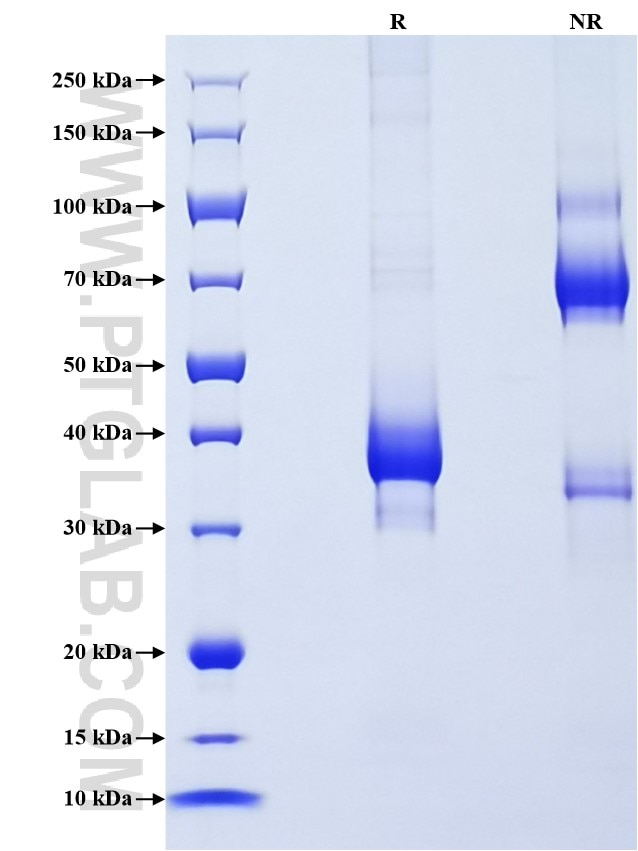
>90 %, SDS-PAGE
Tag
rFc Tag
Activity
not tested
Cat no : Eg4242
Validation Data Gallery
Product Information
| Purity | >90 %, SDS-PAGE |
| Endotoxin | <0.1 EU/μg protein, LAL method |
| Activity |
Not tested |
| Expression | HEK293-derived Human EDA protein Glu63-Ser391 (Accession# Q92838-1) with a rabbit IgG Fc tag at the N-terminus. |
| GeneID | 1896 |
| Accession | Q92838-1 |
| PredictedSize | 62.0 kDa |
| SDS-PAGE | 35-40 kDa, reducing (R) conditions |
| Formulation | Lyophilized from 0.22 μm filtered solution in PBS, pH 7.4. Normally 5% trehalose and 5% mannitol are added as protectants before lyophilization. |
| Reconstitution | Briefly centrifuge the tube before opening. Reconstitute at 0.1-0.5 mg/mL in sterile water. |
| Storage Conditions |
It is recommended that the protein be aliquoted for optimal storage. Avoid repeated freeze-thaw cycles.
|
| Shipping | The product is shipped at ambient temperature. Upon receipt, store it immediately at the recommended temperature. |
Background
EDA (ectodysplasin A), which belongs to the tumor necrosis factor (TNF) family, causes cell death, proliferation, or differentiation. EDA primarily regulates the induction, morphogenesis, and/or maintenance of structures of cutaneous origin (e.g., teeth, hair, sweat glands, and several other glands). Mutations in the gene responsible for EDA signaling result in hypohidrotic ectodermal dysplasia (HED), an A congenital genetic disorder accompanied by malformations of the skin attachments. Recent studies have shown that EDA and its receptors regulate cancer cell proliferation, apoptosis, differentiation, and migration, which may regulate tumorigenesis and cancer progression. The EDA pathway has also been shown to be involved in the pathogenesis of non-alcoholic fatty liver disease (NAFLD) and type II diabetes by regulating glucose and lipid metabolism. (PMID: 36012178)
References:
1. Yang R,et al. Int J Mol Sci. 2022;23(16):8911.
2. Ou S, et al. Int J Mol Sci. 2022;23(24):15700.
3. Deng X,et al. J Diabetes Res. 2023;2023:5087761.