
Recombinant Human TrkB protein (rFc Tag)
Species
Human
Purity
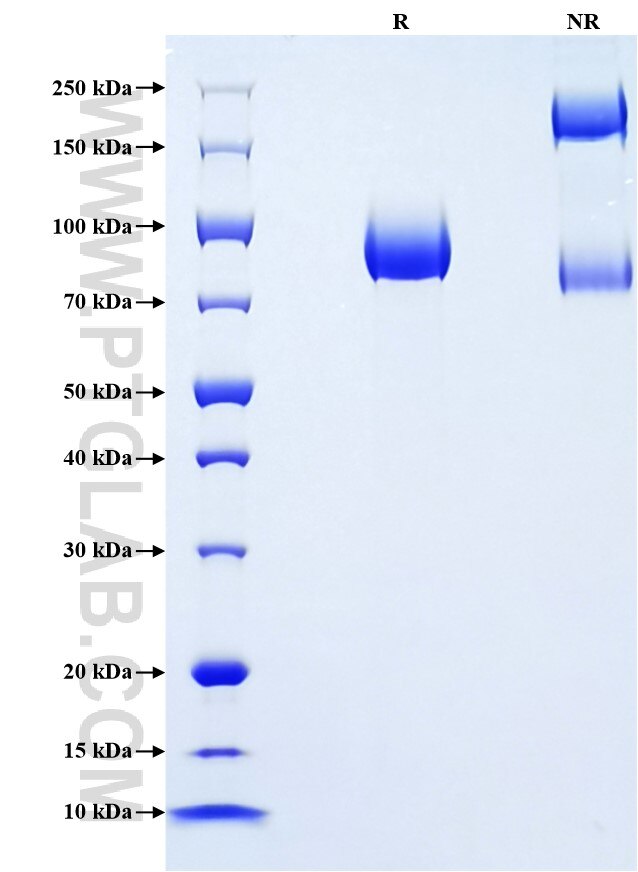
>90 %, SDS-PAGE
Tag
rFc Tag
Activity
not tested
Cat no : Eg2880
Validation Data Gallery
Product Information
| Purity | >90 %, SDS-PAGE |
| Endotoxin | <0.1 EU/μg protein, LAL method |
| Activity |
Not tested |
| Expression | HEK293-derived Human TrkB protein Cys32-His430 (Accession# Q16620-1) with a rabbit IgG Fc tag at the C-terminus. |
| GeneID | 4915 |
| Accession | Q16620-1 |
| PredictedSize | 70.2 kDa |
| SDS-PAGE | 77-110 kDa, reducing (R) conditions |
| Formulation | Lyophilized from 0.22 μm filtered solution in PBS, pH 7.4. Normally 5% trehalose and 5% mannitol are added as protectants before lyophilization. |
| Reconstitution | Briefly centrifuge the tube before opening. Reconstitute at 0.1-0.5 mg/mL in sterile water. |
| Storage Conditions |
It is recommended that the protein be aliquoted for optimal storage. Avoid repeated freeze-thaw cycles.
|
| Shipping | The product is shipped at ambient temperature. Upon receipt, store it immediately at the recommended temperature. |
Background
Tropomyosin-related kinase B (TrkB) is a member of the neurotrophic tyrosine receptor kinase (NTRK) family. It is a high-affinity neurotrophin receptor that is crucial in regulating neuronal survival, differentiation, and synaptic plasticity. TrkB is primarily localized to the cell membrane, where it functions as a receptor for neurotrophins. It is known to exist as pre-formed dimers on the cell surface, with the potential to switch between active and inactive conformations. Abnormal activation of TrkB, caused by overexpression or gene fusions, has been implicated in the initiation and progression of various types of neurogenic tumors.
References:
1.Kot EF. et al. (2024). Nat Commun. 15(1):9316.
2.Li Y. et al. (2023). J Pathol Clin Res. 9(2):89-99.
3.Klein R. et al. (1991). Cell. 66(2):395-403.
4.Ohira K. et al. (2009). Curr Neuropharmacol. 7(4):276-285.