
Recombinant Human HVEM/TNFRSF14 protein (His Tag)
Species
Human
Purity
>90 %, SDS-PAGE
Tag
His Tag
Activity
not tested
Cat no : Eg1275
Validation Data Gallery
Product Information
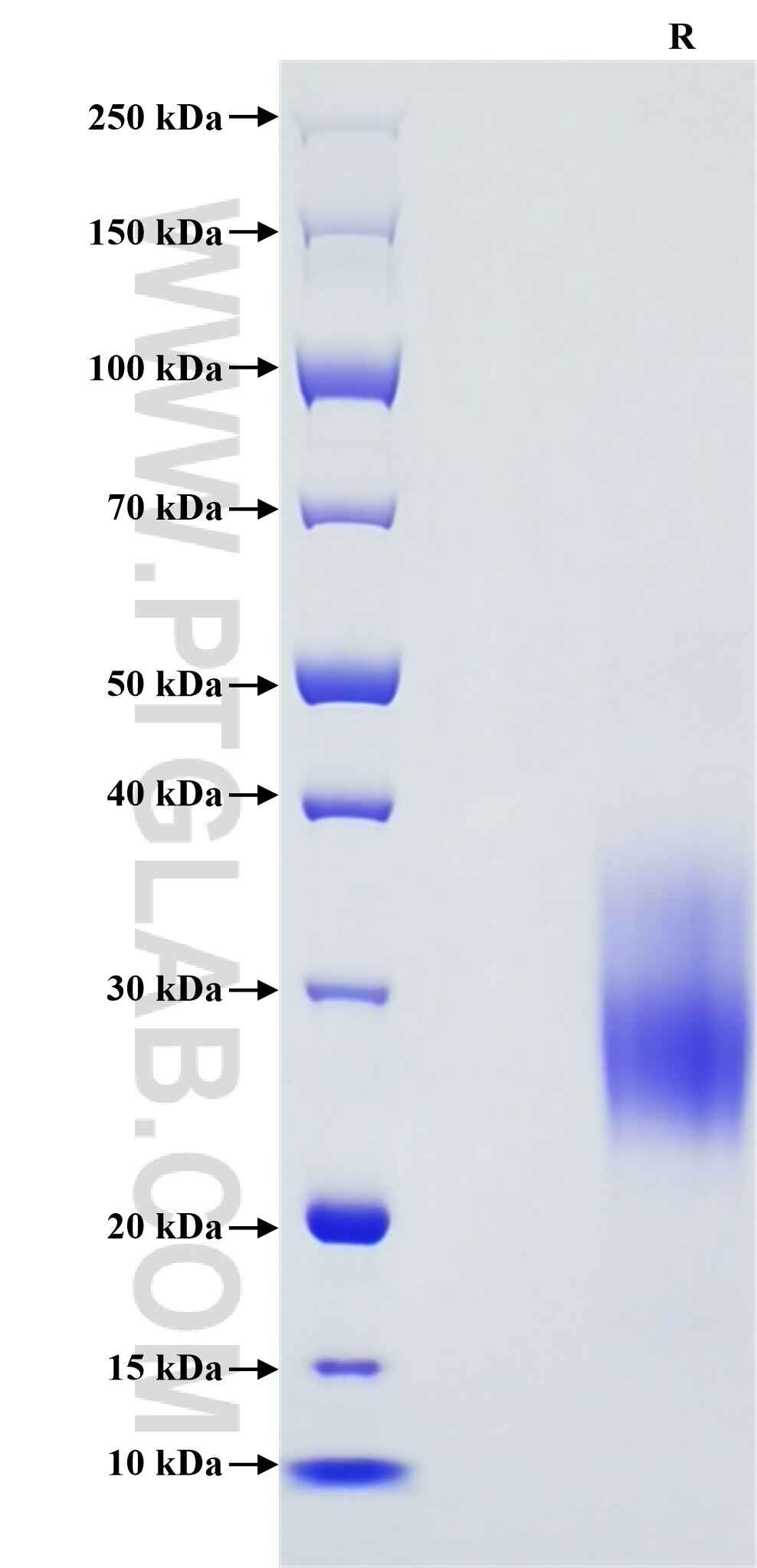
| Purity | >90 %, SDS-PAGE |
| Endotoxin | <0.1 EU/μg protein, LAL method |
| Activity |
Not tested |
| Expression | HEK293-derived Human HVEM protein Leu39-Val202 (Accession# Q92956) with a His tag at the C-terminus. |
| GeneID | 8764 |
| Accession | Q92956 |
| PredictedSize | 18.2 kDa |
| SDS-PAGE | 24-37 kDa, reducing (R) conditions |
| Formulation | Lyophilized from 0.22 μm filtered solution in PBS, pH 7.4. Normally 5% trehalose and 5% mannitol are added as protectants before lyophilization. |
| Reconstitution | Briefly centrifuge the tube before opening. Reconstitute at 0.1-0.5 mg/mL in sterile water. |
| Storage Conditions |
It is recommended that the protein be aliquoted for optimal storage. Avoid repeated freeze-thaw cycles.
|
| Shipping | The product is shipped at ambient temperature. Upon receipt, store it immediately at the recommended temperature. |
Background
TNFSF14 is a cytokine that plays a crucial role in T cell activation and the generation of cytotoxic T cells. It is also involved in the promotion of tumor metastasis and has potential applications in immunotherapy. Tnfsf14 is a member of the tumor necrosis factor (TNF) ligand family. It is a ligand for TNFRSF14, which is also known as a herpesvirus entry mediator (HVEM). This protein may function as a costimulatory factor for the activation of lymphoid cells and as a deterrent to infection by herpesvirus. It has been shown to stimulate the proliferation of T cells and trigger apoptosis of various tumor cells Mouse models have been used to study the function of Tnfsf14 in various disease states, and its human ortholog TNFSF14 is a promising candidate for the development of therapeutic strategies for cancer and autoimmune diseases.
References:
1.Zhang N, Liu X, et al. (2023) Mol Ther. 31(9):2575-2590.
2.Wu Y, Zhan S, Chen L, et al. (2023) J Transl Med. 21(1):544.
3.Oranger A, Colaianni G, et al. (2024)Int J Mol Sci. 25(2):716.
4.Shi JW, Lai ZZ, et al. (2024) EMBO J. 43(21):5018-5036.