
Recombinant Human ULBP1 protein (His Tag)
Species
Human
Purity
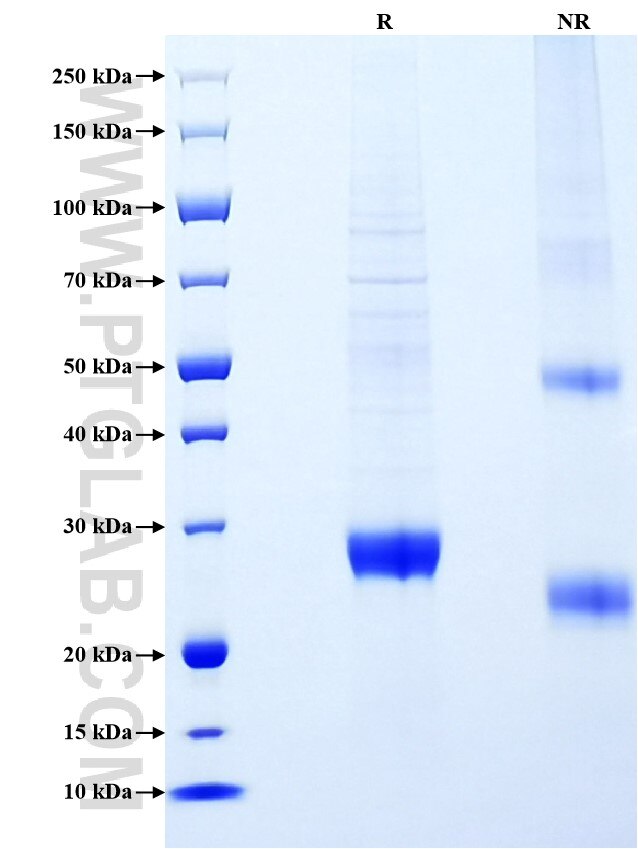
>90 %, SDS-PAGE
Tag
His Tag
Activity
not tested
Cat no : Eg0839
Validation Data Gallery
Product Information
| Purity | >90 %, SDS-PAGE |
| Endotoxin | <0.1 EU/μg protein, LAL method |
| Activity |
Not tested |
| Expression | HEK293-derived Human ULBP1 protein Gly26-Gly216 (Accession# Q9BZM6) with a His tag at the C-terminus. |
| GeneID | 80329 |
| Accession | Q9BZM6 |
| PredictedSize | 23.4 kDa |
| SDS-PAGE | 26-30 kDa, reducing (R) conditions |
| Formulation | Lyophilized from 0.22 μm filtered solution in PBS, pH 7.4. Normally 5% trehalose and 5% mannitol are added as protectants before lyophilization. |
| Reconstitution | Briefly centrifuge the tube before opening. Reconstitute at 0.1-0.5 mg/mL in sterile water. |
| Storage Conditions |
It is recommended that the protein be aliquoted for optimal storage. Avoid repeated freeze-thaw cycles.
|
| Shipping | The product is shipped at ambient temperature. Upon receipt, store it immediately at the recommended temperature. |
Background
ULBP1, or UL16 binding protein 1, is a member of the ULBP family, which consists of MHC class I-related molecules. These proteins play a critical role in the immune response, particularly in activating natural killer (NK) cells. ULBP1 binds to the NKG2D receptor on NK cells, which is a critical step in the activation of these immune cells. ULBP1 is also known for its interaction with the human cytomegalovirus (HCMV) glycoprotein UL16, which helps the virus evade immune detection. The engagement of ULBP1 with NK cell receptors prompts the activation of these immune cells, leading to a more robust immune response against infected cells.
References:
1.Pende D,et al. (2002) Cancer Res. 62 (21):6178-86.
2.Kubin M,et al. (2001) Eur J Immunol. 31 (5):1428-37.
3.Valés-Gómez M, et al. (2006). Cell Microbiol. 8 (4):581-90.