

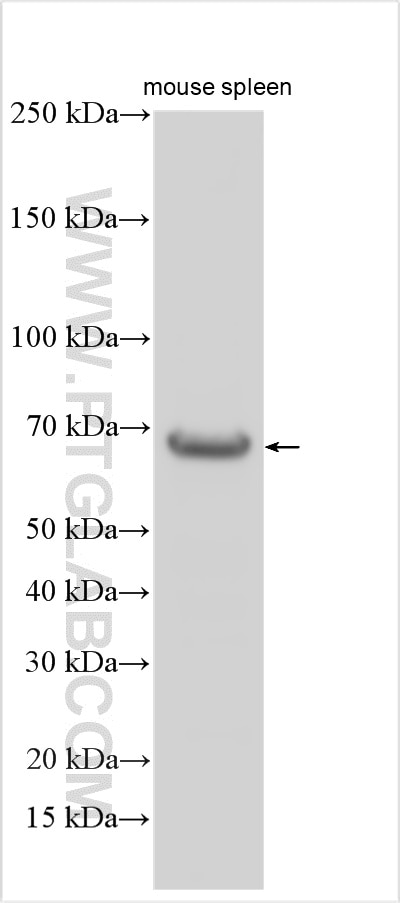



Tested Applications
| Positive WB detected in | mouse spleen tissue, HeLa cells, human placenta tissue |
| Positive IHC detected in | mouse pancreas tissue Note: suggested antigen retrieval with TE buffer pH 9.0; (*) Alternatively, antigen retrieval may be performed with citrate buffer pH 6.0 |
Recommended dilution
| Application | Dilution |
|---|---|
| Western Blot (WB) | WB : 1:500-1:1000 |
| Immunohistochemistry (IHC) | IHC : 1:50-1:500 |
| It is recommended that this reagent should be titrated in each testing system to obtain optimal results. | |
| Sample-dependent, Check data in validation data gallery. | |
Product Information
15141-1-AP targets INPP5B in WB, IHC, IF, IP, ELISA applications and shows reactivity with human, mouse, rat samples.
| Tested Reactivity | human, mouse, rat |
| Cited Reactivity | human, mouse |
| Host / Isotype | Rabbit / IgG |
| Class | Polyclonal |
| Type | Antibody |
| Immunogen |
CatNo: Ag7315 Product name: Recombinant human INPP5B protein Source: e coli.-derived, PET28a Tag: 6*His Domain: 1-309 aa of BC058932 Sequence: MDQSVAIQETLAEGEYCVIAVQGVLCEGDSRQSRLLGLVRYRLEHGGQEHALFLYTHRRMAITGDDVSLDQIVPVSRDFTLEEVSPDGELYILGSDVTVQLDTAELSLVFQLPFGSQTRMFLHEVARACPGFDSATRDPEFLWLSRYRCAELELEMPTPRGCNSALVTWPGYATIGGGGSNFDGLRPNGKGVPMDQSSRGQDKPESLQPRQNKSKSEITDMVRSSTITVSDKAHILSMQKFGLRDTIVKSHLLQKEEDYTYIQNFRFFAGTYNVNGQSPKECLRLWLSNGIQAPDVYCVGFQELDLSKE Predict reactive species |
| Full Name | inositol polyphosphate-5-phosphatase, 75kDa |
| Calculated Molecular Weight | 113 kDa |
| Observed Molecular Weight | 75 kDa |
| GenBank Accession Number | BC058932 |
| Gene Symbol | INPP5B |
| Gene ID (NCBI) | 3633 |
| RRID | AB_2126133 |
| Conjugate | Unconjugated |
| Form | Liquid |
| Purification Method | Antigen affinity purification |
| UNIPROT ID | P32019 |
| Storage Buffer | PBS with 0.02% sodium azide and 50% glycerol, pH 7.3. |
| Storage Conditions | Store at -20°C. Stable for one year after shipment. Aliquoting is unnecessary for -20oC storage. 20ul sizes contain 0.1% BSA. |
Background Information
INPP5B(Type II inositol 1,4,5-trisphosphate 5-phosphatase) is also named as OCRL2,5PTase, 75 kDa inositol polyphosphate-5-phosphatase and belongs to the inositol 1,4,5-trisphosphate 5-phosphatase type II family. This protein, originally described in platelets, is one of at least three known enzymes capable of dephosphorylating inositol-1,4,5-trisphosphate (IP3) to inositol-1,4-bisphosphate (IP2)(PMID:8125013). It has 4 isoforms produced by alternative splicing.
Protocols
| Product Specific Protocols | |
|---|---|
| IHC protocol for INPP5B antibody 15141-1-AP | Download protocol |
| WB protocol for INPP5B antibody 15141-1-AP | Download protocol |
| Standard Protocols | |
|---|---|
| Click here to view our Standard Protocols |
Publications
What published studies show
The INPP5B Polyclonal antibody (catalog #15141-1-AP) has 7 citations. Journals include Cell Metabolism, Journal of the American Society of Nephrology, Cancer Cell International, Life Sciences, Biochimica et Biophysica Acta – Molecular Basis of Disease, Journal of Biological Chemistry, and PLoS ONE. Research fields span metabolic adaptation, renal disease (Lowe syndrome), lung adenocarcinoma prognosis, hepatic lipogenesis, atherosclerotic macrophage polarization, sterol biosynthesis, and primary cilia formation. Applications include WB, IP, IF, and IHC in human and mouse studies.
| Species | Application | Title |
|---|---|---|
Cell Metab Isoform usage as a distinct regulatory layer driving nutrient-responsive metabolic adaptation | ||
J Am Soc Nephrol Effects of Proximal Tubule Shortening on Protein Excretion in a Lowe Syndrome Model. | ||
Cancer Cell Int Decreased INPP5B expression predicts poor prognosis in lung adenocarcinoma. | ||
Life Sci NIK suppresses AKT/ACLY pathway-mediated lipogenesis in liver by stabilizing INPP5B during chronic ethanol exposure.
| ||
Biochim Biophys Acta Mol Basis Dis Integrated application of transcriptome and metabolomics reveals potential therapeutic targets for the polarization of atherosclerotic macrophages | ||
J Biol Chem Comparative proximity biotinylation implicates the small GTPase RAB18 in sterol mobilization and biosynthesis |




