
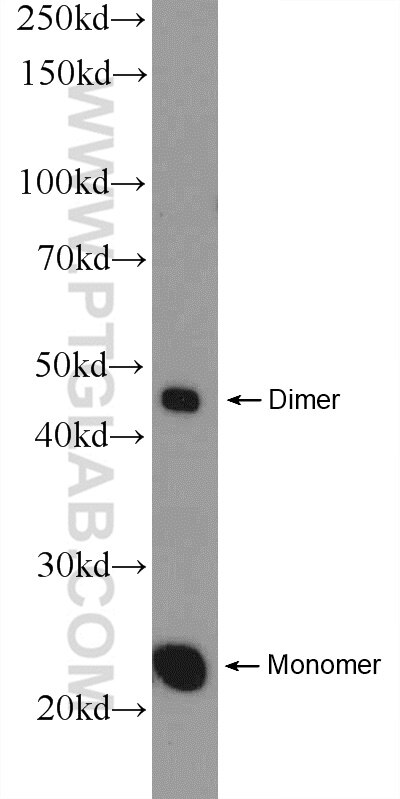
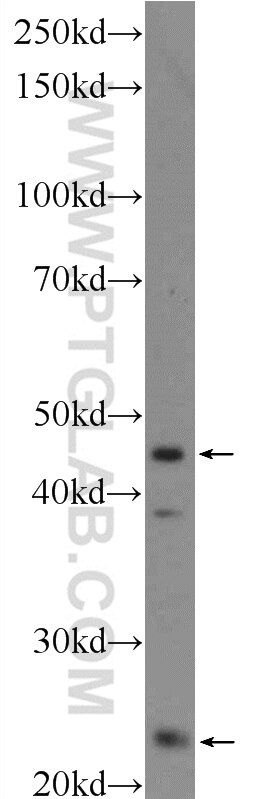

Tested Applications
| Positive WB detected in | HEK-293 cells |
Recommended dilution
| Application | Dilution |
|---|---|
| Western Blot (WB) | WB : 1:200-1:1000 |
| It is recommended that this reagent should be titrated in each testing system to obtain optimal results. | |
| Sample-dependent, Check data in validation data gallery. | |
Product Information
15764-1-AP targets MID1IP1 in WB, IHC, IF, ELISA applications and shows reactivity with human, mouse, rat samples.
| Tested Reactivity | human, mouse, rat |
| Cited Reactivity | human |
| Host / Isotype | Rabbit / IgG |
| Class | Polyclonal |
| Type | Antibody |
| Immunogen |
CatNo: Ag8400 Product name: Recombinant human MID1IP1 protein Source: e coli.-derived, PGEX-4T Tag: GST Domain: 1-183 aa of BC008908 Sequence: MMQICDTYNQKHSLFNAMNRFIGAVNNMDQTVMVPSLLRDVPLADPGLDNDVGVEVGGSGGCLEERTPPVPDSGSANGSFFAPSRDMYSHYVLLKSIRNDIEWGVLHQPPPPAGSEEGSAWKSKDILVDLGHLEGADAGEEDLEQQFHYHLRGLHTVLSKLTRKANILTNRYKQEIGFGNWGH Predict reactive species |
| Full Name | MID1 interacting protein 1 (gastrulation specific G12 homolog (zebrafish)) |
| Calculated Molecular Weight | 183 aa, 20 kDa |
| Observed Molecular Weight | 23 kDa, 46 kDa |
| GenBank Accession Number | BC008908 |
| Gene Symbol | MID1IP1 |
| Gene ID (NCBI) | 58526 |
| RRID | AB_2878181 |
| Conjugate | Unconjugated |
| Form | Liquid |
| Purification Method | Antigen affinity purification |
| UNIPROT ID | Q9NPA3 |
| Storage Buffer | PBS with 0.02% sodium azide and 50% glycerol, pH 7.3. |
| Storage Conditions | Store at -20°C. Stable for one year after shipment. Aliquoting is unnecessary for -20oC storage. 20ul sizes contain 0.1% BSA. |
Background Information
MID1IP1, also named as Mid1-interacting protein 1 or Gastrulation-specific G12-like protein, is a 183 amino acid protein, which belongs to the SPOT14 family. MID1IP1 plays a role in the regulation of lipogenesis in liver. MID1IP1 may localizes in the nucleus and cytoplasm. MID1IP1 may form Homodimer in the absence of THRSP.
Protocols
| Product Specific Protocols | |
|---|---|
| WB protocol for MID1IP1 antibody 15764-1-AP | Download protocol |
| Standard Protocols | |
|---|---|
| Click here to view our Standard Protocols |
Publications
What published studies show
The anti-c-Myc antibody (Cat# 15764-1-AP) has 9 total citations. These appear in Cells, International Journal of Molecular Science, Biomolecules, Frontiers in Pharmacology, Molecules, and Genes Genomics. The research spans liver cancer, colorectal/colon cancer, apoptosis, c-Myc signaling, p53 activation, ribosomal protein regulation, and ferroptosis, with applications primarily in WB, IF, and IHC.
| Species | Application | Title |
|---|---|---|
Cells Colocalization of MID1IP1 and c-Myc is Critically Involved in Liver Cancer Growth via Regulation of Ribosomal Protein L5 and L11 and CNOT2.
| ||
Int J Mol Sci The Antitumor Effect of Timosaponin A3 through c-Myc Inhibition in Colorectal Cancer Cells and Combined Treatment Effect with 5-FU or Doxorubicin | ||
Biomolecules Inhibition of CNOT2 Induces Apoptosis via MID1IP1 in Colorectal Cancer Cells by Activating p53.
| ||
Int J Mol Sci Acetylcorynoline Induces Apoptosis and G2/M Phase Arrest through the c-Myc Signaling Pathway in Colon Cancer Cells | ||
Int J Mol Sci Circaea mollis Siebold & Zucc. Induces Apoptosis in Colorectal Cancer Cells by Inhibiting c-Myc Through the Mediation of RPL5 | ||
Front Pharmacol Ophiopogonin D increase apoptosis by activating p53 via ribosomal protein L5 and L11 and inhibiting the expression of c-Myc via CNOT2 |
Reviews
What customers say
The product has received one review, rated 5 stars. The reviewer described it as "very effective" for Western Blot applications. Overall, the feedback is positive, indicating strong performance in its tested application.
The reviews below have been submitted by verified Proteintech customers who received an incentive for providing their feedback.
kay (Verified Customer) (10-01-2022) | Very effective
|



