

Tested Applications
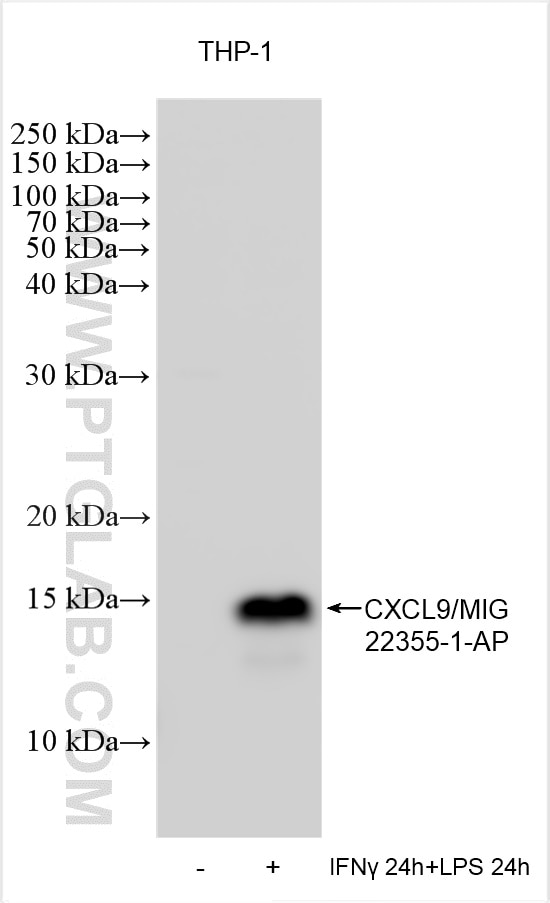
| Positive WB detected in | IFN gamma and LPS treated THP-1 cells |
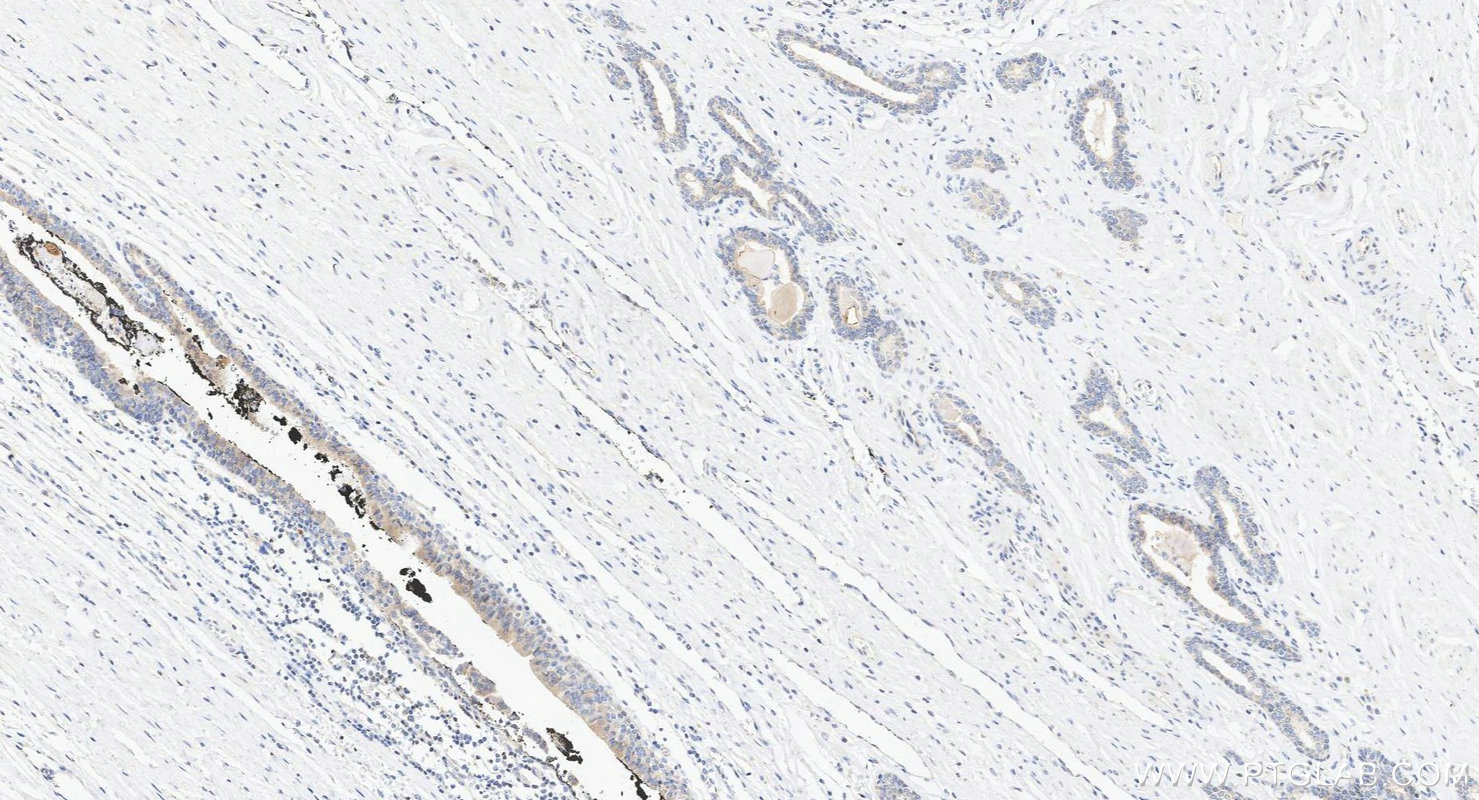
| Positive IHC detected in | human prostate cancer tissue Note: suggested antigen retrieval with TE buffer pH 9.0; (*) Alternatively, antigen retrieval may be performed with citrate buffer pH 6.0 |
Recommended dilution
| Application | Dilution |
|---|---|
| Western Blot (WB) | WB : 1:500-1:2000 |
| Immunohistochemistry (IHC) | IHC : 1:400-1:1600 |
| It is recommended that this reagent should be titrated in each testing system to obtain optimal results. | |
| Sample-dependent, Check data in validation data gallery. | |
Product Information
22355-1-AP targets CXCL9/MIG in WB, IHC, IF, ELISA applications and shows reactivity with human samples.
| Tested Reactivity | human |
| Cited Reactivity | human, mouse |
| Host / Isotype | Rabbit / IgG |
| Class | Polyclonal |
| Type | Antibody |
| Immunogen |
CatNo: Ag17932 Product name: Recombinant human CXCL9 protein Source: e coli.-derived, PGEX-4T Tag: GST Domain: 23-125 aa of BC095396 Sequence: TPVVRKGRCSCISTNQGTIHLQSLKDLKQFAPSPSCEKIEIIATLKNGVQTCLNPDSADVKELIKKWEKQVSQKKKQKNGKKHQKKKVLKVRKSQRSRQKKTT Predict reactive species |
| Full Name | chemokine (C-X-C motif) ligand 9 |
| Calculated Molecular Weight | 14 kDa |
| Observed Molecular Weight | 14 kDa |
| GenBank Accession Number | BC095396 |
| Gene Symbol | CXCL9 |
| Gene ID (NCBI) | 4283 |
| RRID | AB_2879086 |
| Conjugate | Unconjugated |
| Form | Liquid |
| Purification Method | Antigen affinity purification |
| UNIPROT ID | Q07325 |
| Storage Buffer | PBS with 0.02% sodium azide and 50% glycerol, pH 7.3. |
| Storage Conditions | Store at -20°C. Stable for one year after shipment. Aliquoting is unnecessary for -20oC storage. 20ul sizes contain 0.1% BSA. |
Background Information
CXCL9 is a small cytokine known as MIG. CXCL9 is a T-cell chemoattractant, which is induced by IFN-γ. It is closely related to two other CXC chemokines called CXCL10 and CXCL11, whose genes are located near the gene for CXCL9 on human chromosome 4. A high level of CXCL9 revealed in peripheral liquids, can be considered as a marker of host immune response, especially of that involving Th1 cells.
Protocols
| Product Specific Protocols | |
|---|---|
| IHC protocol for CXCL9/MIG antibody 22355-1-AP | Download protocol |
| WB protocol for CXCL9/MIG antibody 22355-1-AP | Download protocol |
| Standard Protocols | |
|---|---|
| Click here to view our Standard Protocols |
Publications
What published studies show
Able is busy answering your previous question. Please try again later.
| Species | Application | Title |
|---|---|---|
Signal Transduct Target Ther Ultra-high dose rate radiotherapy overcomes radioresistance in head and neck squamous cell carcinoma | ||
Cancer Cell Spatial transcriptomics reveals tryptophan metabolism restricting maturation of intratumoral tertiary lymphoid structures | ||
Cell Res Glucose starvation mimetic aldometanib removes immune barriers permitting mice with hepatocellular carcinoma to live to normal ages. | ||
Drug Resist Updat ITPKB suppresses ER calcium release to promote CXCL9 expression and enhance immunotherapy sensitivity in triple-negative breast cancer. | ||
Nat Commun Unravelling the transcriptome of the human tuberculosis lesion and its clinical implications | ||
Nat Commun CD276-dependent efferocytosis by tumor-associated macrophages promotes immune evasion in bladder cancer |
Reviews
What customers say
There is one review for 22355-1-AP. It received a 4-star rating and was used for immunohistochemistry on mouse meningeal tissue at a 1:200 dilution. The reviewer noted that the antibody works well. Blocking was performed in 0.3% Triton-X-100 containing 2% goat serum for 1 hour.
The reviews below have been submitted by verified Proteintech customers who received an incentive for providing their feedback.
Wojciech (Verified Customer) (05-25-2023) | This antibody works well. It was used for IHC analysis of mouse meningeal tissue at dilution of 1:200. Blocking in 0.3% Triton-X-100 containing 2% of goat serum for 1 hour.
|



