

Tested Applications
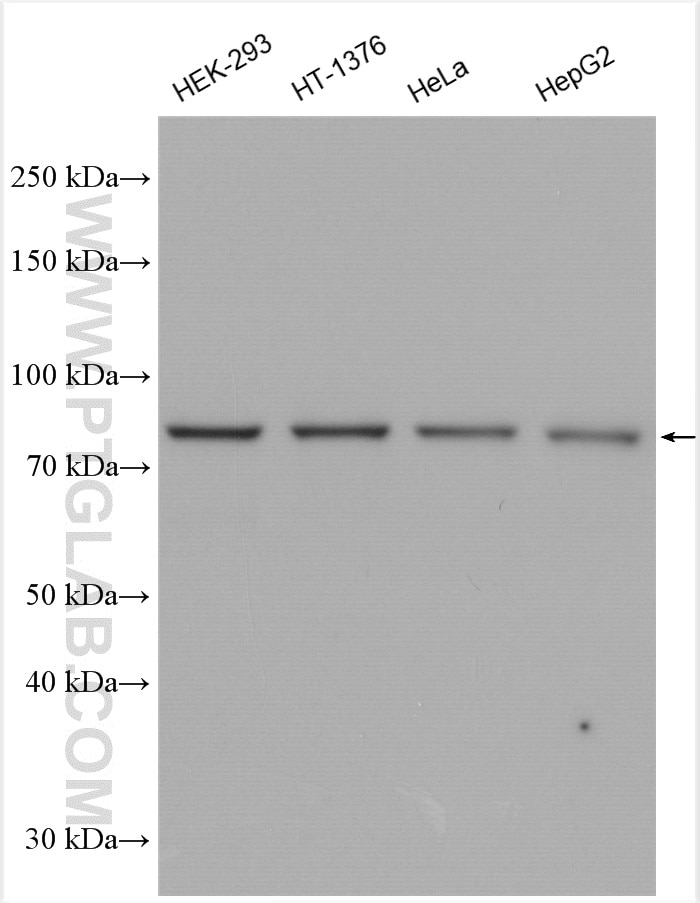
| Positive WB detected in | HEK-293 cells, HT-1376 cells, HeLa cells, HepG2 cells |
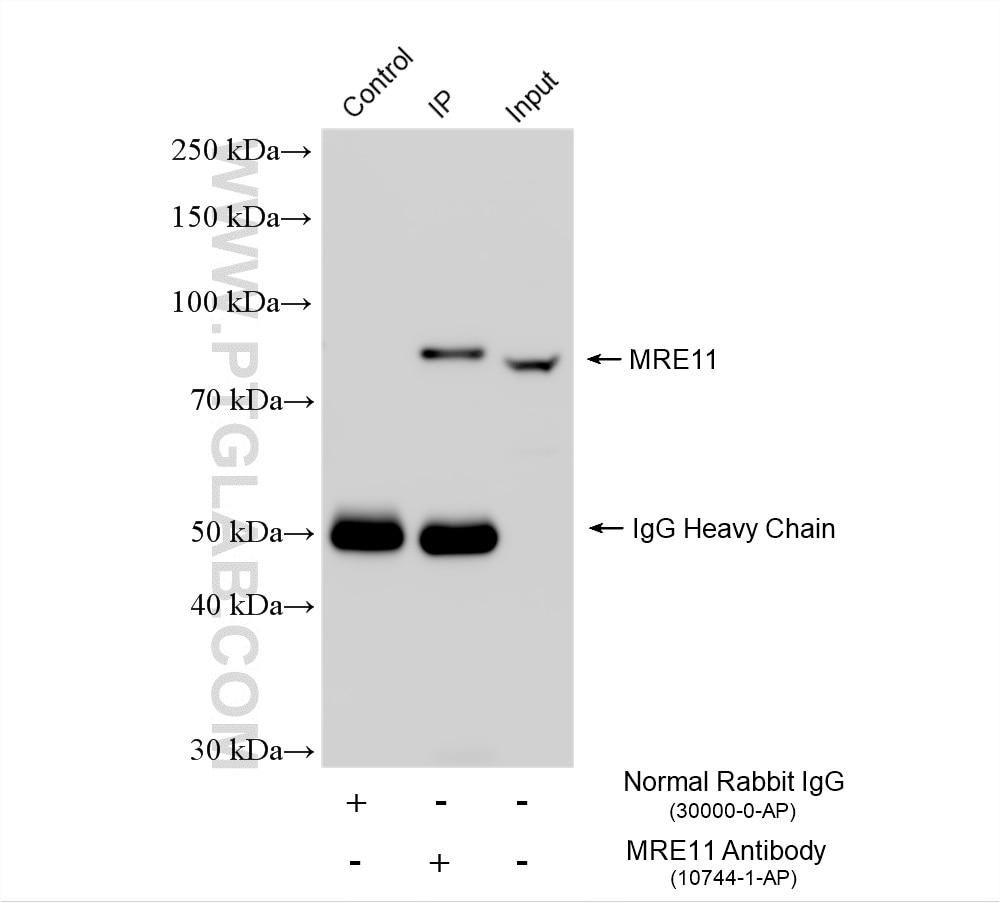
| Positive IP detected in | HeLa cells |
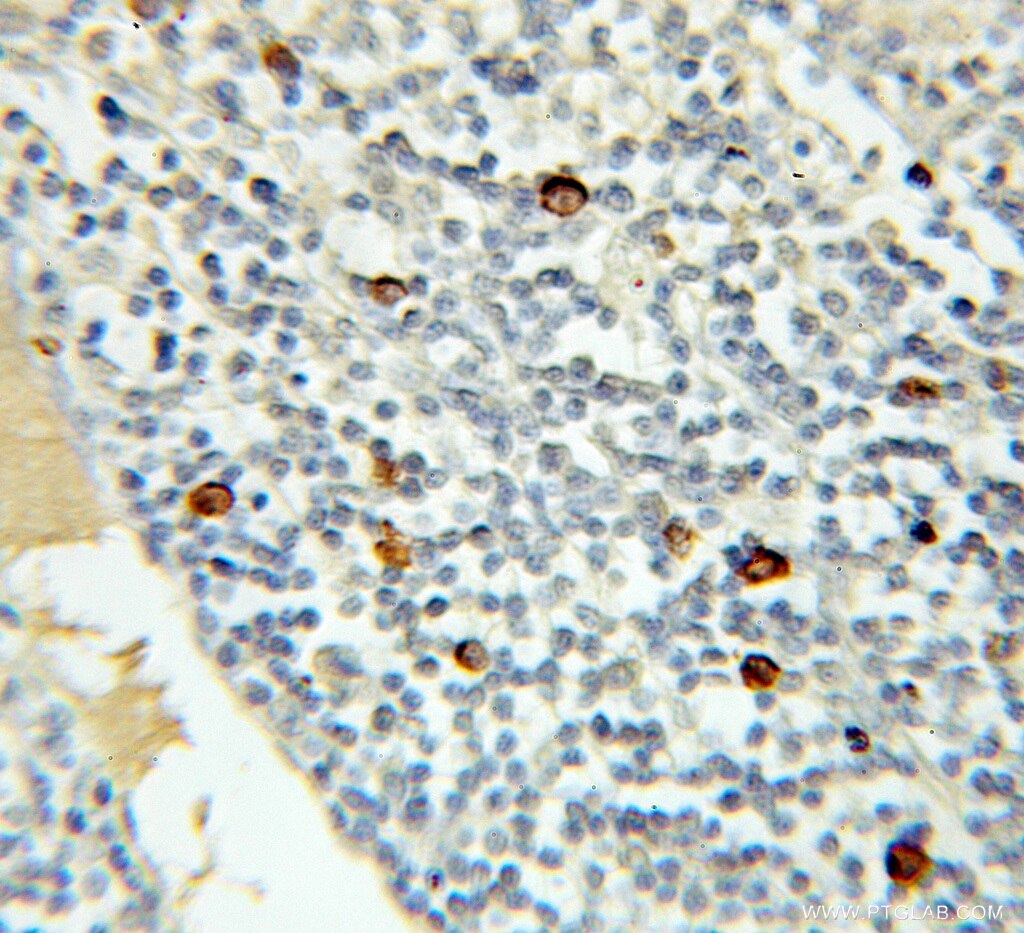
| Positive IHC detected in | human lymphoma tissue Note: suggested antigen retrieval with TE buffer pH 9.0; (*) Alternatively, antigen retrieval may be performed with citrate buffer pH 6.0 |
Recommended dilution
| Application | Dilution |
|---|---|
| Western Blot (WB) | WB : 1:500-1:2000 |
| Immunoprecipitation (IP) | IP : 0.5-4.0 ug for 1.0-3.0 mg of total protein lysate |
| Immunohistochemistry (IHC) | IHC : 1:20-1:200 |
| It is recommended that this reagent should be titrated in each testing system to obtain optimal results. | |
| Sample-dependent, Check data in validation data gallery. | |
Product Information
10744-1-AP targets MRE11 in WB, IHC, IF, IP, ChIP, ELISA applications and shows reactivity with human, mouse, rat samples.
| Tested Reactivity | human, mouse, rat |
| Cited Reactivity | human, mouse, rat |
| Host / Isotype | Rabbit / IgG |
| Class | Polyclonal |
| Type | Antibody |
| Immunogen |
CatNo: Ag1105 Product name: Recombinant human MRE11A protein Source: e coli.-derived, PGEX-4T Tag: GST Domain: 1-206 aa of BC005241 Sequence: MSTADALDDENTFKILVATDIHLGFMEKDAVRGNDTFVTLDEILRLAQENEVDFILLGGDLFHENKPSRKTLHTCLELLRKYCMGDRPVQFEILSDQSVNFGFSKFPWVNYQDGNLNISIPVFSIHGNHDDPTGADALCALDILSCAGFVNHFGRSMSVEKIDISPVLLQKGSTKIALYGLGSIPDERLYRMFVNKKVTMLRPKED Predict reactive species |
| Full Name | MRE11 meiotic recombination 11 homolog A (S. cerevisiae) |
| Calculated Molecular Weight | 81 kDa |
| Observed Molecular Weight | 81 kDa |
| GenBank Accession Number | BC005241 |
| Gene Symbol | MRE11A |
| Gene ID (NCBI) | 4361 |
| RRID | AB_2145118 |
| Conjugate | Unconjugated |
| Form | Liquid |
| Purification Method | Antigen affinity purification |
| UNIPROT ID | P49959 |
| Storage Buffer | PBS with 0.02% sodium azide and 50% glycerol, pH 7.3. |
| Storage Conditions | Store at -20°C. Stable for one year after shipment. Aliquoting is unnecessary for -20oC storage. 20ul sizes contain 0.1% BSA. |
Background Information
Mre11 (meiotic recombination 11), also named as Mre11A, is a component of the MRN( MRE11/RAD50/NBS1) complex which is a versatile complex, playing a key role in the sensing, processing, and repair of DSBs. MRE11 possesses both endonuclease and 3'-5' exonuclease activity. It contains two DNA-binding domains (DBDs), enabling it to bind both single-stranded DNA (ssDNA) and double-stranded DNA (dsDNA). After DSBs, MRE11 is loaded onto DSBs sites and cleaves DNA by cooperating with CtIP (CtBP [C terminal binding protein] interacting protein) to initiate end resection. It's reported that MRE11 is over-expressed in breast cancers. (PMID:38128537; 22914783)
Protocols
| Product Specific Protocols | |
|---|---|
| IF protocol for MRE11 antibody 10744-1-AP | Download protocol |
| IHC protocol for MRE11 antibody 10744-1-AP | Download protocol |
| IP protocol for MRE11 antibody 10744-1-AP | Download protocol |
| WB protocol for MRE11 antibody 10744-1-AP | Download protocol |
| Standard Protocols | |
|---|---|
| Click here to view our Standard Protocols |
Publications
What published studies show
The anti-MRE11 antibody (Cat# 10744-1-AP) has 23 citations. Journals include Nature Communications, Neuron, Science Translational Medicine, Science Advances, Cell Death & Disease, PNAS, Oncogene, Cell Genomics, and others. Research fields span DNA repair (homologous recombination, non-homologous end joining), cancer biology (breast, colorectal, lung, cervical, glioma, hepatocellular carcinoma), immunology, fibrosis, autophagy, and meiosis. Applications are predominantly Western blot, with some IP, IHC, ChIP, and IF.
| Species | Application | Title |
|---|---|---|
Nat Commun A multi-functional role for the MCM8/9 helicase complex in maintaining fork integrity during replication stress | ||
Nat Commun Crosstalk between SUMOylation and ubiquitylation controls DNA end resection by maintaining MRE11 homeostasis on chromatin | ||
Neuron Alpha-synuclein mutations mislocalize cytoplasmic p300 compromising autophagy, which is rescued by ACLY inhibition | ||
Sci Transl Med Guanosine diphosphate-mannose suppresses homologous recombination repair and potentiates antitumor immunity in triple-negative breast cancer | ||
Sci Adv Senataxin and DNA-PKcs redundantly promote non-homologous end joining repair of DNA double strand breaks during V(D)J recombination | ||
Cell Death Dis HAT1 functions as a lactyltransferase and mediates RPA1 lactylation to promote DNA repair and radioresistance in lung adenocarcinoma. |
Reviews
What customers say
The single available review rates the antibody 5 out of 5 stars. The user reported using it for Western Blot at a 1:1000 dilution on HeLa and 293FT cells, and simply noted that it "works well." Overall, the feedback is positive, with no issues or complaints mentioned.
The reviews below have been submitted by verified Proteintech customers who received an incentive for providing their feedback.
Arnaud (Verified Customer) (05-15-2025) | Works well
|





