



Tested Applications
| Positive WB detected in | HeLa cells, Jurkat cells |
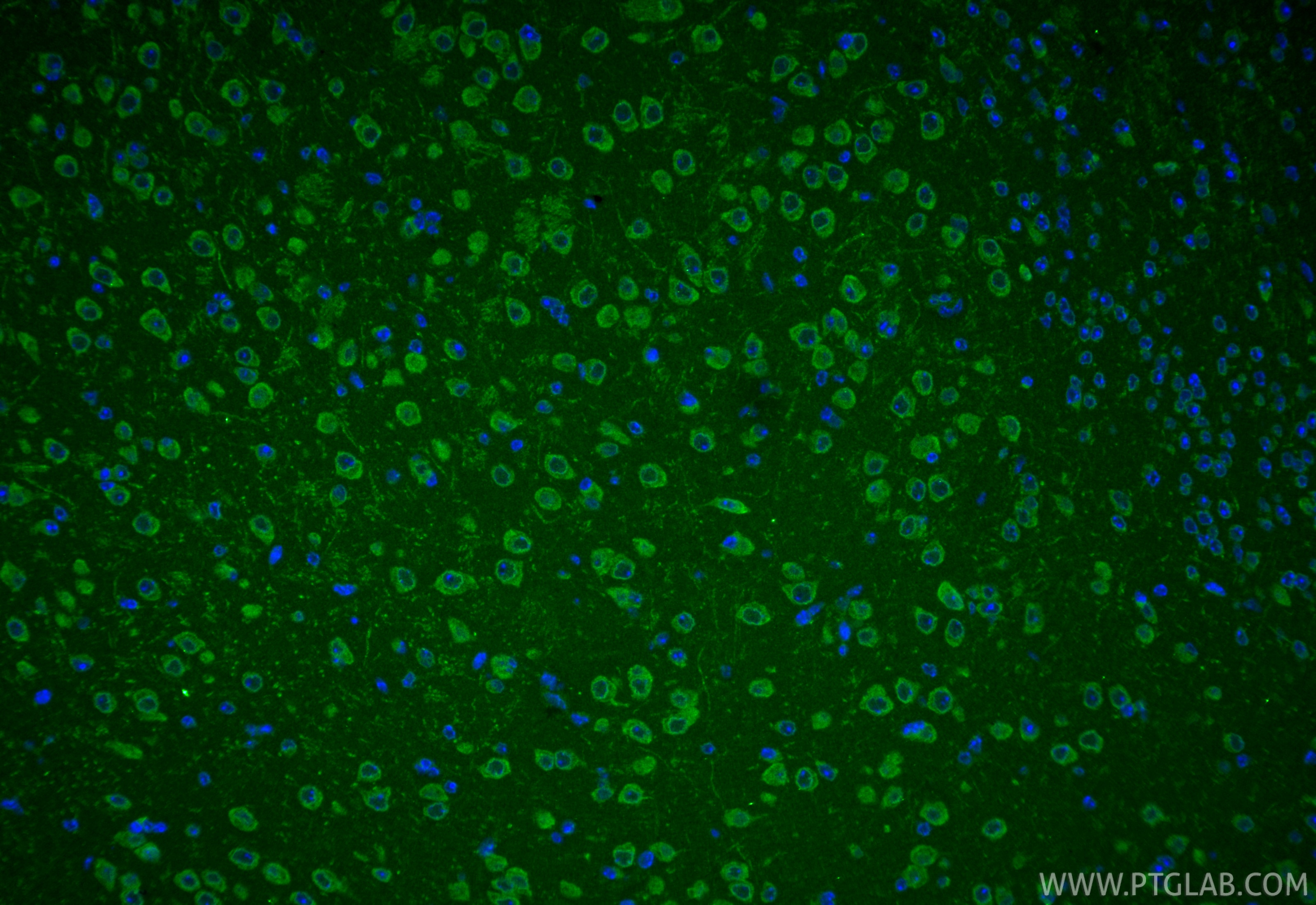
| Positive IF-P detected in | mouse brain tissue |
Recommended dilution
| Application | Dilution |
|---|---|
| Western Blot (WB) | WB : 1:500-1:2000 |
| Immunofluorescence (IF)-P | IF-P : 1:50-1:500 |
| It is recommended that this reagent should be titrated in each testing system to obtain optimal results. | |
| Sample-dependent, Check data in validation data gallery. | |
Product Information
16957-1-AP targets MTERF in WB, IF-P, ELISA applications and shows reactivity with human, mouse, rat samples.
| Tested Reactivity | human, mouse, rat |
| Cited Reactivity | human, mouse |
| Host / Isotype | Rabbit / IgG |
| Class | Polyclonal |
| Type | Antibody |
| Immunogen |
CatNo: Ag10640 Product name: Recombinant human MTERF protein Source: e coli.-derived, PGEX-4T Tag: GST Domain: 1-399 aa of BC000965 Sequence: MQSLSLGQTSISKGLNYLTIMAPGNLWHMRNNFLFGSRCWMTRFSAENIFKSVSFRLFGVKCHNTDSEPLKNEDLLKNLLTMGVDIDMARKRQPGVFHRMITNEQDLKMFLLSKGASKEVIASIISRYPRAITRTPENLSKRWDLWRKIVTSDLEIVNILERSPESFFRSNNNLNLENNIKFLYSVGLTRKCLCRLLTNAPRTFSNSLDLNKQMVEFLQAAGLSLGHNDPTDFVRKIIFKNPFILIQSTKRVKANIEFLRSTFNLNSEELLVLICGPGAEILDLSNDYARRSYANIKEKLFSLGCTEEEVQKFVLSYPDVIFLAEKKFNDKIDCLMEENISISQIIENPRVLDSSISTLKSRIKELVNAGCNLSTLNITLLSWSKKRYEAKLKKLSRFA Predict reactive species |
| Full Name | mitochondrial transcription termination factor |
| Calculated Molecular Weight | 46 kDa |
| Observed Molecular Weight | 31 kDa |
| GenBank Accession Number | BC000965 |
| Gene Symbol | MTERF |
| Gene ID (NCBI) | 7978 |
| RRID | AB_2235580 |
| Conjugate | Unconjugated |
| Form | Liquid |
| Purification Method | Antigen affinity purification |
| UNIPROT ID | Q99551 |
| Storage Buffer | PBS with 0.02% sodium azide and 50% glycerol, pH 7.3. |
| Storage Conditions | Store at -20°C. Stable for one year after shipment. Aliquoting is unnecessary for -20oC storage. 20ul sizes contain 0.1% BSA. |
Background Information
Mitochondrial transcription termination factor (MTERF)also named as Mterf1 is a 399 amino acid protein, which localizes in the mitochondrion and belongs to the mTERF family. MTERF contains three leucine zippers that form a three-stranded coiled-coil that binds to DNA. It has been suggested that only the phosphorylated form of MTERF has transcription termination activity. MTERF plays a central role in the control of mitochondrial rRNA and mRNA synthesis. MTERFD1 is also thought to act as a mitochondrial transcription regulator and is expressed as two isoforms produced by alternative splicing.Using DNA affinity chromatography, a fraction called MTERF was found to be associated with foot-printing capacity, and this contained two polypeptides of 34 and 31 kDa. Moreover, termination-promoting activity appears to reside in the 34-kDa protein. (PMID:7681833).
Protocols
| Product Specific Protocols | |
|---|---|
| IF protocol for MTERF antibody 16957-1-AP | Download protocol |
| WB protocol for MTERF antibody 16957-1-AP | Download protocol |
| Standard Protocols | |
|---|---|
| Click here to view our Standard Protocols |
Publications
What published studies show
The MTERF Polyclonal antibody (Cat# 16957-1-AP) has 3 total citations. These appear in Nature Immunology, Nature Communications, and Life Sciences. The associated research fields include phagocytic regulation of reactive oxygen species and bactericidal activity (human, WB), mitochondrial DNA maintenance and progeria (mouse, WB), and mitochondrial ATP production in lenvatinib-resistant hepatocellular carcinoma.
| Species | Application | Title |
|---|---|---|
Nat Immunol Kinases Mst1 and Mst2 positively regulate phagocytic induction of reactive oxygen species and bactericidal activity. | ||
Nat Commun Mice lacking the mitochondrial exonuclease MGME1 accumulate mtDNA deletions without developing progeria. | ||
Life Sci POLRMT enhances lenvatinib resistance in hepatocellular carcinoma cells by maintaining mitochondrial ATP production |




