
Recombinant Mouse APRIL/TNFSF13 protein (rFc Tag)
Species
Mouse
Purity
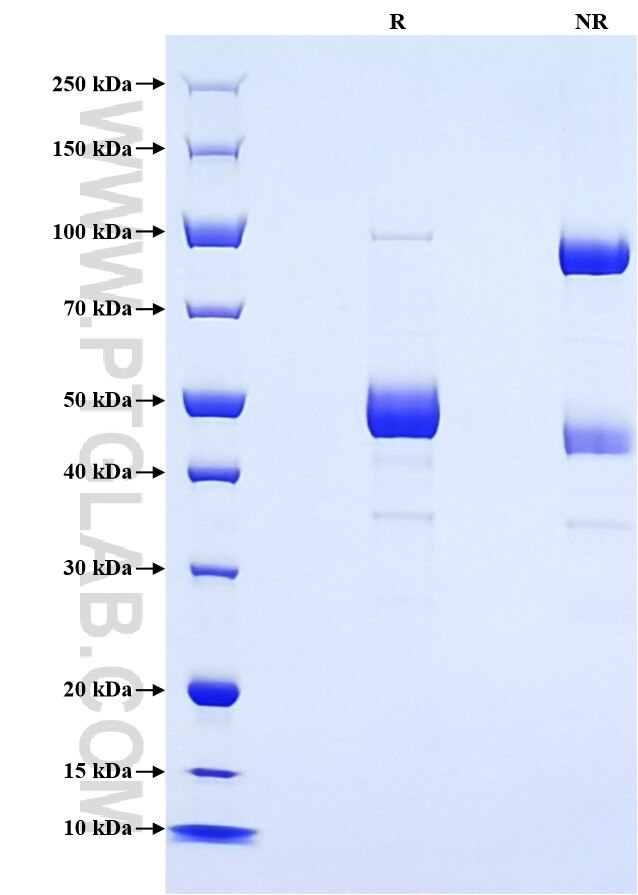
>90 %, SDS-PAGE
Tag
rFc Tag
Activity
not tested
Cat no : Eg1561
Validation Data Gallery
Product Information
| Purity | >90 %, SDS-PAGE |
| Endotoxin | <0.1 EU/μg protein, LAL method |
| Activity |
Not tested |
| Expression | HEK293-derived Mouse APRIL protein Ala96-Leu241 (Accession# Q9D777) with a rabbit IgG Fc tag at the N-terminus. |
| GeneID | 69583 |
| Accession | Q9D777 |
| PredictedSize | 43.5 kDa |
| SDS-PAGE | 45-55 kDa, reducing (R) conditions |
| Formulation | Lyophilized from 0.22 μm filtered solution in PBS, pH 7.4. Normally 5% trehalose and 5% mannitol are added as protectants before lyophilization. |
| Reconstitution | Briefly centrifuge the tube before opening. Reconstitute at 0.1-0.5 mg/mL in sterile water. |
| Storage Conditions |
It is recommended that the protein be aliquoted for optimal storage. Avoid repeated freeze-thaw cycles.
|
| Shipping | The product is shipped at ambient temperature. Upon receipt, store it immediately at the recommended temperature. |
Background
TNFSF13 (also known as APRIL) is a proliferation-inducing ligand of the tumor necrosis factor (TNF) superfamily. TNFSF13 was found to be involved in immunosuppression via diverse immunoregulation pathways and was associated with other immune checkpoints and inflammation. an abundant expression of TNFSF13 in neoplastic cells and M2 macrophages, which TNFSF13 might potentially regulate the cell communication via IL-8, C3, and CD44. TNFSF13 was proved to interact with two receptors: B cell maturation antigen (BCMA), which germanely combined with TNFSF13 to induce tumor cell invasion and immunosuppression.
References:
1.Chen R, et al. (2021) Front Immunol. 12:713757.
2.Carpenter RO, et al. (2013) Clin Cancer Res. 19(8):2048-60.
3.Tai YT, et al. (2016) Blood. 127(25):3225-36.