
Recombinant Mouse Cardiotrophin-1 protein (mFc Tag)
Species
Mouse
Purity
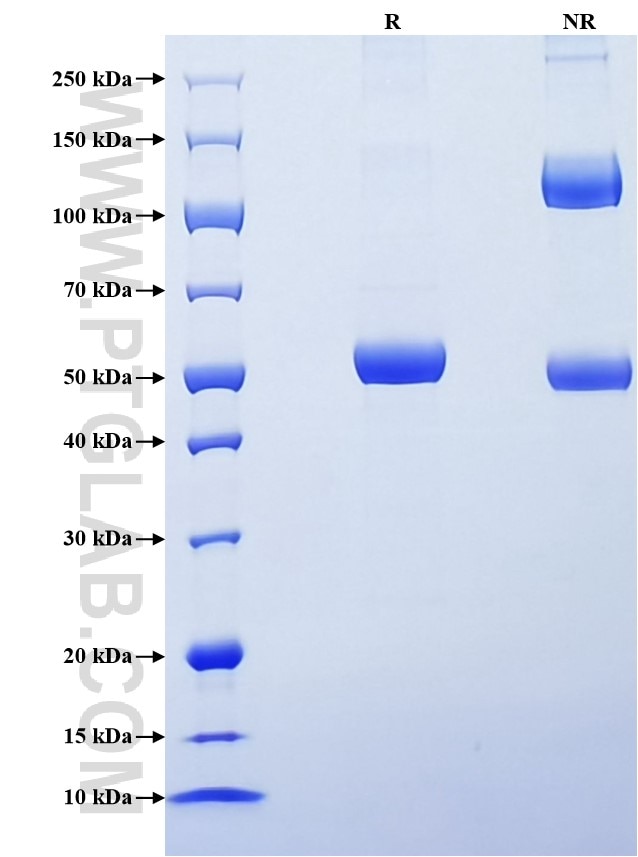
>90 %, SDS-PAGE
Tag
mFc Tag
Activity
not tested
Cat no : Eg4141
Validation Data Gallery
Product Information
| Purity | >90 %, SDS-PAGE |
| Endotoxin | <0.1 EU/μg protein, LAL method |
| Activity |
Not tested |
| Expression | HEK293-derived Mouse Cardiotrophin-1 protein Ser2-Ala203 (Accession# Q60753) with a mouse IgG Fc tag at the C-terminus. |
| GeneID | 13019 |
| Accession | Q60753 |
| PredictedSize | 48.0 kDa |
| SDS-PAGE | 51-58 kDa, reducing (R) conditions |
| Formulation | Lyophilized from 0.22 μm filtered solution in PBS, pH 7.4. Normally 5% trehalose and 5% mannitol are added as protectants before lyophilization. |
| Reconstitution | Briefly centrifuge the tube before opening. Reconstitute at 0.1-0.5 mg/mL in sterile water. |
| Storage Conditions |
It is recommended that the protein be aliquoted for optimal storage. Avoid repeated freeze-thaw cycles.
|
| Shipping | The product is shipped at ambient temperature. Upon receipt, store it immediately at the recommended temperature. |
Background
Ctf1 is a multifunctional cytokine that plays a crucial role in cardioprotection, neuroprotection, and glucose metabolism. Mouse models have been used to study the function of Ctf1 in various disease states, and its human ortholog CT1 is a promising candidate for the development of therapeutic strategies for metabolic and neurological disorders. Cardiotrophin-1 (CTF1) is a member of the IL-6 family of cytokines and has been shown to protect cardiac cells against ischemia/reperfusion injury, inhibit apoptotic cell death, and enhance liver regeneration after hepatectomy. It is also expressed in the embryonic limb bud and is secreted by differentiated myotubes. CTF1 has been shown to exhibit impressive neuroprotective effects and delay the progression of motor neuron degenerative disorders such as amyotrophic lateral sclerosis (ALS), progressive motor neuropathy (PMN), and spinal muscular atrophy (SMA). It also protects cortical neuronal cells against free radical-induced oxidative stress, excitatory damage, and sodium nitroprusside (SNP)-induced neurotoxic effects.
References:
1. Zhou S, Li Z, et al. (2024) J Adv Res. S2090-1232(24)00183-8.
2. Wang D, Li X, et al. (2013) Pharmacol Biochem Behav. 107:48-57.
3. Lutz SZ, Franck O, et al. (2014) PLoS One. 9(7):e100391.
4. Jiménez-González M, et al. (2013) Diabetologia. 56(4):838-46.