
Mouse PDGFR beta ELISA Kit
Cat no : KE10166
Synonyms
Beta platelet-derived growth factor receptor, Beta-type platelet-derived growth factor receptor, CD140 antigen-like family member B, CD140b, EC:2.7.10.1
Validation Data Gallery
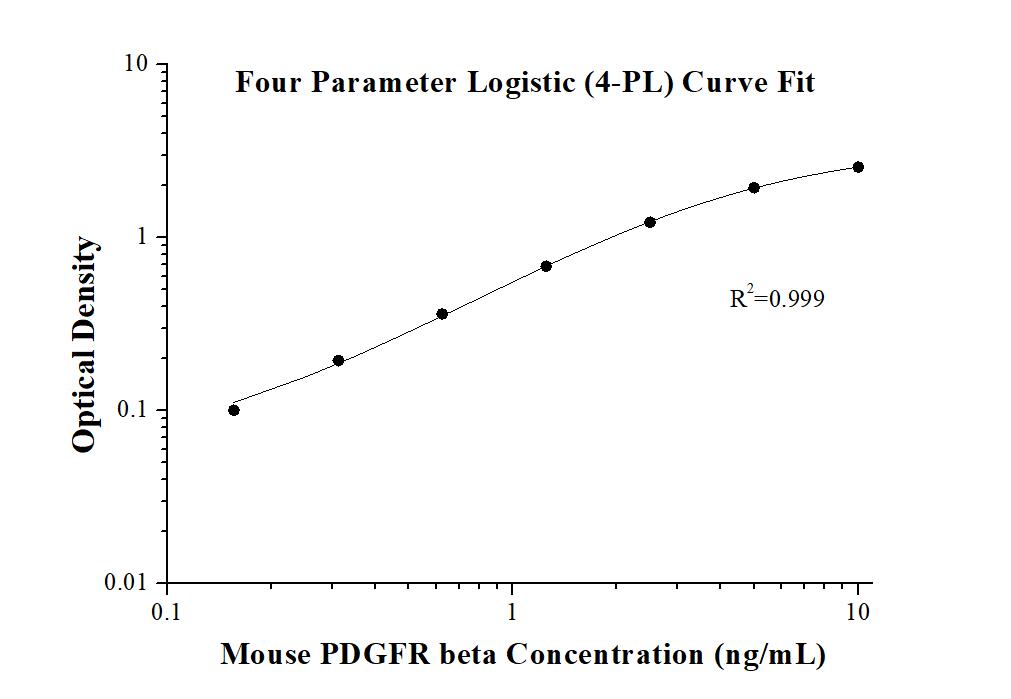
Product Information
KE10166 is a solid phase sandwich Enzyme Linked-Immuno-Sorbent Assay (Sandwich ELISA). The mouse PDGFR beta ELISA kit is to be used to detect and quantify protein levels of endogenous mouse PDGFR beta. The assay recognizes mouse PDGFR beta. An antibody specific for mouse PDGFR beta has been pre-coated onto the microwells. The mouse PDGFR beta protein in samples is captured by the coated antibody after incubation. Following extensive washing, another horseradish peroxidase (HRP)-conjugated antibody specific for mouse PDGFR beta is added to detect the captured mouse PDGFR beta protein. For signal development, followed by Tetramethyl-benzidine (TMB) reagent. Solution containing sulfuric acid is used to stop color development and the color intensity which is proportional to the quantity of bound protein is measurable at 450 nm with the correction wavelength set at 630 nm.
| Product name | Mouse PDGFR beta ELISA Kit |
| Tests | 1 X 96 well plate |
| Sample type | Serum, Plasma, Cell culture supernatant |
| Assay type | Sandwich |
| Sensitivity | 0.02 ng/mL |
| Range | 0.156-10 ng/mL |
| Reactivity | Mouse |
| Tested applications | Sandwich ELISA |
| Gene ID (NCBI) | 18596 |
Recovery
| Sample Type | Average | Range |
|---|---|---|
| Mouse serum | 93% | 74%-108% |
| Cell culture supernatant | 97% | 90%-103% |
IntraAssay
| Sample | n | mean ( ng/mL) | SD | CV% |
|---|---|---|---|---|
| 1 | 8 | 5.84 | 0.35 | 5.95 |
| 2 | 8 | 1.20 | 0.05 | 3.99 |
| 3 | 8 | 0.66 | 0.04 | 5.47 |
InterAssay
| Sample | n | mean ( ng/mL) | SD | CV% |
|---|---|---|---|---|
| 1 | 16 | 5.69 | 0.55 | 9.72 |
| 2 | 16 | 1.21 | 0.06 | 5.02 |
| 3 | 16 | 0.65 | 0.04 | 6.64 |
Background Information
Mouse PDGFR beta (platelet-derived growth factor receptor beta) protein is a cell surface receptor tyrosine kinase involved in cell proliferation, differentiation, migration, and survival. PDGFR-β plays an important role in a variety of physiological and pathological processes, including tissue repair, angiogenesis, and tumor development. In obesity and diabetes studies, PDGFR-β has been associated with adipose tissue expansion and vascular remodeling. PDGF-BB secreted by macrophages was found to be an important regulator of the initiation phase of angiogenesis, which promotes adipose tissue neovascularization by causing pericytes to detach from the vasculature and promoting the germination and growth of adipose tissue neovascularization. In Alzheimer's disease (AD) studies, the PDGFR-β/TGF-β/Smad2/3 signaling pathway modulates blood-brain barrier (BBB) integrity and learning memory capacity. Exogenous PDGF-BB improved learning memory capacity, increased pericyte coverage in the hippocampus, enhanced TGF-βR1, p-Smad2, and p-Smad3 protein expression, and enhanced tight junction protein expression in an AD mouse model, thereby maintaining BBB integrity. These studies suggest that PDGFR-β has important research value in metabolic and neurodegenerative diseases.
Properties
| Storage Instructions | All the reagents are stored at 2-8℃ for 6 months or -20℃ for 12 months. Refer to the protocol for further storage instructions. |
| Synonyms | Beta platelet-derived growth factor receptor, Beta-type platelet-derived growth factor receptor, CD140 antigen-like family member B, CD140b, EC:2.7.10.1 |