

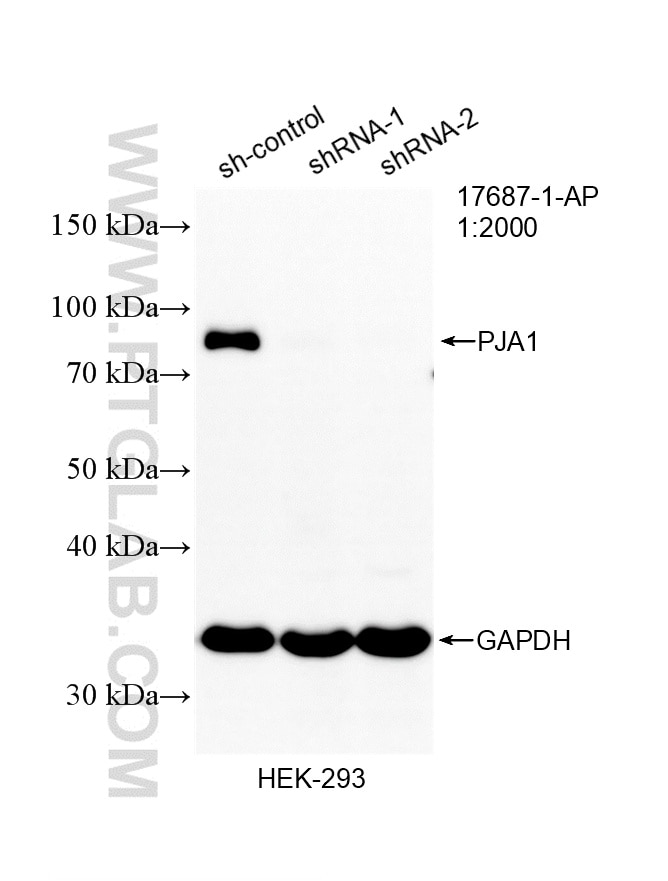



Tested Applications
| Positive WB detected in | HEK-293 cells, mouse brain tissue, rat brain tissue, SH-SY5Y cells |
| Positive IP detected in | mouse brain tissue |
Recommended dilution
| Application | Dilution |
|---|---|
| Western Blot (WB) | WB : 1:2000-1:12000 |
| Immunoprecipitation (IP) | IP : 0.5-4.0 ug for 1.0-3.0 mg of total protein lysate |
| It is recommended that this reagent should be titrated in each testing system to obtain optimal results. | |
| Sample-dependent, Check data in validation data gallery. | |
Product Information
17687-1-AP targets PJA1 in WB, IF, IP, CoIP, ELISA applications and shows reactivity with human, mouse, rat samples.
| Tested Reactivity | human, mouse, rat |
| Cited Reactivity | human, mouse, rat |
| Host / Isotype | Rabbit / IgG |
| Class | Polyclonal |
| Type | Antibody |
| Immunogen |
CatNo: Ag11820 Product name: Recombinant human PJA1 protein Source: e coli.-derived, PGEX-4T Tag: GST Domain: 294-643 aa of BC075803 Sequence: ANDNEGHSDGLARRGRGESSSGYPEPKYPEDKREARSDQVKPEKVPRRRRTMADPDFWTHSDDYYKYCDEDSDSDKEWIAALRRKYRSREQTLSSSGESWETLPGKEEREPPQAKVSASTGTSPGPGASASAGAGAGASAGSNGSNYLEEVREPSLQEEQASLEEGEIPWLQYHENDSSSEGDNDSGHELMQPGVFMLDGNNNLEDDSSVSEDLEVDWSLFDGFADGLGVAEAISYVDPQFLTYMALEERLAQAMETALAHLESLAVDVEVANPPASKESIDALPEILVTEDHGAVGQEMCCPICCSEYVKGEVATELPCHHYFHKPCVSIWLQKSGTCPVCRCMFPPPL Predict reactive species |
| Full Name | praja ring finger 1 |
| Calculated Molecular Weight | 643 aa, 71 kDa |
| Observed Molecular Weight | 71-80 kDa |
| GenBank Accession Number | BC075803 |
| Gene Symbol | PJA1 |
| Gene ID (NCBI) | 64219 |
| RRID | AB_2252483 |
| Conjugate | Unconjugated |
| Form | Liquid |
| Purification Method | Antigen affinity purification |
| UNIPROT ID | Q8NG27 |
| Storage Buffer | PBS with 0.02% sodium azide and 50% glycerol, pH 7.3. |
| Storage Conditions | Store at -20°C. Stable for one year after shipment. Aliquoting is unnecessary for -20oC storage. 20ul sizes contain 0.1% BSA. |
Background Information
PJA1(E3 ubiquitin-protein ligase Praja-1), also named as RNF70, regulates the level of PRC2 (polycomb repressive complex 2) by targeting its free subunits for Ub-mediated proteasomal degradation and it can be involved in protein ubiquitination in the brain and is a suitable candidate gene for MRX(PMID:12036302). The Praja1 protein is unlikely to be a membrane receptor, since it lacks a hydrophobic transmembrane domain(PMID:9393880). It has 3 isoforms produced by alternative splicing with the molecular weight of 71 kDa, 50 kDa and 65 kDa.
Protocols
| Product Specific Protocols | |
|---|---|
| IP protocol for PJA1 antibody 17687-1-AP | Download protocol |
| WB protocol for PJA1 antibody 17687-1-AP | Download protocol |
| Standard Protocols | |
|---|---|
| Click here to view our Standard Protocols |
Publications
What published studies show
Anti-PJA1/Praja1 (17687-1-AP) has 11 total citations published in journals including Nature Communications, Advanced Science, FEBS Journal, Journal of Virology, Annals of Clinical and Translational Neurology, Neuropathology, Cellular and Molecular Bioengineering, Journal of Molecular Evolution, International Journal of Molecular Sciences, and Biochimica et Biophysica Acta. Associated research fields span skeletal myogenesis, ferroptosis in tumor therapy, Alzheimer's disease and synaptic dynamics, tau degradation, antiviral immunity, neurodevelopmental disorders, serotonin transporter regulation, hepatocellular carcinoma, vertebrate evolution, and neurodegenerative protein aggregation.
| Species | Application | Title |
|---|---|---|
Nat Commun Praja1 E3 ubiquitin ligase promotes skeletal myogenesis through degradation of EZH2 upon p38α activation.
| ||
Adv Sci (Weinh) Targeting Methylglyoxal Metabolism to Enhance Ferroptosis Sensitivity in Tumor Therapy
| ||
Int J Mol Sci The E3 Ubiquitin Ligase PRAJA1: A Key Regulator of Synaptic Dynamics and Memory Processes with Implications for Alzheimer's Disease | ||
FEBS J E3 ligase Praja1 mediates ubiquitination and degradation of microtubule-associated protein tau.
| ||
J Virol PJA1 Coordinates with the SMC5/6 Complex to Restrict DNA Viruses and Episomal Genes through Interferon-independent Manner. | ||
Ann Clin Transl Neurol A recurrent PJA1 variant in trigonocephaly and neurodevelopmental disorders. |




