


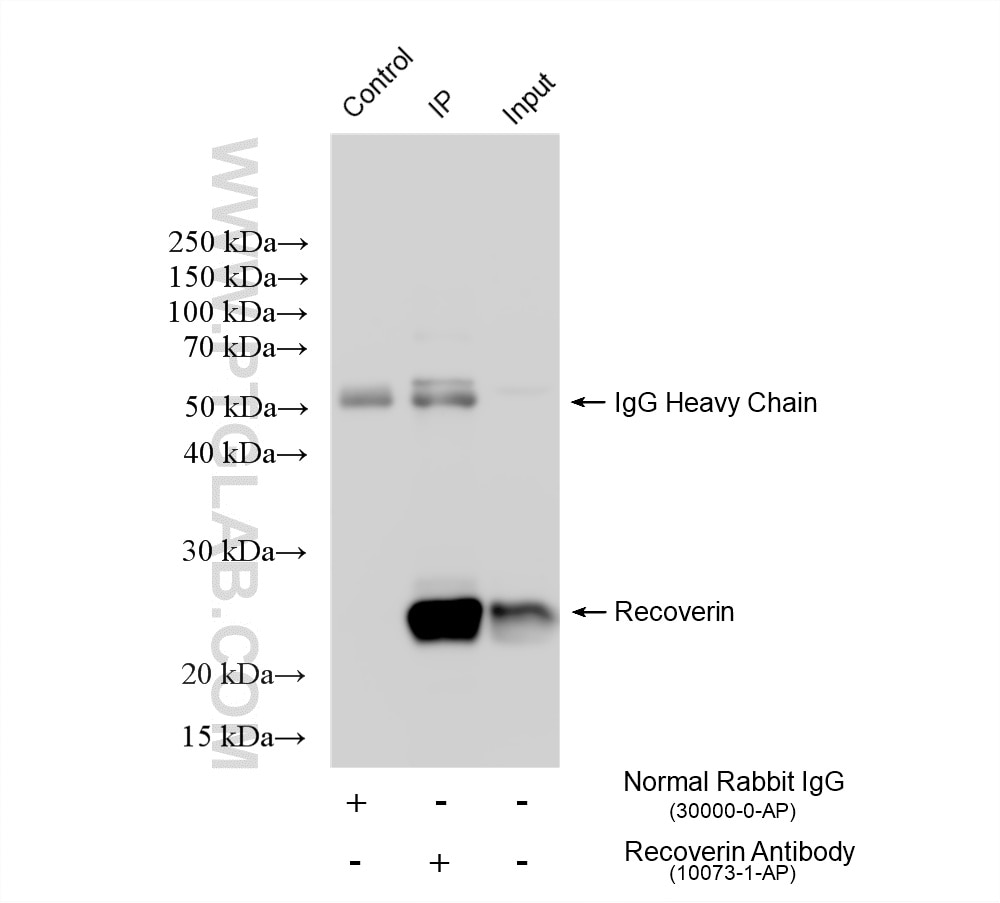



Tested Applications
| Positive WB detected in | mouse eye tissue, rat retina tissue, Y79 cells, rat eye tissue |
| Positive IP detected in | Y79 cells |
| Positive IHC detected in | mouse eye tissue Note: suggested antigen retrieval with TE buffer pH 9.0; (*) Alternatively, antigen retrieval may be performed with citrate buffer pH 6.0 |
| Positive IF-P detected in | mouse eye tissue, mouse brain tissue |
Recommended dilution
| Application | Dilution |
|---|---|
| Western Blot (WB) | WB : 1:500-1:3000 |
| Immunoprecipitation (IP) | IP : 0.5-4.0 ug for 1.0-3.0 mg of total protein lysate |
| Immunohistochemistry (IHC) | IHC : 1:50-1:500 |
| Immunofluorescence (IF)-P | IF-P : 1:50-1:500 |
| It is recommended that this reagent should be titrated in each testing system to obtain optimal results. | |
| Sample-dependent, Check data in validation data gallery. | |
Product Information
10073-1-AP targets Recoverin in WB, IHC, IF-P, IP, ELISA applications and shows reactivity with human, mouse, rat samples.
| Tested Reactivity | human, mouse, rat |
| Cited Reactivity | human, mouse, rat, pig, zebrafish |
| Host / Isotype | Rabbit / IgG |
| Class | Polyclonal |
| Type | Antibody |
| Immunogen |
CatNo: Ag0119 Product name: Recombinant human Recoverin protein Source: e coli.-derived, PGEX-4T Tag: GST Domain: 7-166 aa of BC001720 Sequence: GALSKEILEELQLNTKFSEEELCSWYQSFLKDCPTGRITQQQFQSIYAKFFPDTDPKAYAQHVFRSFDSNLDGTLDFKEYVIALHMTTAGKTNQKLEWAFSLYDVDGNGTISKNEVLEIVMAIFKMITPEDVKLLPDDENTPEKRAEKIWKYFGKNDDDK Predict reactive species |
| Full Name | recoverin |
| Calculated Molecular Weight | 24 kDa |
| Observed Molecular Weight | 23 kDa |
| GenBank Accession Number | BC001720 |
| Gene Symbol | Recoverin |
| Gene ID (NCBI) | 5957 |
| RRID | AB_2178005 |
| Conjugate | Unconjugated |
| Form | Liquid |
| Purification Method | Antigen affinity purification |
| UNIPROT ID | P35243 |
| Storage Buffer | PBS with 0.02% sodium azide and 50% glycerol, pH 7.3. |
| Storage Conditions | Store at -20°C. Stable for one year after shipment. Aliquoting is unnecessary for -20oC storage. 20ul sizes contain 0.1% BSA. |
Background Information
Recoverin, belonging to a family of the neuronal calcium sensor (NCS) proteins, has a restricted expression in retinal photoreceptors or neurons or neuroendocrine cells. It has been suggested to play a role in light and dark adaptation by regulating rhodopsin phosphorylation. Recently, it has been found that autoantibodies against recoverin (24 kDa) have been strongly associated with cancer -associated retinopathy (CAR) syndrome, a paraneoplastic disease of the retina. But functions of recoverin in cancer cells remain unknown.
Protocols
| Product Specific Protocols | |
|---|---|
| IF protocol for Recoverin antibody 10073-1-AP | Download protocol |
| IHC protocol for Recoverin antibody 10073-1-AP | Download protocol |
| IP protocol for Recoverin antibody 10073-1-AP | Download protocol |
| WB protocol for Recoverin antibody 10073-1-AP | Download protocol |
| Standard Protocols | |
|---|---|
| Click here to view our Standard Protocols |
Publications
What published studies show
The Recoverin Polyclonal antibody (catalog number 10073-1-AP) has 27 citations. These appear in journals including Nature Communications, ACS Nano, Science Translational Medicine, Advanced Science, Bioactive Materials, iScience, Journal of Neuroscience, Investigative Ophthalmology & Visual Science, and Experimental Eye Research. The research fields are predominantly ophthalmology and retinal biology, covering photoreceptor development and degeneration, retinal transplantation, stem-cell-derived retinal models, glaucoma, retinitis pigmentosa, retinoblastoma, and neurodegeneration, with applications in IF, IHC, and WB.
| Species | Application | Title |
|---|---|---|
Bioact Mater Micromolded honeycomb scaffold design to support the generation of a bilayered RPE and photoreceptor cell construct | ||
ACS Nano Maternal-Derived Polystyrene Nanoplastics Impair Early Retinal Development in Zebrafish (Danio rerio). | ||
Sci Transl Med A 3D human retina model reveals a non-cell-autonomous and non-neuronal mechanism of photoreceptor loss in a lysosomal storage disorder | ||
Adv Sci (Weinh) A Nucleic Acid-Based LYTAC Plus Platform to Simultaneously Mediate Disease-Driven Protein Downregulation | ||
NPJ Regen Med MAP4Ks inhibition promotes retinal neuron regeneration from Müller glia in adult mice |
Reviews
What customers say
The single review for this product is highly positive, rated 5 stars. The user performed immunofluorescence on ROs at a 1:500 dilution and reported no aspecific staining with a great outcome. Overall, the feedback highlights clean specificity and strong performance in IF applications.
The reviews below have been submitted by verified Proteintech customers who received an incentive for providing their feedback.
Alessandro (Verified Customer) (07-27-2022) | No aspecific staining, great outcome
|





