



Tested Applications
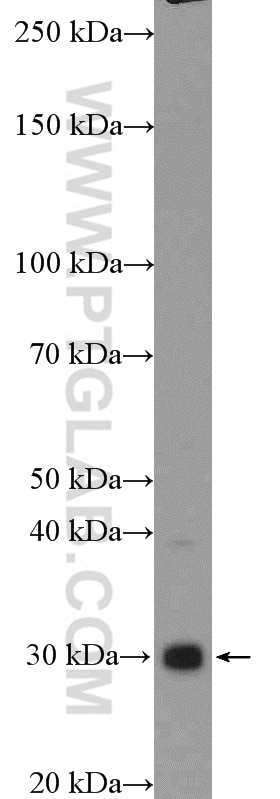
| Positive WB detected in | PC-3 cells, HepG2 cells |
| Positive IP detected in | PC-3 cells |
| Positive IHC detected in | mouse testis tissue Note: suggested antigen retrieval with TE buffer pH 9.0; (*) Alternatively, antigen retrieval may be performed with citrate buffer pH 6.0 |
Recommended dilution
| Application | Dilution |
|---|---|
| Western Blot (WB) | WB : 1:500-1:1000 |
| Immunoprecipitation (IP) | IP : 0.5-4.0 ug for 1.0-3.0 mg of total protein lysate |
| Immunohistochemistry (IHC) | IHC : 1:1000-1:4000 |
| It is recommended that this reagent should be titrated in each testing system to obtain optimal results. | |
| Sample-dependent, Check data in validation data gallery. | |
Product Information
17810-1-AP targets RNF4 in WB, IHC, IF, IP, CoIP, ELISA applications and shows reactivity with human, mouse, rat samples.
| Tested Reactivity | human, mouse, rat |
| Cited Reactivity | human, mouse |
| Host / Isotype | Rabbit / IgG |
| Class | Polyclonal |
| Type | Antibody |
| Immunogen |
CatNo: Ag12115 Product name: Recombinant human RNF4 protein Source: e coli.-derived, PGEX-4T Tag: GST Domain: 1-190 aa of BC031935 Sequence: MSTRKRRGGAINSRQAQKRTREATSTPEISLEAEPIELVETAGDEIVDLTCESLEPVVVDLTHNDSVVIVDERRRPRRNARRLPQDHADSCVVSSDDEELSRDRDVYVTTHTPRNARDEGATGLRPSGTVSCPICMDGYSEIVQNGRLIVSTECGHVFCSQCLRDSLKNANTCPTCRKKINHKRYHPIYI Predict reactive species |
| Full Name | ring finger protein 4 |
| Calculated Molecular Weight | 190 aa, 21 kDa |
| Observed Molecular Weight | 30 kDa |
| GenBank Accession Number | BC031935 |
| Gene Symbol | RNF4 |
| Gene ID (NCBI) | 6047 |
| RRID | AB_2878443 |
| Conjugate | Unconjugated |
| Form | Liquid |
| Purification Method | Antigen affinity purification |
| UNIPROT ID | P78317 |
| Storage Buffer | PBS with 0.02% sodium azide and 50% glycerol, pH 7.3. |
| Storage Conditions | Store at -20°C. Stable for one year after shipment. Aliquoting is unnecessary for -20oC storage. 20ul sizes contain 0.1% BSA. |
Background Information
RNF4 is a E3 ubiquitin-protein ligase that binds polysumoylated chains covalently attached to proteins and mediates 'Lys-6'-, 'Lys-11'-, 'Lys-48'- and 'Lys-63'-linked polyubiquitination of those substrates and their subsequent targeting to the proteasome for degradation. It regulates the degradation of several proteins including PML and PEA3[PMID:18408734]. It also participates in chromosome alignment and spindle assembly, and regulates the kinetochore CENPH-CENPI-CENPK complex by targeting polysumoylated CENPI to proteasomal degradation. In addition, RNF4 can regulates the cellular responses to hypoxia and heat shock through degradation of respectively EPAS1 and PARP1 [PMID:20026589]. Alternatively, it may also bind DNA/nucleosomes and have a more direct role in the regulation of transcription for instance enhancing basal transcription and steroid receptor-mediated transcriptional activation [PMID:11319220]. RNF4 exist as two isoforms. Isoform one is a 30 kDa protein and isoform two is a about 15 kDa protein. RNF4 binds polysumoylated chains and the molecular weight of RNF4 migrate in the experiment to 35 kDa, 47 kDa, 69 kDa as ubiquitinated protein.
Protocols
| Product Specific Protocols | |
|---|---|
| IHC protocol for RNF4 antibody 17810-1-AP | Download protocol |
| IP protocol for RNF4 antibody 17810-1-AP | Download protocol |
| WB protocol for RNF4 antibody 17810-1-AP | Download protocol |
| Standard Protocols | |
|---|---|
| Click here to view our Standard Protocols |
Publications
What published studies show
Anti-RNF4 antibody (Cat# 17810-1-AP) has 17 citations spanning journals including Cell, Nature Cell Biology, Nature Communications, Theranostics, Advanced Science, Oncogene, EMBO Reports, and ACS Chemical Biology. Research fields covered include DNA repair, autophagy, ferroptosis, protein ubiquitination/degradation, SUMOylation, cell death, and cancer biology (colorectal, hepatocellular, cholangiocarcinoma, breast, and lung cancers), as well as lipid metabolism and skin aging.
| Species | Application | Title |
|---|---|---|
Cell TEX264 drives selective autophagy of DNA lesions to promote DNA repair and cell survival | ||
Nat Cell Biol Phase separation of ERCC6L2-CtIP regulates the extent of DNA end resection
| ||
Nat Commun Crosstalk between SUMOylation and ubiquitylation controls DNA end resection by maintaining MRE11 homeostasis on chromatin | ||
Theranostics CSF2RB overexpression promotes the protective effects of mesenchymal stromal cells against ischemic heart injury
| ||
Adv Sci (Weinh) Meisoindigo Acts as a Molecular Glue to Target PKMYT1 for Degradation in Chronic Myeloid Leukemia Therapy | ||
Phytomedicine Pharmacological targeting of NR4A1 restrains lipid metabolism-ferroptosis axis in UVR-induced skin aging. |
Reviews
What customers say
The single review for 17810-1-AP reports a positive experience with the antibody in Western Blot. The user tested it on HEK293 cells at a 1:1,000 dilution and rated it 4 out of 5, noting that the antibody worked well. Overall, the feedback is favorable, indicating reliable performance for this application.
The reviews below have been submitted by verified Proteintech customers who received an incentive for providing their feedback.
Chun (Verified Customer) (06-19-2022) | This antibody worked well.
|



