
Recombinant Rat Agrin protein (rFc Tag) (HPLC verified)
Species
Rat
Purity
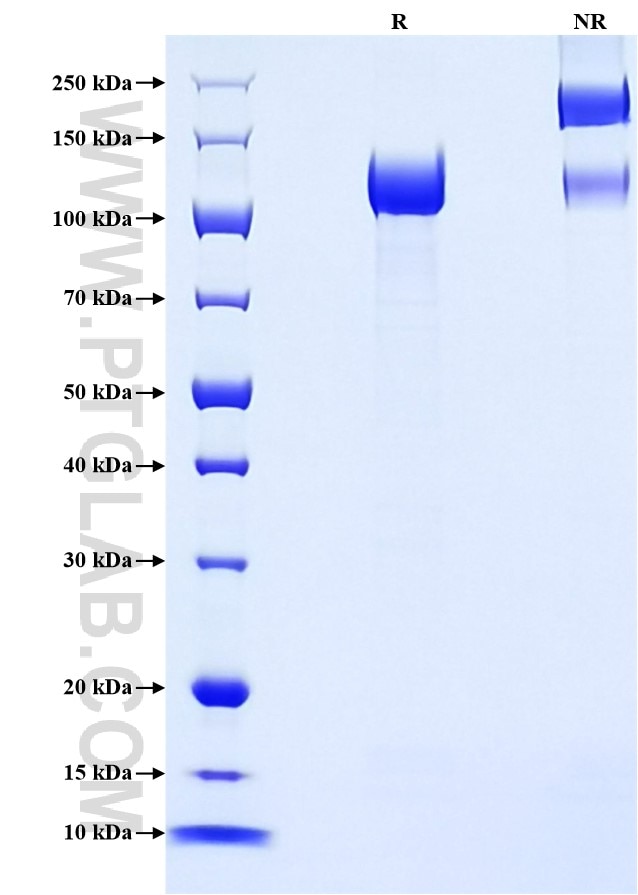
>90 %, SDS-PAGE
>90 %, SEC-HPLC
Tag
rFc Tag
Activity
not tested
Cat no : Eg3412
Validation Data Gallery
Product Information
| Purity | >90 %, SDS-PAGE >90 %, SEC-HPLC |
| Endotoxin | <0.1 EU/μg protein, LAL method |
| Activity |
Not tested |
| Expression | HEK293-derived Rat Agrin protein Ala1153-Pro1948 (Accession# P25304-4) with a rabbit IgG Fc tag at the N-terminus. |
| GeneID | 25592 |
| Accession | P25304-4 |
| PredictedSize | 112.4 kDa |
| SDS-PAGE | 100-140 kDa, reducing (R) conditions |
| Formulation | Lyophilized from 0.22 μm filtered solution in PBS, pH 7.4. Normally 5% trehalose and 5% mannitol are added as protectants before lyophilization. |
| Reconstitution | Briefly centrifuge the tube before opening. Reconstitute at 0.1-0.5 mg/mL in sterile water. |
| Storage Conditions |
It is recommended that the protein be aliquoted for optimal storage. Avoid repeated freeze-thaw cycles.
|
| Shipping | The product is shipped at ambient temperature. Upon receipt, store it immediately at the recommended temperature. |
Background
Rat Agrin is a large proteoglycan secreted by motor neurons, muscle cells, and others, and serves as a key component of the extracellular matrix. As the central organizer of neuromuscular junction formation, it efficiently clusters acetylcholine receptors on the postsynaptic membrane by binding to the LRP4/MuSK receptor complex, thereby driving the development and maturation of neuromuscular synapses. Beyond the nervous system, Agrin is also involved in regulating myotube formation, cardiac regeneration, and stem cell differentiation. Studies have shown that exogenous Agrin protein can promote axonal regeneration after spinal cord injury and induce dedifferentiation and proliferation of cardiomyocytes, demonstrating strong tissue repair potential. Consequently, Agrin has emerged as a highly promising therapeutic protein molecule in the fields of neural and cardiac regeneration.
References:
1. Bassat, Elad et al. Nature vol. 547,7662 (2017): 179-184.
2. Mokhtari, Reza Bayat et al. Advanced science (Weinheim, Baden-Wurttemberg, Germany) vol. 12,20 (2025): e2413443.
3. Li, Xiang et al. International journal of molecular medicine vol. 54,5 (2024): 98.
4. Yu Lin, Melissa Ong et al. The Journal of investigative dermatology vol. 145,1 (2025): 155-170.e2.