
Recombinant Rat M-CSF protein (rFc Tag)
Species
Rat
Purity
>90 %, SDS-PAGE
Tag
rFc Tag
Activity
not tested
Cat no : Eg3414
Validation Data Gallery
Product Information
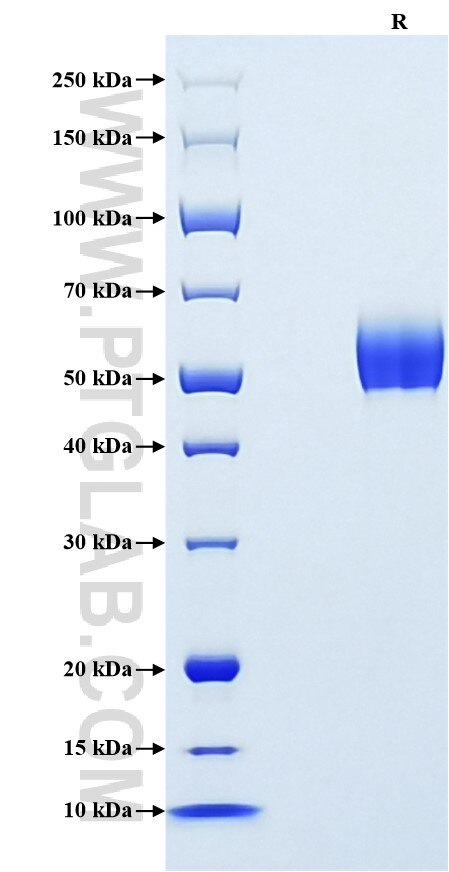
| Purity | >90 %, SDS-PAGE |
| Endotoxin | <0.1 EU/μg protein, LAL method |
| Activity |
Not tested |
| Expression | HEK293-derived Rat M-CSF protein Glu33-Pro186 (Accession# Q8JZQ0-1) with a rabbit IgG Fc tag at the C-terminus. |
| GeneID | 78965 |
| Accession | Q8JZQ0-1 |
| PredictedSize | 44.3 kDa |
| SDS-PAGE | 46-65 kDa, reducing (R) conditions |
| Formulation | Lyophilized from 0.22 μm filtered solution in PBS, pH 7.4. Normally 5% trehalose and 5% mannitol are added as protectants before lyophilization. |
| Reconstitution | Briefly centrifuge the tube before opening. Reconstitute at 0.1-0.5 mg/mL in sterile water. |
| Storage Conditions |
It is recommended that the protein be aliquoted for optimal storage. Avoid repeated freeze-thaw cycles.
|
| Shipping | The product is shipped at ambient temperature. Upon receipt, store it immediately at the recommended temperature. |
Background
M-CSF, also called colony-stimulating factor-1 or CSF-1), is a haematopoietic growth factor, which controls survival, proliferation, differentiation and function of mononuclear phagocytes. It also plays a role in bone metabolism, fertility, pregnancy and inflammatory processes. M-CSF may be expressed on the surface of the cell as a membrane-spanning glycoprotein or secreted into circumstance. M-CSF was identified as an 84-kDa homodimeric glycoprotein found in healthy human urine, and is present in the peripheral blood and urine. M-CSF serum levels were elevated in pre-transplant haemodialysis patients, so it might be a specific marker of Kidney Allograft Rejection.
References:
1. J W Pollard, et al. (1987). Nature. 330(6147): 484-486.
2. B R Witt, et al. (1997). Fertil Steril. 68(2): 259-264.
3. Anna Popova, et al. (2010). Immunobiology. 216(1-2):164-172.
4. K Motoyoshi, et al. (1998). Int J Hematol.67(2):109-122.
5. K Motoyoshi, et al. (1978). Blood. 52(5): 1012-1020.
6. Yannick Le Meur, et al. (2004). Nephrol Dial Transplant.19(7):1862-1865.