
Recombinant Rat Progranulin/PGRN protein (mFc Tag)
Species
Rat
Purity
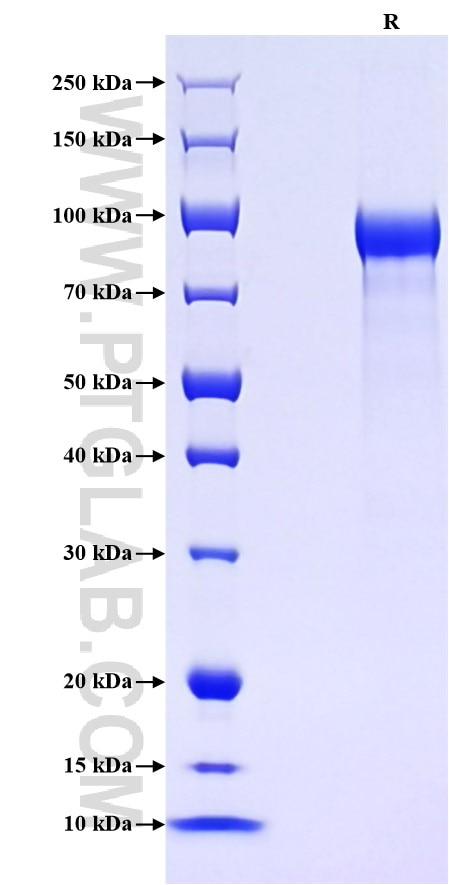
>90 %, SDS-PAGE
Tag
mFc Tag
Activity
not tested
Cat no : Eg3240
Validation Data Gallery
Product Information
| Purity | >90 %, SDS-PAGE |
| Endotoxin | <0.1 EU/μg protein, LAL method |
| Activity |
Not tested |
| Expression | HEK293-derived Rat Progranulin protein Thr18-Leu588 (Accession# P23785) with a mouse IgG Fc tag at the C-terminus. |
| GeneID | 29143 |
| Accession | P23785 |
| PredictedSize | 88.1 kDa |
| SDS-PAGE | 85-100 kDa, reducing (R) conditions |
| Formulation | Lyophilized from 0.22 μm filtered solution in PBS, pH 7.4. Normally 5% trehalose and 5% mannitol are added as protectants before lyophilization. |
| Reconstitution | Briefly centrifuge the tube before opening. Reconstitute at 0.1-0.5 mg/mL in sterile water. |
| Storage Conditions |
It is recommended that the protein be aliquoted for optimal storage. Avoid repeated freeze-thaw cycles.
|
| Shipping | The product is shipped at ambient temperature. Upon receipt, store it immediately at the recommended temperature. |
Background
Progranulin, also known as Acrogranin, PCDGF, and Epithelin/Granulin Precursor, was first identified as a 593-aa secreted glycoprotein involved in the regulation of cancer progression and wound healing. It is a widely expressed glycoprotein that can undergo proteolysis to generate numerous Granulin peptides. Progranulin (PGRN) has been considered a growth factor-like molecule implicated in additional biological and pathological processes including early embryogenesis, inflammation, host defense, cartilage development and degradation.
References:
1. Yazhou Cui. et al. (2019). Cytokine Growth Factor Rev. 45:53-64.
2. A Bateman. et al. (1990). iochem Biophys Res Commun.173(3):1161-1168.
3. Zhiheng He. et al. (2002). Cancer Res. 62(19):5590-5596.
4. Zhiheng He. et al. (2003). Nat Med. 9(2):225-229.
5. Wei Tang. et al. (2011). Science. 22;332(6028):478-484.
6. Jing Zhu. et al. (2002). Cell. 111(6):867-878.
7. L Díaz-Cueto. et al. (2000). Dev Biol. 217(2):406-418.