
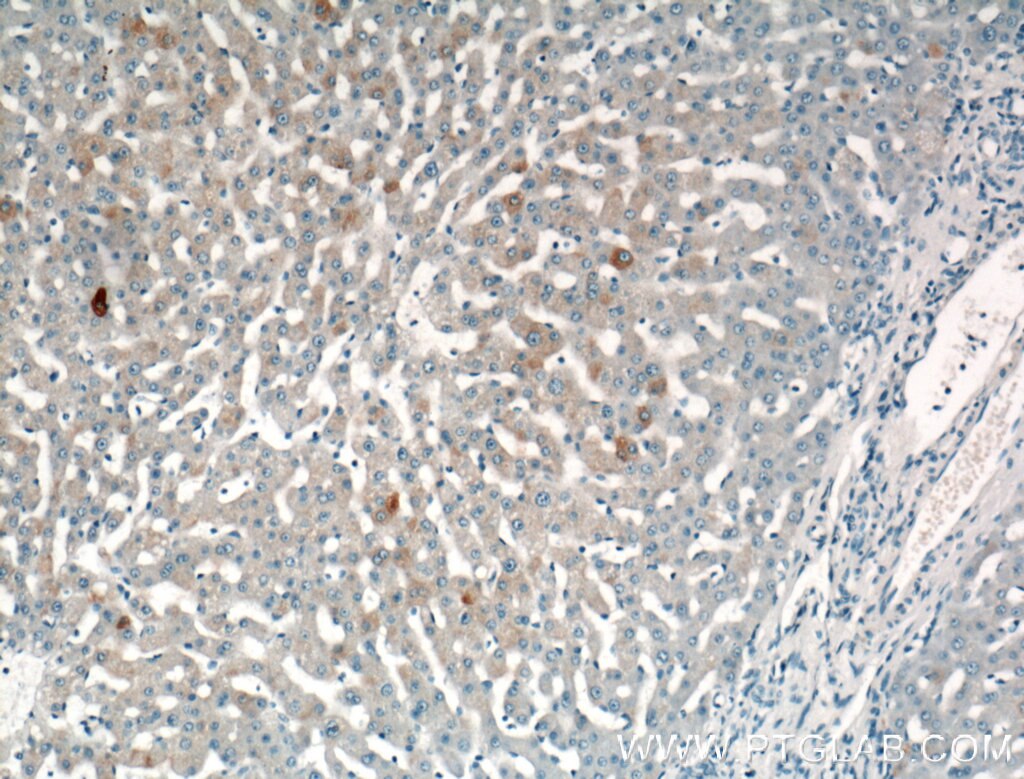
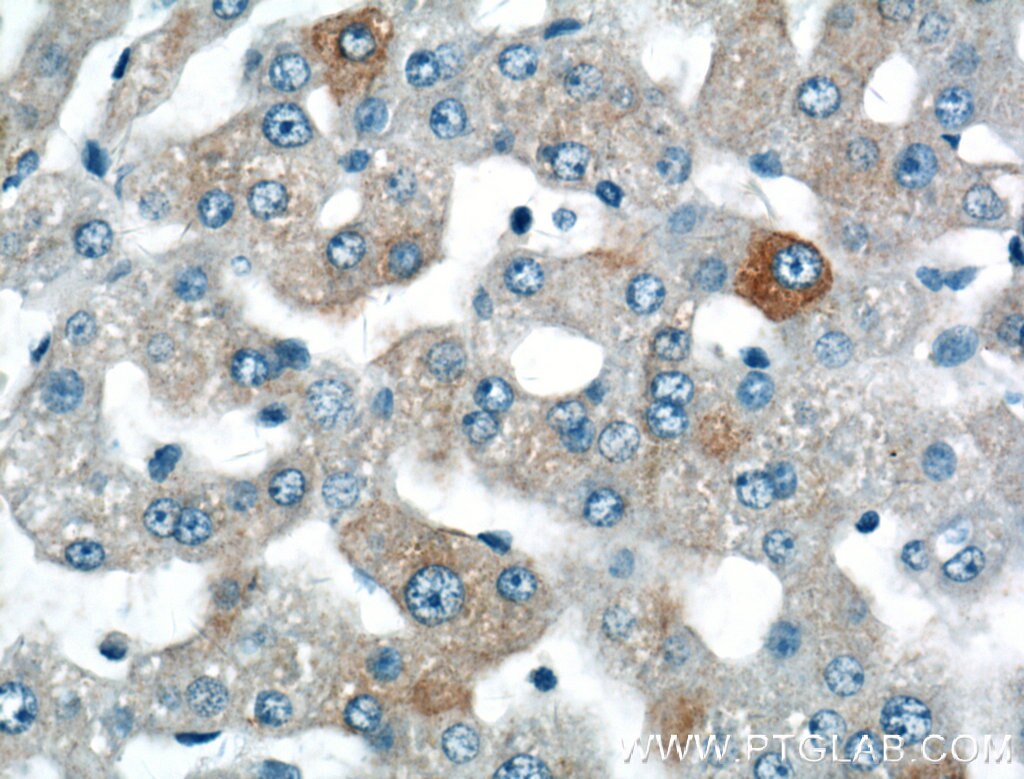

Tested Applications
| Positive IHC detected in | human liver tissue Note: suggested antigen retrieval with TE buffer pH 9.0; (*) Alternatively, antigen retrieval may be performed with citrate buffer pH 6.0 |
Recommended dilution
| Application | Dilution |
|---|---|
| Immunohistochemistry (IHC) | IHC : 1:50-1:500 |
| It is recommended that this reagent should be titrated in each testing system to obtain optimal results. | |
| Sample-dependent, Check data in validation data gallery. | |
Product Information
16555-1-AP targets SPG11 in WB, IHC, CoIP, ELISA applications and shows reactivity with human, mouse, rat samples.
| Tested Reactivity | human, mouse, rat |
| Cited Reactivity | human, mouse |
| Host / Isotype | Rabbit / IgG |
| Class | Polyclonal |
| Type | Antibody |
| Immunogen |
CatNo: Ag9769 Product name: Recombinant human SPG11 protein Source: e coli.-derived, PGEX-4T Tag: GST Domain: 133-482 aa of BC024161 Sequence: TLVGMKLLDKISSVPHGELSCTTELLILAHHCFTLTCHMEGIIRVLQAAHMLTDNHLAPSEEYGLVVRLLTGIGRYNEMTYIFDLLHKKHYFEVLMRKKLDPSGTLKTALLDYIKRCRPGDSEKHNMIALCFSMCREIGENHEAAARIQLKLIESQPWEDSLKDGHQLKQLLLKALTLMLDAAESYAKDSCVRQAQHCQRLTKLITLQIHFLNTGQNTMLINLGRHKLMDCILALPRFYQASIVAEAYDFVPDWAEILYQQVILKGDFNYLEEFKQQRLLKSSIFEEISKKYKQHQPTDMVMENLKKLLTYCEDVYLYYKLAYEHKFYEIVNVLLKDPQTGCCLKDMLAG Predict reactive species |
| Full Name | spastic paraplegia 11 (autosomal recessive) |
| Calculated Molecular Weight | 2443 aa, 279 kDa |
| GenBank Accession Number | BC024161 |
| Gene Symbol | SPG11 |
| Gene ID (NCBI) | 80208 |
| RRID | AB_2878277 |
| Conjugate | Unconjugated |
| Form | Liquid |
| Purification Method | Antigen affinity purification |
| UNIPROT ID | Q96JI7 |
| Storage Buffer | PBS with 0.02% sodium azide and 50% glycerol, pH 7.3. |
| Storage Conditions | Store at -20°C. Stable for one year after shipment. Aliquoting is unnecessary for -20oC storage. 20ul sizes contain 0.1% BSA. |
Protocols
| Product Specific Protocols | |
|---|---|
| IHC protocol for SPG11 antibody 16555-1-AP | Download protocol |
| Standard Protocols | |
|---|---|
| Click here to view our Standard Protocols |
Publications
What published studies show
Anti-SPASTZIN (16555-1-AP) has 11 citations published in journals including Science, J Clin Invest, Cell Reports, PLoS Biology, Neurobiology of Disease, Annals of Clinical and Translational Neurology, PLoS Genetics, Human Molecular Genetics, and bioRxiv. Research fields span lysosomal biology and autophagy, hereditary spastic paraplegia (SPG11/SPG15), neurodegeneration, ribophagy, lipid metabolism, and extracellular vesicle release. Applications are predominantly Western blot, with some Co-IP and ELISA.
| Species | Application | Title |
|---|---|---|
J Clin Invest Spastic paraplegia proteins spastizin and spatacsin mediate autophagic lysosome reformation. | ||
PLoS Biol Spatacsin regulates directionality of lysosome trafficking by promoting the degradation of its partner AP5Z1 | ||
Neurobiol Dis Loss of spatacsin function alters lysosomal lipid clearance leading to upper and lower motor neuron degeneration.
| ||
Neurobiol Dis SPG11 models reveal lysosomal calcium regulation of neural progenitor proliferation.
|



