
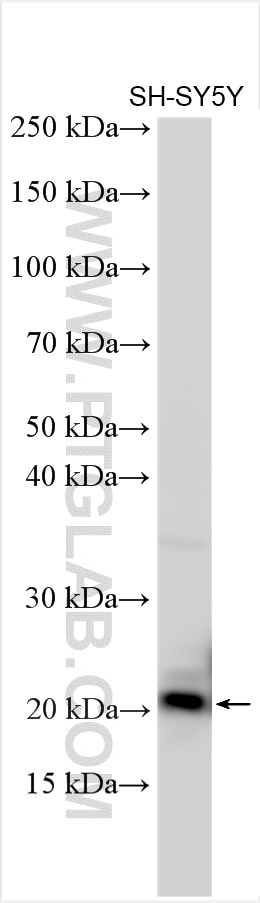

Tested Applications
| Positive WB detected in | SH-SY5Y cells |
Recommended dilution
| Application | Dilution |
|---|---|
| Western Blot (WB) | WB : 1:5000-1:20000 |
| It is recommended that this reagent should be titrated in each testing system to obtain optimal results. | |
| Sample-dependent, Check data in validation data gallery. | |
Product Information
11311-1-AP targets STMN3 in WB, IHC, IF, ELISA applications and shows reactivity with human, mouse, rat samples.
| Tested Reactivity | human, mouse, rat |
| Cited Reactivity | human, mouse |
| Host / Isotype | Rabbit / IgG |
| Class | Polyclonal |
| Type | Antibody |
| Immunogen |
CatNo: Ag1853 Product name: Recombinant human STMN3 protein Source: e coli.-derived, PGEX-4T Tag: GST Domain: 1-180 aa of BC009381 Sequence: MASTISAYKEKMKELSVLSLICSCFYTQPHPNTVYQYGDMEVKQLDKRASGQSFEVILKSPSDLSPESPMLSSPPKKKDTSLEELQKRLEAAEERRKTQEAQVLKQLAERREHEREVLHKALEENNNFSRQAEEKLNYKMELSKEIREAHLAALRERLREKELHAAEVRRNKEQREEMSG Predict reactive species |
| Full Name | stathmin-like 3 |
| Calculated Molecular Weight | 21 kDa |
| Observed Molecular Weight | 21-25 kDa |
| GenBank Accession Number | BC009381 |
| Gene Symbol | STMN3 |
| Gene ID (NCBI) | 50861 |
| RRID | AB_2197399 |
| Conjugate | Unconjugated |
| Form | Liquid |
| Purification Method | Antigen affinity purification |
| UNIPROT ID | Q9NZ72 |
| Storage Buffer | PBS with 0.02% sodium azide and 50% glycerol, pH 7.3. |
| Storage Conditions | Store at -20°C. Stable for one year after shipment. Aliquoting is unnecessary for -20oC storage. 20ul sizes contain 0.1% BSA. |
Background Information
Stathmin family phosphoproteins participate in the control of microtubule dynamics and have been proposed to be involved in the control of neuronal differentiation. Neuron specific Stathmin-3 (STMN3) is a novel STAT3 (signal transducer and activator of transcription 3) interacting protein. STAT3 is a key contributor to cancer cell migration and invasion. STMN3 exhibits microtubule-destabilizing activity, which is antagonized by STAT3. SCG10 is a widely studied and recognized neuronal differentiation marker, STMN3 is a SCG10-like protein (SCLIP) and is present from the earliest stages of hippocampal neuron differentiation in culture at vesicle-like structures following dynamic microtubules. RNAi mediated inhibition of this gene resulted in increased axonal branching.
Protocols
| Product Specific Protocols | |
|---|---|
| WB protocol for STMN3 antibody 11311-1-AP | Download protocol |
| Standard Protocols | |
|---|---|
| Click here to view our Standard Protocols |
Publications
What published studies show
STMN3 Polyclonal antibody (Cat# 11311-1-AP) has 12 citations spanning journals including Cancer Research, Brain, Cell Reports, Molecular Cancer Therapeutics, Journal of Biological Chemistry, Journal of Cell Science, Molecular Biology of the Cell, BMC Cell Biology, bioRxiv, eLife, and Science Advances. Research fields cover cancer biology (lung, renal, ovarian), neurodegeneration (ALS), microtubule dynamics, axon maintenance and regeneration, neuronal differentiation, and viral neurobiology.
| Species | Application | Title |
|---|---|---|
Cancer Res Coordinated expression of stathmin family members by far upstream sequence element-binding protein-1 increases motility in non-small cell lung cancer. | ||
Brain STMN2 protein depletion via translation deficits and stress granules in amyotrophic lateral sclerosis. | ||
Cell Rep Loss of Stathmin-2, a hallmark of TDP-43-associated ALS, causes motor neuropathy. | ||
J Biol Chem The Stathmin-2 membrane targeting domain is required for axon protection and regulated degradation by DLK signaling |


