
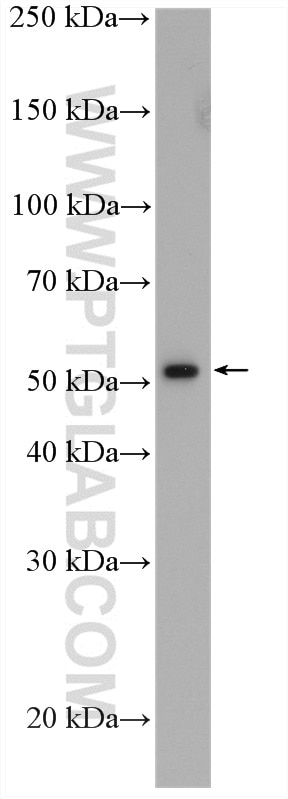

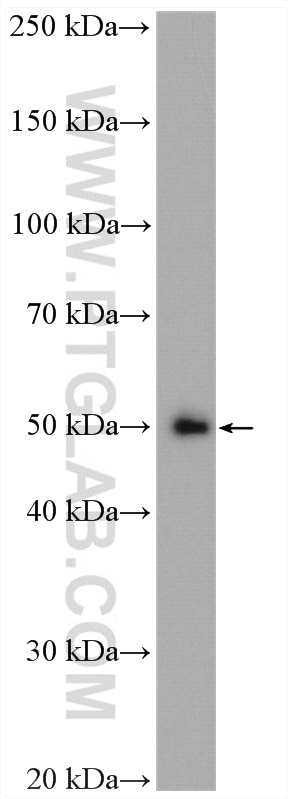
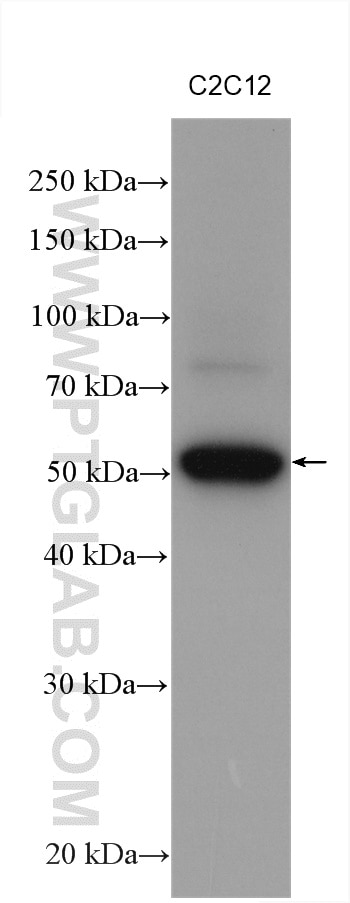

Tested Applications
| Positive WB detected in | BGC-823 cells, A375 cells, C2C12 cells |
Recommended dilution
| Application | Dilution |
|---|---|
| Western Blot (WB) | WB : 1:500-1:1500 |
| It is recommended that this reagent should be titrated in each testing system to obtain optimal results. | |
| Sample-dependent, Check data in validation data gallery. | |
Product Information
13283-1-AP targets TEAD1 in WB, IF, ELISA applications and shows reactivity with mouse, human samples.
| Tested Reactivity | mouse, human |
| Cited Reactivity | human, rat |
| Host / Isotype | Rabbit / IgG |
| Class | Polyclonal |
| Type | Antibody |
| Immunogen |
CatNo: Ag4082 Product name: Recombinant human TEAD1 protein Source: e coli.-derived, PGEX-4T Tag: GST Domain: 1-60 aa of BC026959 Sequence: MLTPSIVYECATRNFQRAPFTIWHFQRMFQPSKGQLFKVLVGFYPNLVEIGKADRGKEDE Predict reactive species |
| Full Name | TEA domain family member 1 (SV40 transcriptional enhancer factor) |
| Calculated Molecular Weight | 426 aa, 47, 9 kDa |
| Observed Molecular Weight | 52 kDa |
| GenBank Accession Number | BC026959 |
| Gene Symbol | TEAD1 |
| Gene ID (NCBI) | 7003 |
| RRID | AB_2287290 |
| Conjugate | Unconjugated |
| Form | Liquid |
| Purification Method | Antigen affinity purification |
| UNIPROT ID | P28347 |
| Storage Buffer | PBS with 0.02% sodium azide and 50% glycerol, pH 7.3. |
| Storage Conditions | Store at -20°C. Stable for one year after shipment. Aliquoting is unnecessary for -20oC storage. 20ul sizes contain 0.1% BSA. |
Background Information
TEAD1 belongs to a protein family that share the TEA/ATTS domain. It acts as a transcriptional factor by binding to the GT-IIC and Sph(I 1 II) enhansons in the simian virus 40 (SV40) enhancer. Also it can modulate SV40 late transcription together with large T antigen. The transcriptional activity of TEAD1 required several regions of the proteins , a TBP-associated factors and a limiting transcriptional intermediary factors. TEAD1 also preforms an essential role in the Hippo signaling pathway. TEAD1 regulates gene expression of YAP1 and WWTR1/TAZ, thus mediating cell proliferation, migration and epithelial mesenchymal transition induction. TEAD is preferentially expressed in skeletal muscle. Lower levels in pancreas, placenta, and heart.
Publications
What published studies show
The anti-YAP antibody (Cat# 13283-1-AP) has 12 total citations spanning journals including Cell, MedComm, Adv Sci, Cancer Lett, Int J Mol Sci, Cancers, Oncol Rep, Dig Dis Sci, Biomed Pharmacother, Arch Oral Biol, Prog Orthod, and Oncol Lett. Research fields cover RNA metabolism and stress granules, osteogenic differentiation, bone remodeling, glioma epigenetics, breast cancer (vasculogenic mimicry, glycolysis), renal cell carcinoma, hepatocellular carcinoma ferroptosis, colonic adenoma, and gastric carcinoma metastasis.
| Species | Application | Title |
|---|---|---|
Cell QKI shuttles internal m7G-modified transcripts into stress granules and modulates mRNA metabolism | ||
MedComm (2020) YAP/TEAD1 and β-catenin/LEF1 synergistically induce estrogen receptor α to promote osteogenic differentiation of bone marrow stromal cells | ||
Adv Sci (Weinh) CRISPR/Cas13 sgRNA-Mediated RNA-RNA Interaction Mapping in Live Cells with APOBEC RNA Editing | ||
Cancer Lett EGFR/c-myc axis regulates TGFβ/Hippo/Notch pathway via epigenetic silencing miR-524 in gliomas. | ||
Prog Orthod Mechanosensor YAP mediates bone remodeling via NF-κB p65 induced osteoclastogenesis during orthodontic tooth movement | ||
Int J Mol Sci Role of Clostridium perfringens Enterotoxin on YAP Activation in Colonic Sessile Serrated Adenoma/ Polyps with Dysplasia. |





