

Tested Applications
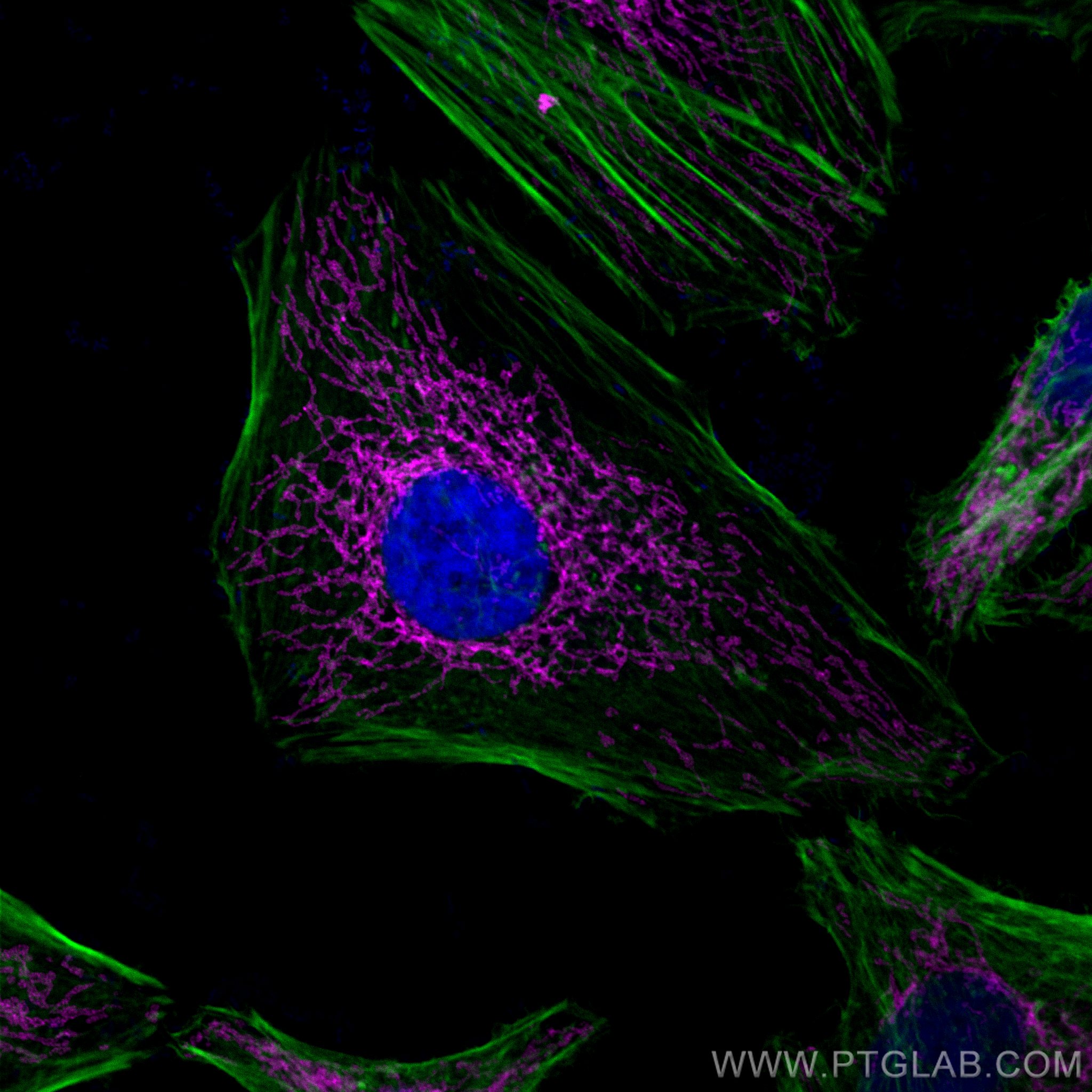
| Positive IF/ICC detected in | HeLa cells |
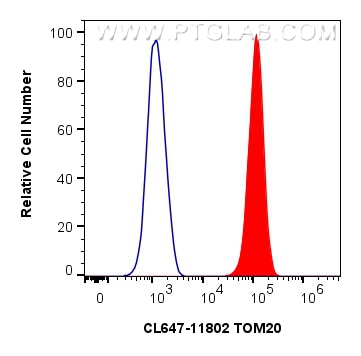
| Positive FC (Intra) detected in | HepG2 cells |
Recommended dilution
| Application | Dilution |
|---|---|
| Immunofluorescence (IF)/ICC | IF/ICC : 1:50-1:500 |
| Flow Cytometry (FC) (INTRA) | FC (INTRA) : 0.80 ug per 10^6 cells in a 100 µl suspension |
| It is recommended that this reagent should be titrated in each testing system to obtain optimal results. | |
| Sample-dependent, Check data in validation data gallery. | |
Product Information
CL647-11802 targets TOM20 in WB, IF/ICC, FC (Intra) applications and shows reactivity with human, mouse, rat samples.
| Tested Reactivity | human, mouse, rat |
| Cited Reactivity | human, mouse, rat |
| Host / Isotype | Rabbit / IgG |
| Class | Polyclonal |
| Type | Antibody |
| Immunogen |
CatNo: Ag2378 Product name: Recombinant human TOM20 protein Source: e coli.-derived, PGEX-4T Tag: GST Domain: 1-145 aa of BC000882 Sequence: MVGRNSAIAAGVCGALFIGYCIYFDRKRRSDPNFKNRLRERRKKQKLAKERAGLSKLPDLKDAEAVQKFFLEEIQLGEELLAQGEYEKGVDHLTNAIAVCGQPQQLLQVLQQTLPPPVFQMLLTKLPTISQRIVSAQSLAEDDVE Predict reactive species |
| Full Name | translocase of outer mitochondrial membrane 20 homolog (yeast) |
| Calculated Molecular Weight | 145 aa, 16 kDa |
| Observed Molecular Weight | 16 kDa |
| GenBank Accession Number | BC000882 |
| Gene Symbol | TOM20 |
| Gene ID (NCBI) | 9804 |
| RRID | AB_2934864 |
| Conjugate | CoraLite® Plus 647 Fluorescent Dye |
| Excitation/Emission Maxima Wavelengths | 654 nm / 674 nm |
| Excitation Laser | Red Laser (633 nm) |
| Form | Liquid |
| Purification Method | Antigen affinity purification |
| UNIPROT ID | Q15388 |
| Storage Buffer | PBS with 50% glycerol, 0.05% Proclin300, 0.5% BSA, pH 7.3. |
| Storage Conditions | Store at -20°C. Avoid exposure to light. Stable for one year after shipment. Aliquoting is unnecessary for -20oC storage. |
Background Information
Background
TOM20 (KIAA0016) belongs to the Tom family. It is a subunit of the mitochondrial import receptor (PMID: 7584026), whose main role is to translocate cytosolically synthesized mitochondrial proteins through the outer mitochondrial membrane and subsequently facilitate the movement of proteins into the TOM40 translocation pore complex (PMID: 21173275).
What is the molecular weight of TOM20?
It is a short 16.3 kDa protein containing several highly conserved regions, including the transmembrane segment, the ligand-binding domain, and flexible segments at the N terminus and the C terminus of the protein crucial for its function (PMID: 15733919).
What is the subcellular localization of TOM20?
It specifically localizes in the mitochondrial outer membrane. In malignant cells, strong granular staining in the cytoplasm has been observed.
What is the tissue specificity of TOM20?
It is ubiquitously expressed in various tissues, with a particularly high expression in the brain, thyroid, and pancreas.
What is the function of TOM20 in the mitochondrial membrane?
Mitochondrial preproteins are generally synthesized in the cytoplasm with signal or targeting sequences, which are recognized by specific receptors on the outer mitochondrial membrane. TOM20, as one of the components of the TOM40 complex, specifically recognizes pre-sequences on target proteins or their unfolded forms. In addition to its translocase activity, TOM20 may act as a chaperone preventing these proteins from aggregation at the surface of mitochondria (PMID: 14699115).
What is TOM20's involvement in disease?
Diseases linked to the misregulation of TOM20 include Perry Syndrome and neurodegeneration with brain iron accumulation 2A. Numerous studies also associate deregulation of TOM20 with an array of mitochondrial dysfunctions and mitophagy defects (PMIDs: 30254015, 30160596).
Protocols
| Product Specific Protocols | |
|---|---|
| FC protocol for CL Plus 647 TOM20 antibody CL647-11802 | Download protocol |
| IF protocol for CL Plus 647 TOM20 antibody CL647-11802 | Download protocol |
| Standard Protocols | |
|---|---|
| Click here to view our Standard Protocols |
Publications
What published studies show
The TOM20 Polyclonal antibody (Cat# CL647-11802) has 9 citations published in journals including Advanced Materials, Nature Metabolism, Cell Stem Cell, Nature Cardiovascular Research, Brain Research Bulletin, Biochemical and Biophysical Research Communications, bioRxiv, and Cell Reports. Research fields span mitochondrial biology, bone healing, cancer metabolism, leukemic transformation, cardiovascular disease, neuroplasticity, macrophage inflammation, lipid metabolism, and insulin resistance. Applications cited include IF, FC (Intra), and WB across human, mouse, and rat species.
| Species | Application | Title |
|---|---|---|
Adv Mater Functionalized Nanozyme Microcapsules Targeting Deafness Prevention via Mitochondrial Homeostasis Remodeling | ||
Adv Mater Signal Converter-Based Therapy Platform Promoting Aging Bone Healing by Improving Permeability of the Mitochondrial Membrane | ||
Nat Metab Glucose limitation protects cancer cells from apoptosis induced by pyrimidine restriction and replication inhibition | ||
Cell Stem Cell Mechano-oncogenic cytoskeletal remodeling drives leukemic transformation with mitochondrial vesicle-mediated STING activation | ||
Nat Cardiovasc Res Correcting mitochondrial loss mitigates NOTCH1-related aortopathy in mice | ||
Brain Res Bull Tas2r123-associated mitochondrial organization and neuroplasticity underlying the antidepressant effect of resveratrol |
Reviews
What customers say
The only review for CL647-11802 was posted in September 2025 by a user who rated it 2 out of 5 stars. The reviewer reported using the antibody for immunofluorescence on T cells and described the signal as weak and questioned its specificity. No dilution details were provided. Overall, the single feedback suggests the product underperformed in terms of signal strength and specificity for this application.
The reviews below have been submitted by verified Proteintech customers who received an incentive for providing their feedback.
Pierre (Verified Customer) (09-26-2025) | Weak, not so specific ?
|



