
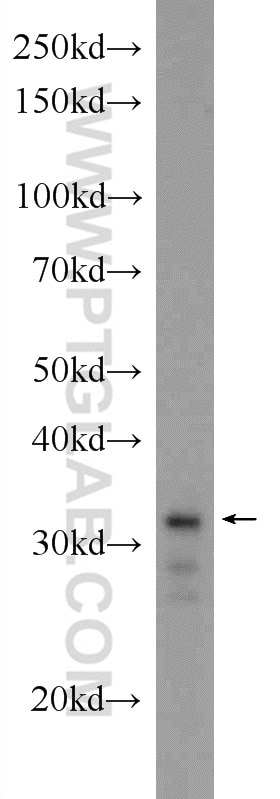



Tested Applications
| Positive WB detected in | HepG2 cells, HEK-293 cells, Jurkat cells, Raji cells |
| Positive IHC detected in | human breast cancer tissue, mouse liver tissue, human colon cancer tissue, human liver cancer tissue Note: suggested antigen retrieval with TE buffer pH 9.0; (*) Alternatively, antigen retrieval may be performed with citrate buffer pH 6.0 |
| Positive FC (Intra) detected in | HepG2 cells |
Recommended dilution
| Application | Dilution |
|---|---|
| Western Blot (WB) | WB : 1:1000-1:5000 |
| Immunohistochemistry (IHC) | IHC : 1:50-1:500 |
| Flow Cytometry (FC) (INTRA) | FC (INTRA) : 0.40 ug per 10^6 cells in a 100 µl suspension |
| It is recommended that this reagent should be titrated in each testing system to obtain optimal results. | |
| Sample-dependent, Check data in validation data gallery. | |
Product Information
24168-1-AP targets XBP1S/XBP1U in WB, IHC, IF, FC (Intra), ChIP, ELISA applications and shows reactivity with human, mouse samples.
| Tested Reactivity | human, mouse |
| Cited Reactivity | human, mouse, rat |
| Host / Isotype | Rabbit / IgG |
| Class | Polyclonal |
| Type | Antibody |
| Immunogen |
CatNo: Ag21454 Product name: Recombinant human XBP1 protein Source: e coli.-derived, PET30a Tag: 6*His Domain: 1-167 aa of BC000938 Sequence: MVVVAAAPNPADGTPKVLLLSGQPASAAGAPAGQALPLMVPAQRGASPEAASGGLPQARKRQRLTHLSPEEKALRRKLKNRVAAQTARDRKKARMSELEQQVVDLEEENQKLLLENQLLREKTHGLVVENQELRQRLGMDALVAEEEAEAKGNEVRPVAGSAESAAL Predict reactive species |
| Full Name | X-box binding protein 1 |
| Calculated Molecular Weight | 261 aa, 29 kDa |
| Observed Molecular Weight | ~32 kDa; ~60 kDa |
| GenBank Accession Number | BC000938 |
| Gene Symbol | XBP1 |
| Gene ID (NCBI) | 7494 |
| RRID | AB_2879445 |
| Conjugate | Unconjugated |
| Form | Liquid |
| Purification Method | Antigen Affinity purified |
| UNIPROT ID | P17861 |
| Storage Buffer | PBS with 0.02% sodium azide and 50% glycerol, pH 7.3. |
| Storage Conditions | Store at -20°C. Stable for one year after shipment. Aliquoting is unnecessary for -20oC storage. 20ul sizes contain 0.1% BSA. |
Background Information
XBP1 is also named as XBP2, belongs to the bZIP family. The X-box-binding protein-1 (XBP1) is a transcriptional regulator of the ER stress response that lies downstream of inositol-requiring enzyme 1 (IRE1α) activation (PMID: 14559994). IRE1α possesses both kinase and ribonuclease activity and processes XBP1 mRNA to produce an active transcription factor in response to ER stress (PMID: 11779464, 11780124). It has been found that upon accumulation of unfolded proteins in the endoplasmic reticulum, the mRNA of this gene is processed to an active form by an unconventional splicing mechanism that is mediated by the endonuclease inositol-requiring enzyme 1. The resulting loss of 26 nt from the spliced mRNA causes a frame-shift and an isoform XBP1S, which is the functionally active transcription factor. The isoform encoded by the unspliced mRNA, XBP1U, is constitutively expressed, and thought to function as a negative feedback regulator of XBP1S, which shuts off transcription of target genes during the recovery phase of ER stress (PMID: 11850408). The unspliced XBP1U isoform is composed of 261 amino acid residues, and the spliced XBP1S isoform is composed of 376 amino acid residues. The XBP1 antibody (24168-1-AP) can detect both XBP1U and XBP1S.
Protocols
| Product Specific Protocols | |
|---|---|
| FC protocol for XBP1S/XBP1U antibody 24168-1-AP | Download protocol |
| IHC protocol for XBP1S/XBP1U antibody 24168-1-AP | Download protocol |
| WB protocol for XBP1S/XBP1U antibody 24168-1-AP | Download protocol |
| Standard Protocols | |
|---|---|
| Click here to view our Standard Protocols |
Publications
What published studies show
The XBP1S/XBP1U Polyclonal antibody (Cat# 24168-1-AP) has 33 citations. They appear in journals including Nature Chemical Biology, ACS Nano, Theranostics, Journal of Experimental & Clinical Cancer Research, Cell Death & Disease, Cancer Letters, Phytomedicine, mSystems, Journal of Virology, Molecular Carcinogenesis, and Brain Research. Research fields center on endoplasmic reticulum stress and the unfolded protein response (IRE1/XBP1), spanning cancer (NSCLC, melanoma, colorectal, breast), liver fibrosis, diabetic kidney disease, atherosclerosis, neuroprotection, and viral infection.
| Species | Application | Title |
|---|---|---|
ACS Nano Cellular Adaptive Component-Mediated Targeting of Chylomicron-Mimic Nanoemulsion to Hepatic Stellate Cells for Liver Fibrosis. | ||
Nat Chem Biol A natural small molecule alleviates liver fibrosis by targeting apolipoprotein L2 | ||
Nat Chem Biol A small molecule targets LIC1 to suppress lung tumor growth by inducing autophagy. | ||
Theranostics Endothelial KSR2 regulated by genetic variation protects against atherosclerosis through AMPKα1 stabilization. | ||
J Exp Clin Cancer Res Calreticulin promotes EMT in pancreatic cancer via mediating Ca2+ dependent acute and chronic endoplasmic reticulum stress. | ||
Cell Death Dis Targeting the SYVN1-EGFR axis: a breakthrough strategy for TKI-resistant NSCLC. |
Reviews
What customers say
The product received one review with a 4-star rating. The reviewer reported using the antibody in an antibody array to identify proteins in human EDTA plasma, indicating its suitability for protein detection applications in plasma samples. Overall, the feedback reflects a positive experience with the reagent's performance in array-based protein identification.
The reviews below have been submitted by verified Proteintech customers who received an incentive for providing their feedback.
Carly (Verified Customer) (09-27-2019) | Used in an antibody array to identify proteins in human EDTA plasma.
|



