

Tested Applications
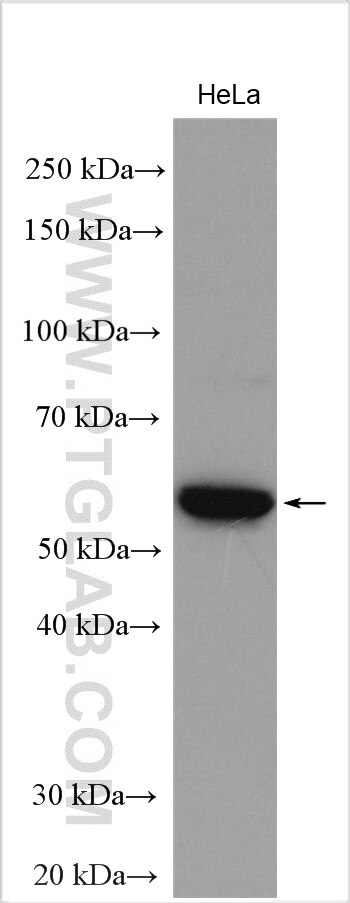
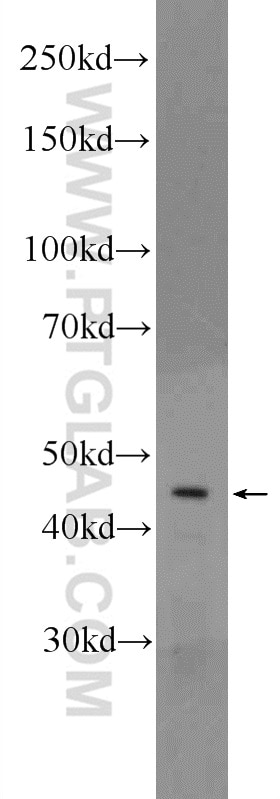
| Positive WB detected in | HeLa cells, SH-SY5Y cells |
Recommended dilution
| Application | Dilution |
|---|---|
| Western Blot (WB) | WB : 1:200-1:1000 |
| It is recommended that this reagent should be titrated in each testing system to obtain optimal results. | |
| Sample-dependent, Check data in validation data gallery. | |
Product Information
20967-1-AP targets CRHR1 in WB, IF, ELISA applications and shows reactivity with human samples.
| Tested Reactivity | human |
| Cited Reactivity | human |
| Host / Isotype | Rabbit / IgG |
| Class | Polyclonal |
| Type | Antibody |
| Immunogen |
Peptide Predict reactive species |
| Full Name | corticotropin releasing hormone receptor 1 |
| Calculated Molecular Weight | 48 kDa |
| Observed Molecular Weight | 46-55 kDa |
| GenBank Accession Number | NM_004382 |
| Gene Symbol | CRHR1 |
| Gene ID (NCBI) | 1394 |
| RRID | AB_2878776 |
| Conjugate | Unconjugated |
| Form | Liquid |
| Purification Method | Antigen affinity purification |
| UNIPROT ID | P34998 |
| Storage Buffer | PBS with 0.02% sodium azide and 50% glycerol, pH 7.3. |
| Storage Conditions | Store at -20°C. Stable for one year after shipment. Aliquoting is unnecessary for -20oC storage. 20ul sizes contain 0.1% BSA. |
Background Information
Corticotropin-releasing hormone (CRH, also known as Corticotropin-releasing factor, CRF) is a 41 amino acid peptide hormone and a key regulator of the stress response. CRH and the related urocortin peptides (UCN, UCN2 and UCN3) mediate their actions through two mammalian receptor subtypes, CRHR1 and CRHR2 (PMID: 23863939). CRHR1 (also known as CRFR1) exhibits high affinity towards CRH and UCN but low affinity towards UCN2 and no affinity towards UCN3 (PMID: 22684850). The activity of this receptor is mediated by G proteins which activate adenylyl cyclase. Widely distributed throughout the brain, CRHR1 critically controls behavioral adaptation to stress and is causally linked to emotional disorders (PMID: 21885734). Alternative splicing results in multiple transcript variants encoding distinct isoforms of CRHR1. This antibody raised against a synthesized peptide corresponding to amino acid residues 148-165 of isoform CRF-R1 can only recognize isoform CRF-R1.
Protocols
| Product Specific Protocols | |
|---|---|
| WB protocol for CRHR1 antibody 20967-1-AP | Download protocol |
| Standard Protocols | |
|---|---|
| Click here to view our Standard Protocols |
Publications
What published studies show
CRH Antibody (Cat# 20967-1-AP) has 15 citations published in journals including Nature Biotechnology, Neuron, PNAS, Food Research International, International Journal of Molecular Medicine, Pharmaceuticals, Brain Research Bulletin, Journal of Gastroenterology and Hepatology, Reproductive Toxicology, Neurogastroenterology and Motility, and others. Research fields span neuroscience (stress response, addiction, fear), gastroenterology (gut barrier, IBS), reproductive biology, and oncology.
| Species | Application | Title |
|---|---|---|
Nat Biotechnol Generation of locus coeruleus norepinephrine neurons from human pluripotent stem cells | ||
Neuron Corticotropin-releasing hormone signaling from piriform cortex to amygdala mediates social homophily in opioid addiction | ||
Proc Natl Acad Sci U S A Overactivation of corticotropin-releasing factor receptor type 1 and aquaporin-4 by hypoxia induces cerebral edema. | ||
Food Res Int Lactobacillus reuteri or Lactobacillus rhamnosus GG intervention facilitates gut barrier function, decreases corticosterone and ameliorates social behavior in LPS-exposed offspring | ||
Int J Mol Med Sini San ameliorates duodenal mucosal barrier injury and low‑grade inflammation via the CRF pathway in a rat model of functional dyspepsia. | ||
Pharmaceuticals (Basel) A Novel Mast Cell Stabilizer JM25-1 Rehabilitates Impaired Gut Barrier by Targeting the Corticotropin-Releasing Hormone Receptors |



