
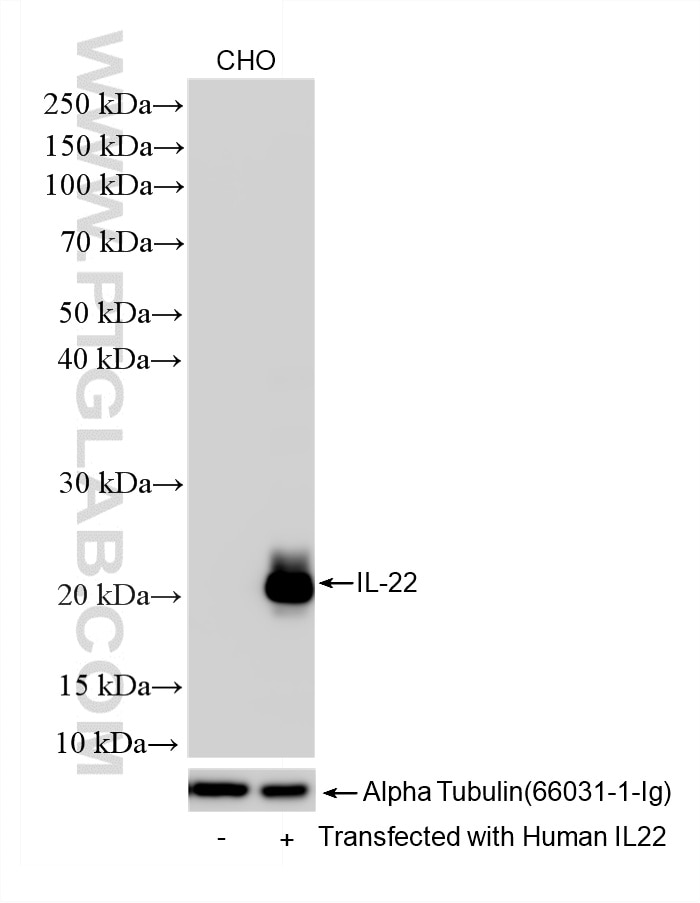
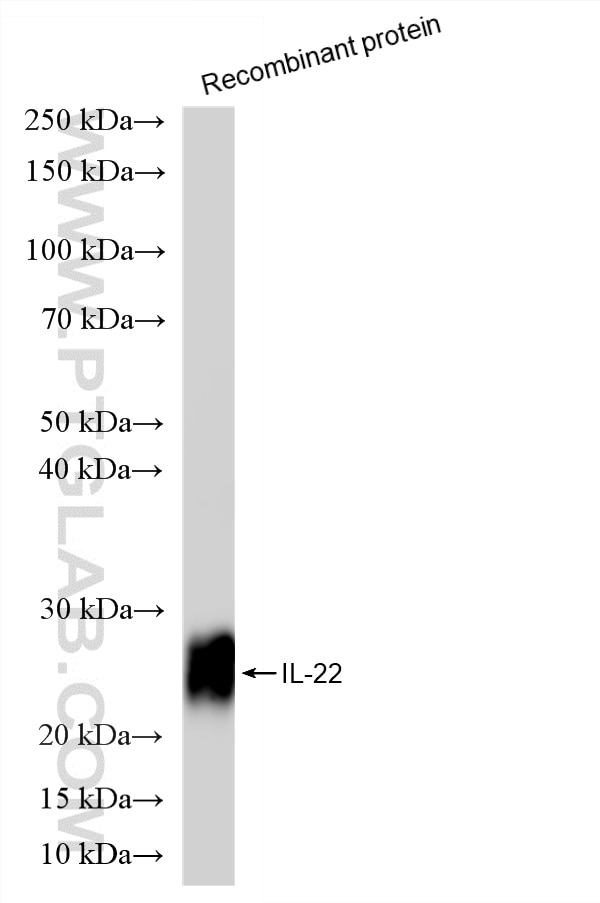
Tested Applications
| Positive WB detected in | Transfected with Human IL22 CHO cells, Recombinant protein |
Recommended dilution
| Application | Dilution |
|---|---|
| Western Blot (WB) | WB : 1:2000-1:10000 |
| It is recommended that this reagent should be titrated in each testing system to obtain optimal results. | |
| Sample-dependent, Check data in validation data gallery. | |
Product Information
82766-15-RR targets IL-22 in WB, ELISA applications and shows reactivity with human samples.
| Tested Reactivity | human |
| Cited Reactivity | mouse |
| Host / Isotype | Rabbit / IgG |
| Class | Recombinant |
| Type | Antibody |
| Immunogen |
Recombinant protein Predict reactive species |
| Full Name | interleukin 22 |
| Observed Molecular Weight | 20 kDa |
| GenBank Accession Number | BC066263 |
| Gene Symbol | IL-22 |
| Gene ID (NCBI) | 50616 |
| RRID | AB_3743428 |
| Conjugate | Unconjugated |
| Form | Liquid |
| Purification Method | Protein A purification |
| UNIPROT ID | Q9GZX6 |
| Storage Buffer | PBS with 0.02% sodium azide and 50% glycerol, pH 7.3. |
| Storage Conditions | Store at -20°C. Stable for one year after shipment. Aliquoting is unnecessary for -20oC storage. 20ul sizes contain 0.1% BSA. |
Background Information
Interleukin-22 (IL-22) is a member of the IL-10 cytokine family, primarily produced by immune cells such as group 3 innate lymphoid cells (ILC3s), Th17 cells, Th22 cells, and γδ T cells (PMID: 25706098). Its unique feature lies in targeting non-immune epithelial and stromal cells, which exclusively express the heterodimeric IL-22 receptor (IL-22R1 and IL-10R2). IL-22 plays a dual role in immunity and tissue homeostasis: it promotes epithelial cell proliferation, regeneration, and barrier integrity through the upregulation of antimicrobial peptides (e.g., defensins) and mucin production, thereby enhancing defense against extracellular pathogens. However, IL-22 can also drive pathological inflammation in autoimmune and chronic inflammatory diseases (e.g., psoriasis, colitis) when dysregulated. This functional dichotomy highlights its context-dependent nature as both a protective mediator and a pathogenic effector (PMID: 20498020).
Protocols
| Product Specific Protocols | |
|---|---|
| WB protocol for IL-22 antibody 82766-15-RR | Download protocol |
| Standard Protocols | |
|---|---|
| Click here to view our Standard Protocols |
Publications
What published studies show
| Species | Application | Title |
|---|---|---|
Int J Mol Sci 20(S/R)-Ginsenoside Rh1 Alleviates AOM/DSS-Induced Colorectal Cancer: Gut-Microbiota Modulation and Tryptophan-Metabolism-Mediated AhR/PXR Activation and IDO1. | ||
Int J Biol Macromol Multi-omics insights into anti-colitis benefits of the synbiotic and postbiotic derived from wheat bran arabinoxylan and Limosilactobacillus reuteri. |



