

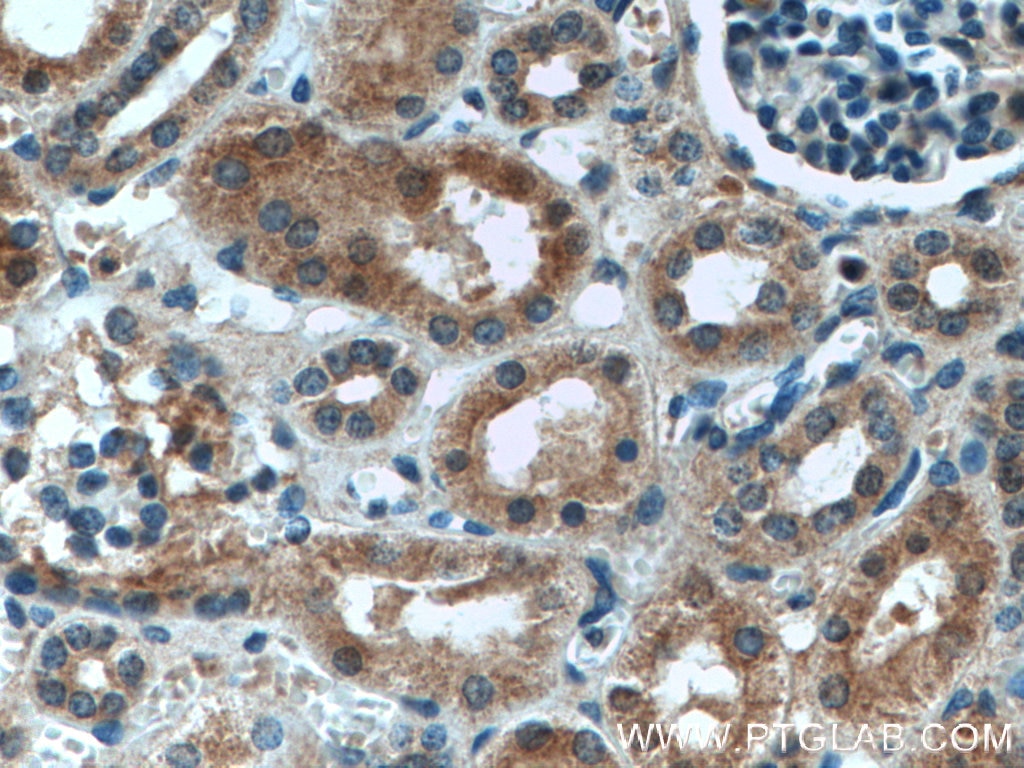

Tested Applications
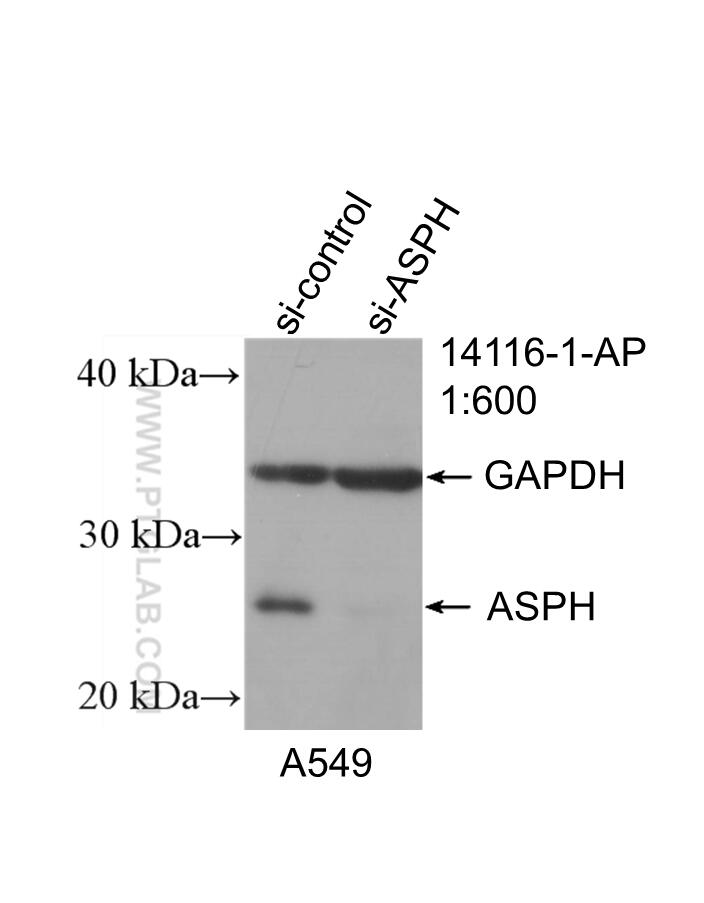
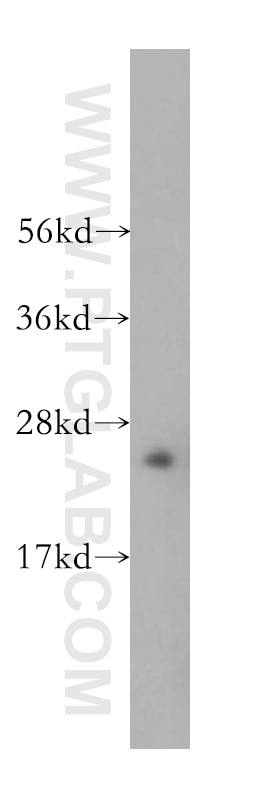
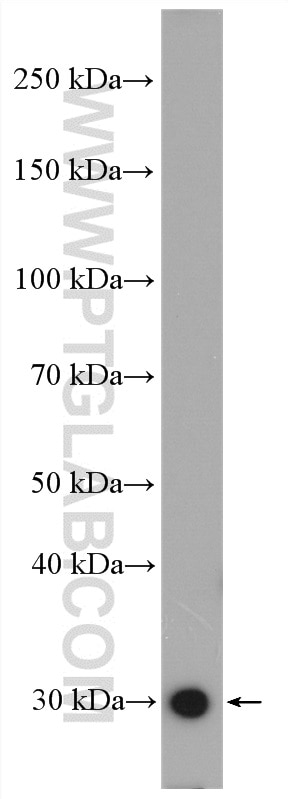
| Positive WB detected in | mouse brain tissue, A549 cells, human brain tissue, rat brain tissue |
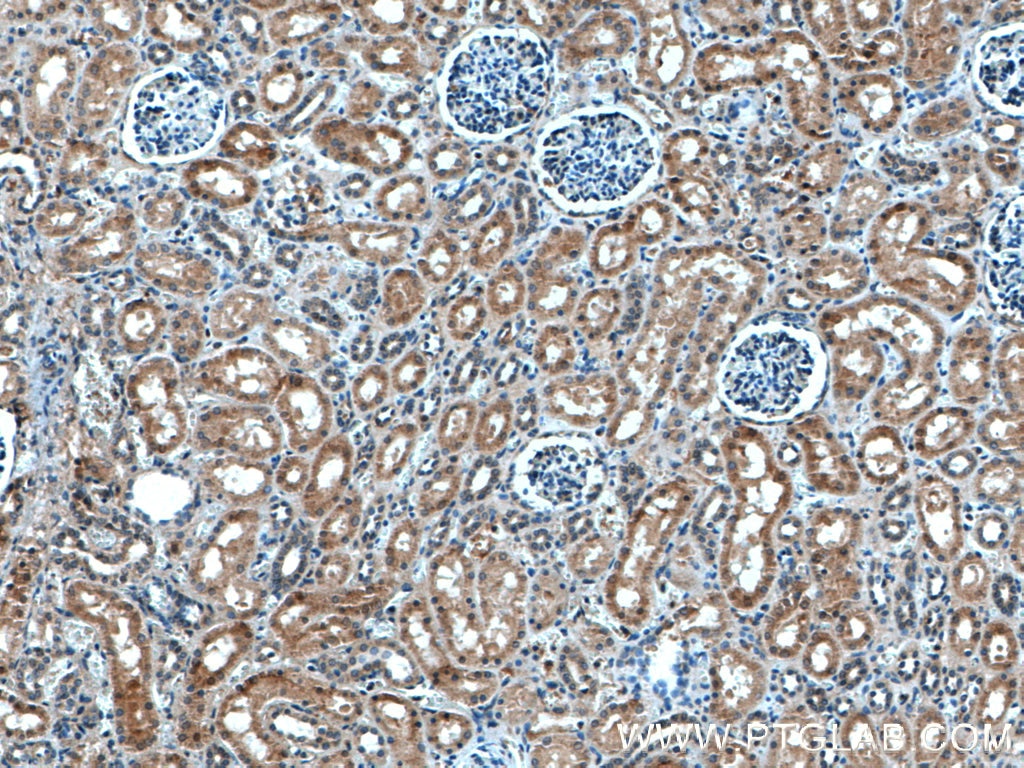
| Positive IHC detected in | human kidney tissue Note: suggested antigen retrieval with TE buffer pH 9.0; (*) Alternatively, antigen retrieval may be performed with citrate buffer pH 6.0 |
Recommended dilution
| Application | Dilution |
|---|---|
| Western Blot (WB) | WB : 1:1000-1:6000 |
| Immunohistochemistry (IHC) | IHC : 1:50-1:500 |
| It is recommended that this reagent should be titrated in each testing system to obtain optimal results. | |
| Sample-dependent, Check data in validation data gallery. | |
Product Information
14116-1-AP targets ASPH in WB, IHC, ELISA applications and shows reactivity with human, mouse, rat samples.
| Tested Reactivity | human, mouse, rat |
| Cited Reactivity | human, rat |
| Host / Isotype | Rabbit / IgG |
| Class | Polyclonal |
| Type | Antibody |
| Immunogen |
CatNo: Ag5265 Product name: Recombinant human ASPH protein Source: e coli.-derived, PGEX-4T Tag: GST Domain: 1-203 aa of BC066929 Sequence: MAQRKNAKSSGNSSSSGSGSGSTSAGSSSPGARRETKHGGHKNGRKGGLSGTSFFTWFMVIALLGVWTSVAVVWFDLVDYEEVLAKAKDFRYNLSEVLQGKLGIYDADGDGDFDVDDAKVLLGLTKDGSNENIDSLEEVLNILAEESSDWFYGFLSFLYDIMTPFEMLEEEEEESETADGVDGTSQNEGVQGKTCVILDLHNQ Predict reactive species |
| Full Name | aspartate beta-hydroxylase |
| Calculated Molecular Weight | 86 kDa |
| Observed Molecular Weight | 26 kDa |
| GenBank Accession Number | BC066929 |
| Gene Symbol | ASPH |
| Gene ID (NCBI) | 444 |
| RRID | AB_2060148 |
| Conjugate | Unconjugated |
| Form | Liquid |
| Purification Method | Antigen affinity purification |
| UNIPROT ID | Q12797 |
| Storage Buffer | PBS with 0.02% sodium azide and 50% glycerol, pH 7.3. |
| Storage Conditions | Store at -20°C. Stable for one year after shipment. Aliquoting is unnecessary for -20oC storage. 20ul sizes contain 0.1% BSA. |
Background Information
Aspartate-β-hydroxylase (ASPH; termed AAH in older literature) has been implicated in the cross-talk among all of these signaling pathways. Correspondingly, ASPH is expressed at high levels in many malignant neoplasms of different histogeneses. It has the 86-141 kDa bands (native and phosphorylated forms), cleavage products of 35-56 and 22-26 kDa.(PMID:27981247/PMID: 10956665)
Protocols
| Product Specific Protocols | |
|---|---|
| IHC protocol for ASPH antibody 14116-1-AP | Download protocol |
| WB protocol for ASPH antibody 14116-1-AP | Download protocol |
| Standard Protocols | |
|---|---|
| Click here to view our Standard Protocols |
Publications
What published studies show
ASPH (Aspartate β-Hydroxylase) antibody, catalog number 14116-1-AP, has 6 total citations. These appear in EBioMedicine, Biochemical Pharmacology, Journal of Immunological Research, Scientific Progress, Heliyon, and BMC Medical Genomics. Research fields span hepatocellular carcinoma metastasis via EMT, hepatic fibrosis, HCC immunotherapy, lung adenocarcinoma prognosis modeling, pan-adenocarcinoma diagnosis and immunotherapy, and vascular smooth muscle phenotypic switching in aortic dissection.
| Species | Application | Title |
|---|---|---|
EBioMedicine Hydroxylase Activity of ASPH Promotes Hepatocellular Carcinoma Metastasis Through Epithelial-to-Mesenchymal Transition Pathway.
| ||
Biochem Pharmacol Inhibition of circular RNA ASPH reduces the proliferation and promotes the apoptosis of hepatic stellate cells in hepatic fibrosis | ||
J Immunol Res Construction and Characterization of Adenovirus Vectors Encoding Aspartate-β-Hydroxylase to Preliminary Application in Immunotherapy of Hepatocellular Carcinoma. | ||
Sci Prog A model of coagulation-related genes for prediction of prognosis in lung adenocarcinoma and verification in vitro.
| ||
Heliyon Labyrinthin: A distinct pan-adenocarcinoma diagnostic and immunotherapeutic tumor specific antigen. | ||
BMC Med Genomics Loss of CASQ2 promotes vascular smooth muscle cell phenotypic switching in aortic dissection uncovered by integrated single-cell transcriptomics. |







