

Tested Applications
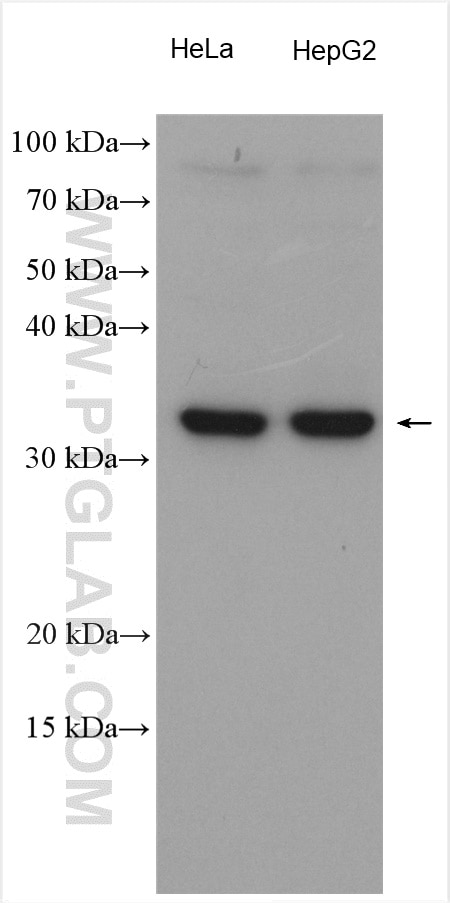
| Positive WB detected in | HeLa cells, HepG2 cells |
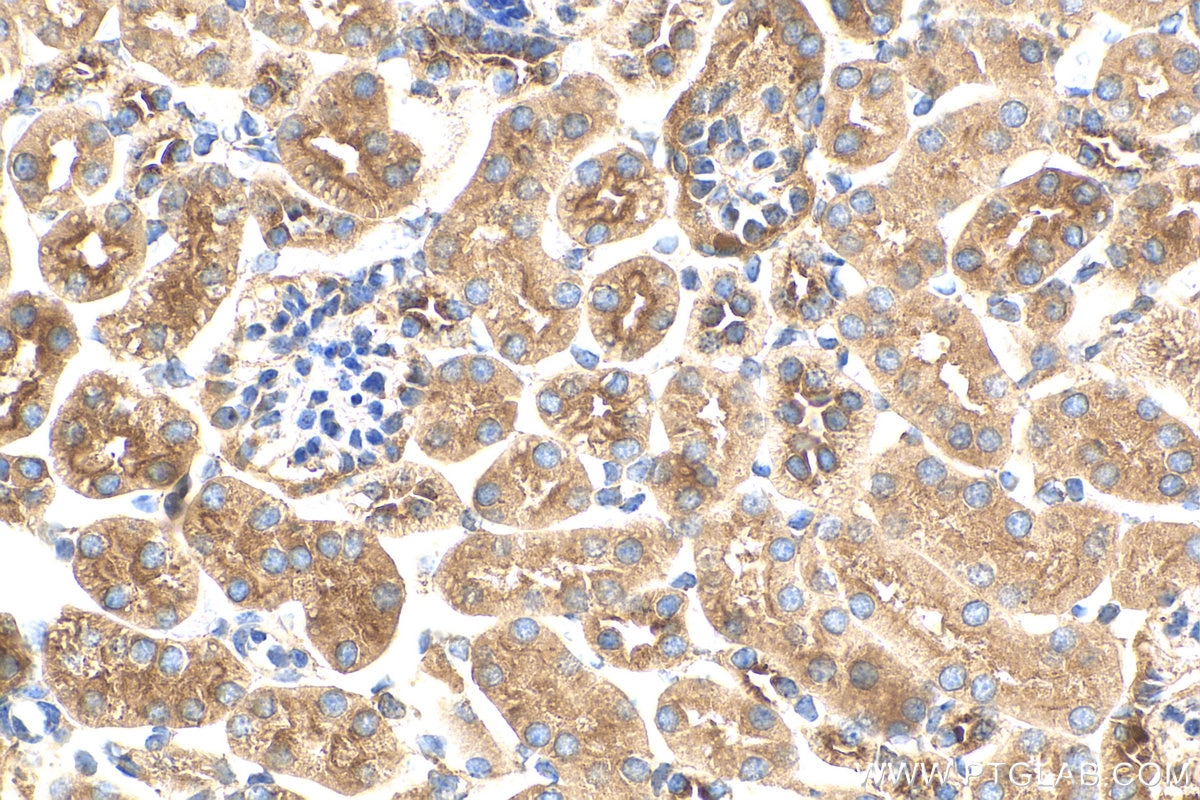
| Positive IHC detected in | mouse kidney tissue Note: suggested antigen retrieval with TE buffer pH 9.0; (*) Alternatively, antigen retrieval may be performed with citrate buffer pH 6.0 |
Recommended dilution
| Application | Dilution |
|---|---|
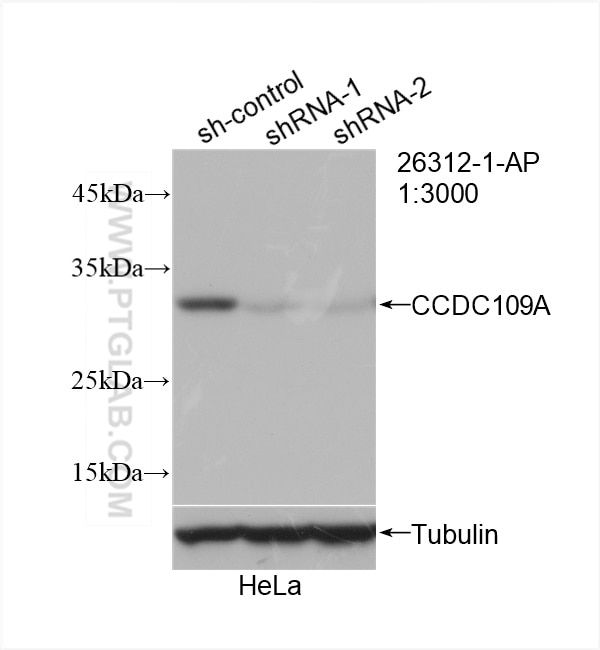
| Western Blot (WB) | WB : 1:2000-1:12000 |
| Immunohistochemistry (IHC) | IHC : 1:50-1:500 |
| It is recommended that this reagent should be titrated in each testing system to obtain optimal results. | |
| Sample-dependent, Check data in validation data gallery. | |
Product Information
26312-1-AP targets MCU/CCDC109A in WB, IHC, IF, IP, ELISA applications and shows reactivity with human, mouse samples.
| Tested Reactivity | human, mouse |
| Cited Reactivity | human, mouse, rat |
| Host / Isotype | Rabbit / IgG |
| Class | Polyclonal |
| Type | Antibody |
| Immunogen |
CatNo: Ag24733 Product name: Recombinant human CCDC109A protein Source: e coli.-derived, PGEX-4T Tag: GST Domain: 155-233 aa of BC034235 Sequence: DLTYHVRPPKRDLLSHENAATLNDVKTLVQQLYTTLCIEQHQLNKERELIERLEDLKEQLAPLEKVRIEISRKAEKRTT Predict reactive species |
| Full Name | coiled-coil domain containing 109A |
| Calculated Molecular Weight | 35 kDa |
| Observed Molecular Weight | 30-35 kDa |
| GenBank Accession Number | BC034235 |
| Gene Symbol | CCDC109A |
| Gene ID (NCBI) | 90550 |
| RRID | AB_2880474 |
| Conjugate | Unconjugated |
| Form | Liquid |
| Purification Method | Antigen affinity purification |
| UNIPROT ID | Q8NE86 |
| Storage Buffer | PBS with 0.02% sodium azide and 50% glycerol, pH 7.3. |
| Storage Conditions | Store at -20°C. Stable for one year after shipment. Aliquoting is unnecessary for -20oC storage. 20ul sizes contain 0.1% BSA. |
Background Information
MCU, also known as CCDC109A, is highly conserved across all eukaryotes. The MCU protein is composed of two coiled-coil domains, two TMDs, and a short motif of amino acids between the two TMDs. Knockdown of MCU dramatically reduces mitochondrial Ca2+ uptake in isolated mitochondria, in permeabilized cells and living cells. MCU has 3 isoforms with MW 40,37 and 35 kDa (refer to UniProt). The observed MW of MCU is mainly between 30 to 35 kDa in paper (PMID: 26341627; 28337252).
Protocols
| Product Specific Protocols | |
|---|---|
| IHC protocol for MCU/CCDC109A antibody 26312-1-AP | Download protocol |
| WB protocol for MCU/CCDC109A antibody 26312-1-AP | Download protocol |
| Standard Protocols | |
|---|---|
| Click here to view our Standard Protocols |
Publications
What published studies show
The MCU/CCDC109A Polyclonal antibody (Cat# 26312-1-AP) has 52 citations across journals including Nature Biomedical Engineering, Nature Chemical Biology, Cell Reports, Cell Death & Differentiation, Free Radical Biology and Medicine, and Advanced Science. Research fields span mitochondrial calcium homeostasis, ER-mitochondria contact sites, cardiac ischemia-reperfusion injury, atherosclerosis, neurodegeneration (Alzheimer's, Parkinson's), ferroptosis, cancer, oxidative stress, and rheumatoid arthritis. Applications are predominantly Western blot, with some IF, IP, and IHC.
| Species | Application | Title |
|---|---|---|
Nat Biomed Eng Electro-metabolic coupling in multi-chambered vascularized human cardiac organoids | ||
Bioact Mater TLR2 inhibition attenuates NET-driven inflammation and restenosis during poly-lactic acid bioresorbable scaffold degradation. | ||
J Adv Res Sodium citrate targeting Ca2+/CAMKK2 pathway exhibits anti-tumor activity through inducing apoptosis and ferroptosis in ovarian cancer | ||
Redox Biol Nogo-B mediates endothelial oxidative stress and inflammation to promote coronary atherosclerosis in pressure-overloaded mouse hearts | ||
Nat Chem Biol CGI1746 targets σ1R to modulate ferroptosis through mitochondria-associated membranes | ||
Adv Sci (Weinh) Acetylation of the Mitochondrial Chaperone GRP75 Governs ER-Mitochondrial Calcium Homeostasis and Hepatocyte Insulin Resistance. |
Reviews
What customers say
The product received a 5-star rating from a reviewer who used it for Western Blot and reported that it works well with mouse cells. Overall, the feedback is positive, indicating reliable performance in its tested application.
The reviews below have been submitted by verified Proteintech customers who received an incentive for providing their feedback.
Jae (Verified Customer) (12-19-2025) | works well with mouse cells
|




