



Tested Applications
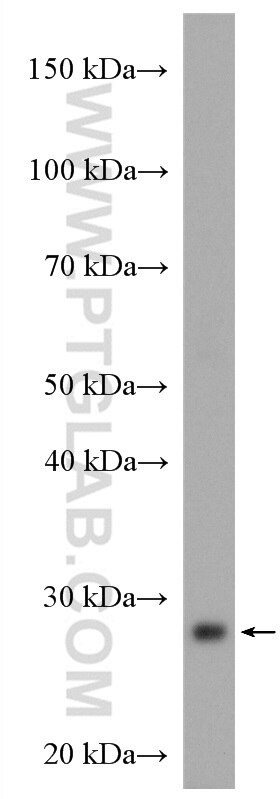
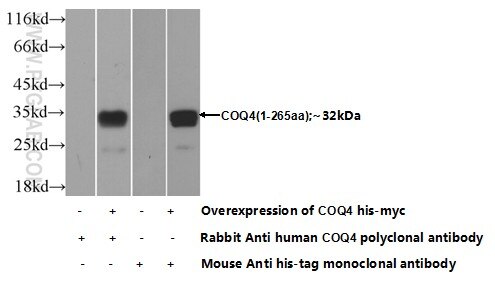
| Positive WB detected in | mouse liver tissue, Transfected HEK-293 cells |
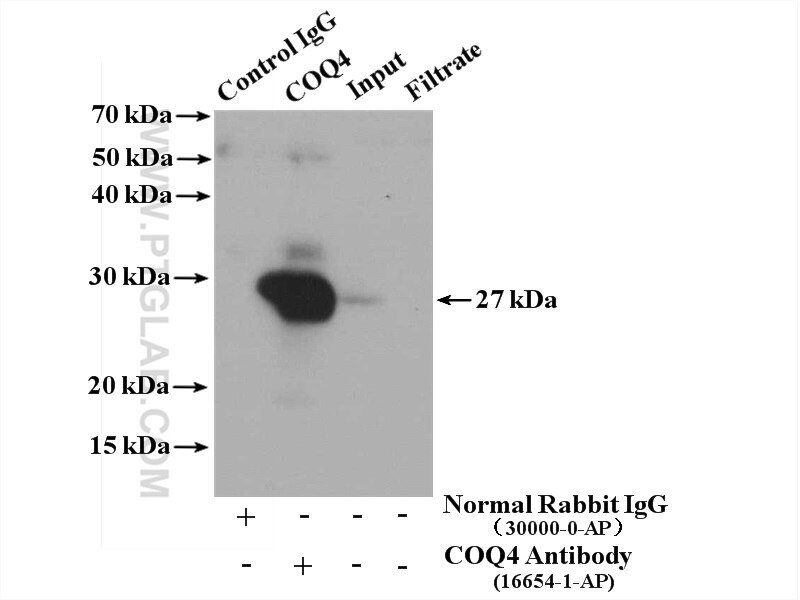
| Positive IP detected in | mouse liver tissue |
| Positive IHC detected in | human liver tissue, human pancreas tissue Note: suggested antigen retrieval with TE buffer pH 9.0; (*) Alternatively, antigen retrieval may be performed with citrate buffer pH 6.0 |
Recommended dilution
| Application | Dilution |
|---|---|
| Western Blot (WB) | WB : 1:500-1:2000 |
| Immunoprecipitation (IP) | IP : 0.5-4.0 ug for 1.0-3.0 mg of total protein lysate |
| Immunohistochemistry (IHC) | IHC : 1:50-1:500 |
| It is recommended that this reagent should be titrated in each testing system to obtain optimal results. | |
| Sample-dependent, Check data in validation data gallery. | |
Product Information
16654-1-AP targets COQ4 in WB, IHC, IF, IP, ELISA applications and shows reactivity with human, mouse, rat samples.
| Tested Reactivity | human, mouse, rat |
| Cited Reactivity | human, mouse |
| Host / Isotype | Rabbit / IgG |
| Class | Polyclonal |
| Type | Antibody |
| Immunogen |
CatNo: Ag10089 Product name: Recombinant human COQ4 protein Source: e coli.-derived, PGEX-4T Tag: GST Domain: 1-265 aa of BC011895 Sequence: MATLLRPVLRRLCGLPGLQRPAAEMPLRARSDGAGPLYSHHLPTSPLQKALLAAGSAAMALYNPYRHDMVAVLGETTGHRTLKVLRDQMRRDPEGAQILQERPRISTSTLDLGKLQSLPEGSLGREYLRFLDVNRVSPDTRAPTRFVDDEELAYVIQRYREVHDMLHTLLGMPTNILGEIVVKWFEAVQTGLPMCILGAFFGPIRLGAQSLQVLVSELIPWAVQNGRRAPCVLNLYYERRWEQSLRALREELGITAPPMHVQGLA Predict reactive species |
| Full Name | coenzyme Q4 homolog (S. cerevisiae) |
| Calculated Molecular Weight | 265 aa, 30 kDa |
| Observed Molecular Weight | 32 kDa |
| GenBank Accession Number | BC011895 |
| Gene Symbol | COQ4 |
| Gene ID (NCBI) | 51117 |
| RRID | AB_2878296 |
| Conjugate | Unconjugated |
| Form | Liquid |
| Purification Method | Antigen affinity purification |
| UNIPROT ID | Q9Y3A0 |
| Storage Buffer | PBS with 0.02% sodium azide and 50% glycerol, pH 7.3. |
| Storage Conditions | Store at -20°C. Stable for one year after shipment. Aliquoting is unnecessary for -20oC storage. 20ul sizes contain 0.1% BSA. |
Background Information
Human coenzyme Q4 (COQ4), as a component of the coenzyme Q biosynthetic pathway, is required for the oxidative decarboxylation of the C1 carbon of Coenzyme Q in eukaryotic cells (PMID: 38295803). COQ4 deficiency manifests as an early-onset neurodegenerative disorder. COQ4 encodes a ubiquitously expressed 265-amino-acid protein that is peripherally associated with the mitochondrial inner membrane on the matrix side (PMID: 25658047, 34656997)
Protocols
| Product Specific Protocols | |
|---|---|
| IHC protocol for COQ4 antibody 16654-1-AP | Download protocol |
| IP protocol for COQ4 antibody 16654-1-AP | Download protocol |
| WB protocol for COQ4 antibody 16654-1-AP | Download protocol |
| Standard Protocols | |
|---|---|
| Click here to view our Standard Protocols |
Publications
What published studies show
The COQ4 Polyclonal antibody (catalog number 16654-1-AP) has 16 citations. These appear in journals including Autophagy, Redox Biology, Pharmacological Research, Antioxidants, EMBO Molecular Medicine, Cell Reports, Communications Medicine, Journal of Biological Chemistry, Molecular Genetics and Metabolism, Annals of Clinical and Translational Neurology, Journal of Medical Genetics, Biochimica et Biophysica Acta Bioenergetics, Brain Development, and eLife. Research fields span CoQ10 biosynthesis and deficiency disorders, mitochondrial disease, lipid metabolism, autophagy, ferroptosis, and neurology. Applications are primarily Western blot and immunofluorescence in human and mouse models.
| Species | Application | Title |
|---|---|---|
Autophagy Autophagy regulates differentiation of ovarian granulosa cells through degradation of WT1 | ||
Redox Biol The Q-junction and the inflammatory response are critical pathological and therapeutic factors in CoQ deficiency. | ||
Pharmacol Res β-Resorcylic acid prevents MASLD in ob/ob mice by modulating lipid metabolism and inflammation in the liver | ||
Antioxidants (Basel) Evolution of COQ-Synthome Transcripts and CoQ Levels in Mice Tissues Along Aging: Effect of Resveratrol and Exercise | ||
Antioxidants (Basel) Resveratrol Regulates the Expression of Genes Involved in CoQ Synthesis in Liver in Mice Fed with High Fat Diet. | ||
EMBO Mol Med β-RA reduces DMQ/CoQ ratio and rescues the encephalopathic phenotype in Coq9 R239X mice. |






