
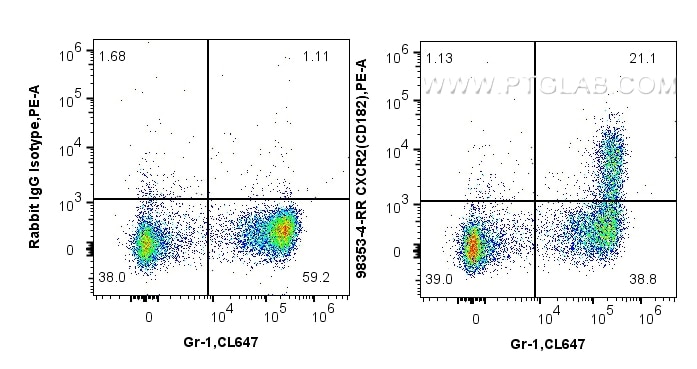
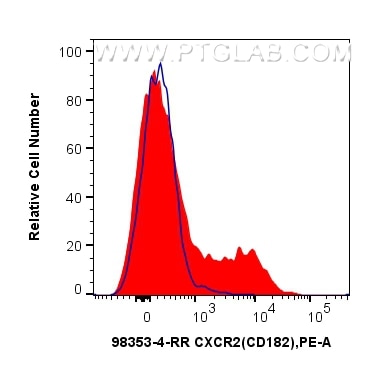

Tested Applications
| Positive FC detected in | mouse bone marrow cells |
Recommended dilution
| Application | Dilution |
|---|---|
| Flow Cytometry (FC) | FC : 0.25 ug per 10^6 cells in a 100 µl suspension |
| This reagent has been tested for flow cytometric analysis. It is recommended that this reagent should be titrated in each testing system to obtain optimal results. | |
| Sample-dependent, Check data in validation data gallery. | |
Product Information
98353-4-RR targets CXCR2 in FC applications and shows reactivity with mouse samples.
| Tested Reactivity | mouse |
| Host / Isotype | Rabbit / IgG |
| Class | Recombinant |
| Type | Antibody |
| Immunogen |
CatNo: Eg2228 Product name: Recombinant Mouse CXCR2 protein (rFc Tag) Source: mammalian cells-derived, pHZ-KIsec-N-rFc Tag: N-rFc Domain: 1-47 aa of NM_009909.3 Sequence: MGEFKVDKFNIEDFFSGDLDIFNYSSGMPSILPDAVPCHSENLEINS Predict reactive species |
| Full Name | interleukin 8 receptor, beta |
| Calculated Molecular Weight | 40 kDa |
| GenBank Accession Number | NM_009909.3 |
| Gene Symbol | Cxcr2 |
| Gene ID (NCBI) | 12765 |
| RRID | AB_3746003 |
| Conjugate | Unconjugated |
| Form | Liquid |
| Purification Method | Protein A purification |
| UNIPROT ID | P35343 |
| Storage Buffer | PBS with 0.09% sodium azide, pH 7.3. |
| Storage Conditions | Store at 2 - 8°C. Stable for one year after shipment. |
Background Information
CXCR2, also named as CD182, Cmkar2, Gpcr16, or Il8rb, belongs to the G-protein coupled receptor 1 family. CXCR2 is a receptor for interleukin-8, which is a powerful neutrophil chemotactic factor. Binding of IL-8 to the receptor causes activation of neutrophils. This response is mediated via a G-protein that activates a phosphatidylinositol-calcium second messenger system. CXCR2 binds to IL-8 with high affinity. CXCR2 also binds with high affinity to CXCL3, GRO/MGSA and NAP-2.
Protocols
| Product Specific Protocols | |
|---|---|
| FC protocol for CXCR2 antibody 98353-4-RR | Download protocol |
| Standard Protocols | |
|---|---|
| Click here to view our Standard Protocols |



