

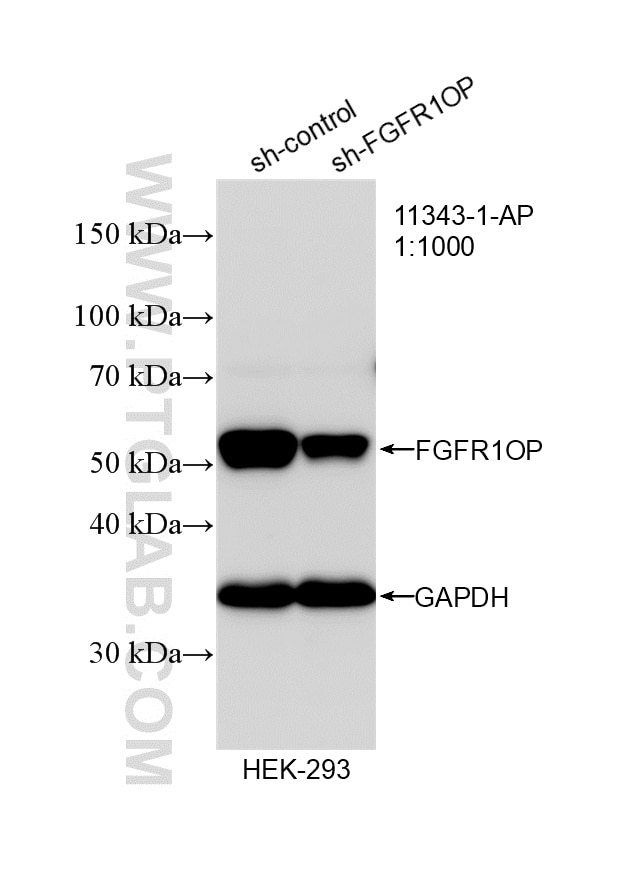



Tested Applications
| Positive WB detected in | HEK-293 cells, mouse heart tissue, U-937 cells, HL-60 cells, MCF-7 cells, HeLa cells |
| Positive IHC detected in | human lymphoma tissue Note: suggested antigen retrieval with TE buffer pH 9.0; (*) Alternatively, antigen retrieval may be performed with citrate buffer pH 6.0 |
| Positive IF/ICC detected in | HeLa cells, HEK-293 cells |
Recommended dilution
| Application | Dilution |
|---|---|
| Western Blot (WB) | WB : 1:5000-1:50000 |
| Immunohistochemistry (IHC) | IHC : 1:20-1:200 |
| Immunofluorescence (IF)/ICC | IF/ICC : 1:50-1:500 |
| It is recommended that this reagent should be titrated in each testing system to obtain optimal results. | |
| Sample-dependent, Check data in validation data gallery. | |
Product Information
11343-1-AP targets FGFR1OP in WB, IHC, IF/ICC, ELISA applications and shows reactivity with human, mouse, rat samples.
| Tested Reactivity | human, mouse, rat |
| Cited Reactivity | human, mouse, rat, zebrafish |
| Host / Isotype | Rabbit / IgG |
| Class | Polyclonal |
| Type | Antibody |
| Immunogen |
CatNo: Ag1891 Product name: Recombinant human FGFR1OP protein Source: e coli.-derived, PGEX-4T Tag: GST Domain: 1-374 aa of BC011902 Sequence: MAATAAAVVAEEDTELRDLLVQTLENSGVLNRIKAELRAAVFLALEEQEKVENKTPLVNESLRKFLNTKDGRLVASLVAEFLQFFNLDFTLAVFQPETSTLQGLEGRENLARDLGIIEAEGTVGGPLLLEVIRRCQQKEKGPTTGEGALDLSDVHSPPKSPEGKTSAQTTPSKKANDEANQSDTSVSLSEPKSKSSLHLLSHETKIGSFLSNRTLDGKDKAGLCPDEDDMEGDSFFDDPIPKPEKTYGLRNEPRKQAGSLASLSDAPPLKSGLSSLAGAPSLKDSESKRGNTVLKDLKLISDKIGSLGLGTGEDDDYVDDFNSTSHRSEKSEISIGEEIEEDLSVEIDDINTSDKLDDLTQDLTVSQLSDVADY Predict reactive species |
| Full Name | FGFR1 oncogene partner |
| Calculated Molecular Weight | 43 kDa |
| Observed Molecular Weight | 50 kDa |
| GenBank Accession Number | BC011902 |
| Gene Symbol | FGFR1OP |
| Gene ID (NCBI) | 11116 |
| RRID | AB_2103362 |
| Conjugate | Unconjugated |
| Form | Liquid |
| Purification Method | Antigen affinity purification |
| UNIPROT ID | O95684 |
| Storage Buffer | PBS with 0.02% sodium azide and 50% glycerol, pH 7.3. |
| Storage Conditions | Store at -20°C. Stable for one year after shipment. Aliquoting is unnecessary for -20oC storage. 20ul sizes contain 0.1% BSA. |
Background Information
The fibroblast growth factor receptor 1 oncogene partner (FGFR1OP), FOP, is a centrosomal protein that is involved in the anchoring of microtubules to subcellular structures. Three isoforms have been produced by alternative splicing. A chromosomal aberration involving FGFR1OP may be a cause of stem cell myeloproliferative disorder (MPD). MPD is characterized by myeloid hyperplasia, eosinophilia and T-cell or B-cell lymphoblastic lymphoma and progresses to acute myeloid leukemia.
Protocols
| Product Specific Protocols | |
|---|---|
| IF protocol for FGFR1OP antibody 11343-1-AP | Download protocol |
| IHC protocol for FGFR1OP antibody 11343-1-AP | Download protocol |
| WB protocol for FGFR1OP antibody 11343-1-AP | Download protocol |
| Standard Protocols | |
|---|---|
| Click here to view our Standard Protocols |
Publications
What published studies show
The FGFR1OP Polyclonal antibody (Cat# 11343-1-AP) has 28 citations spanning journals including Cell, Nature Communications, Cell Discovery, Developmental Cell, Cell Reports, Journal of Autoimmunity, Journal of Cell Biology, Development, Journal of Cell Science, Molecular Biology of the Cell, eLife, and others. Research fields covered include ciliogenesis, primary cilia signaling, centrosome biology, ciliopathies (e.g., short rib-polydactyly, polycystic kidney disease), neural stem cell biology, adipogenesis, T cell differentiation, and actin cytoskeletal remodeling.
| Species | Application | Title |
|---|---|---|
Nat Commun Microtubule asters anchored by FSD1 control axoneme assembly and ciliogenesis.
| ||
Cell Discov Loss-of-function variants in ODAD1 disrupt ODA docking and induce actin cytoskeletal remodeling in primary ciliary dyskinesia. | ||
Dev Cell Endoderm development requires centrioles to restrain p53-mediated apoptosis in the absence of ERK activity. | ||
Dev Cell The CEP19-RABL2 GTPase Complex Binds IFT-B to Initiate Intraflagellar Transport at the Ciliary Base. | ||
Cell Rep Neural stem cell relay from B1 to B2 cells in the adult mouse ventricular-subventricular zone. |




