
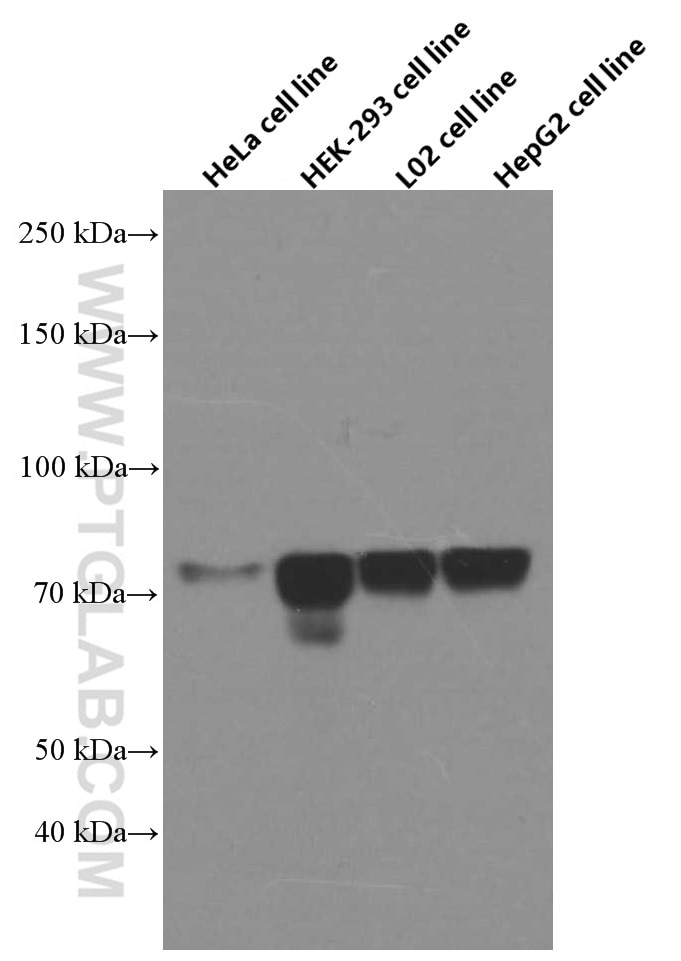
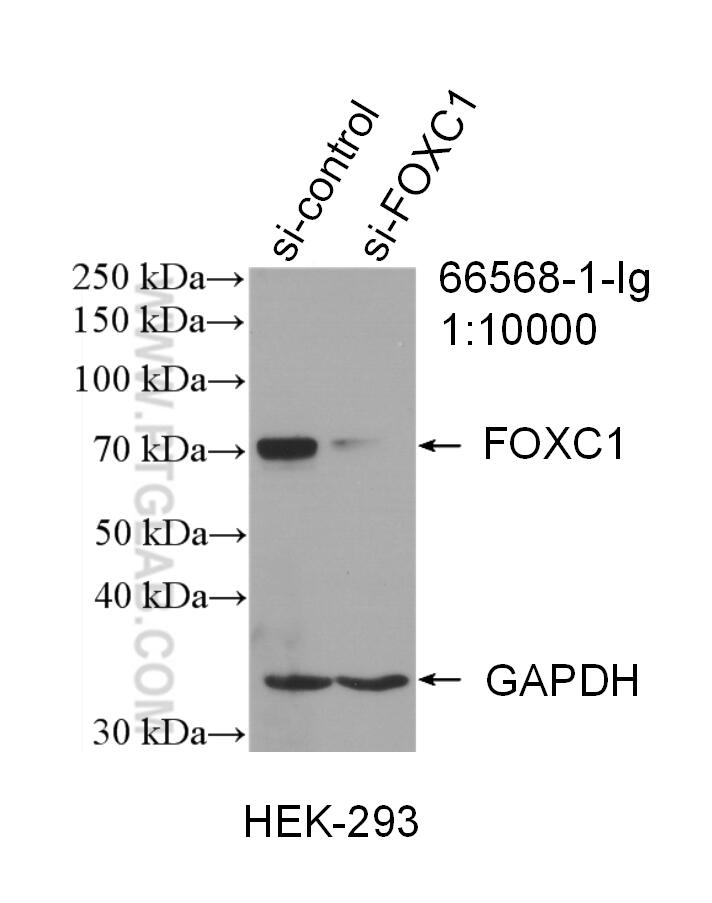

Tested Applications
| Positive WB detected in | HeLa cells, HEK-293 cells, HEK293 cells, L02 cells, HepG2 cells |
Recommended dilution
| Application | Dilution |
|---|---|
| Western Blot (WB) | WB : 1:2000-1:20000 |
| It is recommended that this reagent should be titrated in each testing system to obtain optimal results. | |
| Sample-dependent, Check data in validation data gallery. | |
Product Information
66568-1-Ig targets FOXC1 in WB, ELISA applications and shows reactivity with human samples.
| Tested Reactivity | human |
| Cited Reactivity | human |
| Host / Isotype | Mouse / IgG1 |
| Class | Monoclonal |
| Type | Antibody |
| Immunogen |
Peptide Predict reactive species |
| Full Name | forkhead box C1 |
| Calculated Molecular Weight | 57 kDa |
| Observed Molecular Weight | 70-75 kDa |
| GenBank Accession Number | NM_001453 |
| Gene Symbol | FOXC1 |
| Gene ID (NCBI) | 2296 |
| RRID | AB_2881929 |
| Conjugate | Unconjugated |
| Form | Liquid |
| Purification Method | Protein G purification |
| UNIPROT ID | Q12948 |
| Storage Buffer | PBS with 0.02% sodium azide and 50% glycerol, pH 7.3. |
| Storage Conditions | Store at -20°C. Stable for one year after shipment. Aliquoting is unnecessary for -20oC storage. 20ul sizes contain 0.1% BSA. |
Background Information
FOXC1, also named as FKHL7 and FREAC3, binding of FREAC-3 and FREAC-4 to their cognate sites results in bending of the DNA at an angle of 80-90 degrees. Defects in FOXC1 are the cause of Axenfeld-Rieger syndrome type 3 (RIEG3). Defects in FOXC1 are the cause of iridogoniodysgenesis anomaly (IGDA). Defects in FOXC1 are a cause of Peters anomaly.
Protocols
| Product Specific Protocols | |
|---|---|
| WB protocol for FOXC1 antibody 66568-1-Ig | Download protocol |
| Standard Protocols | |
|---|---|
| Click here to view our Standard Protocols |
Publications
What published studies show
The FOXC1 Monoclonal antibody (1F4E11), catalog number 66568-1-Ig, has a total of 1 citation. It appears in Journal of Advanced Research (IF 17.1), published in December 2025. The cited study, which used this antibody for Western Blot in human samples, focuses on diabetic wound healing, specifically exploring FBP1 as a novel therapeutic target and the role of asiatic acid-hydrogen sulfide donors in accelerating wound repair.
| Species | Application | Title |
|---|---|---|
J Adv Res Discovery of FBP1 as novel therapeutic target and asiatic acid-hydrogen sulfide donors accelerate diabetic wound healing. |



