
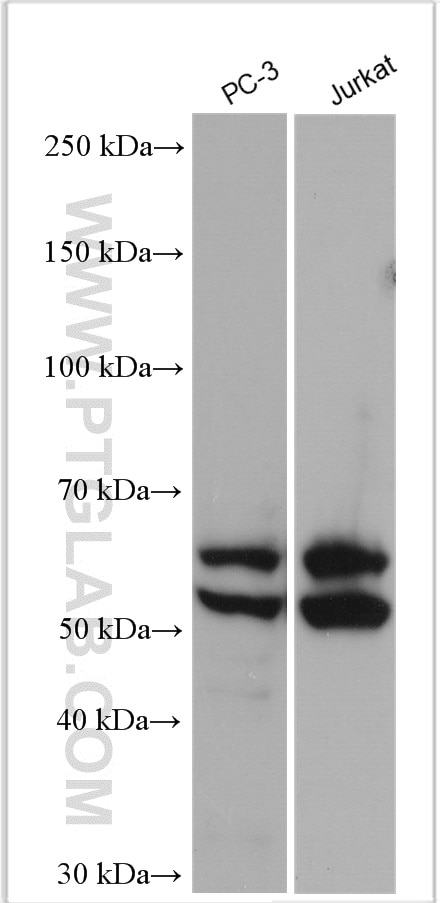
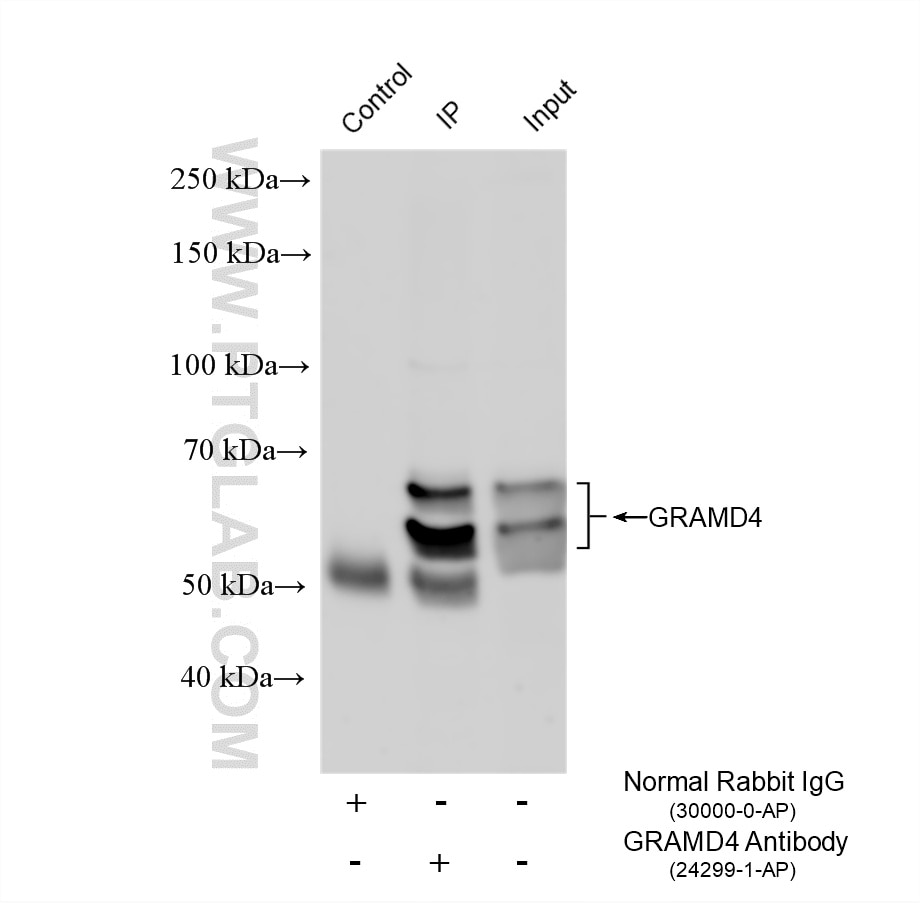
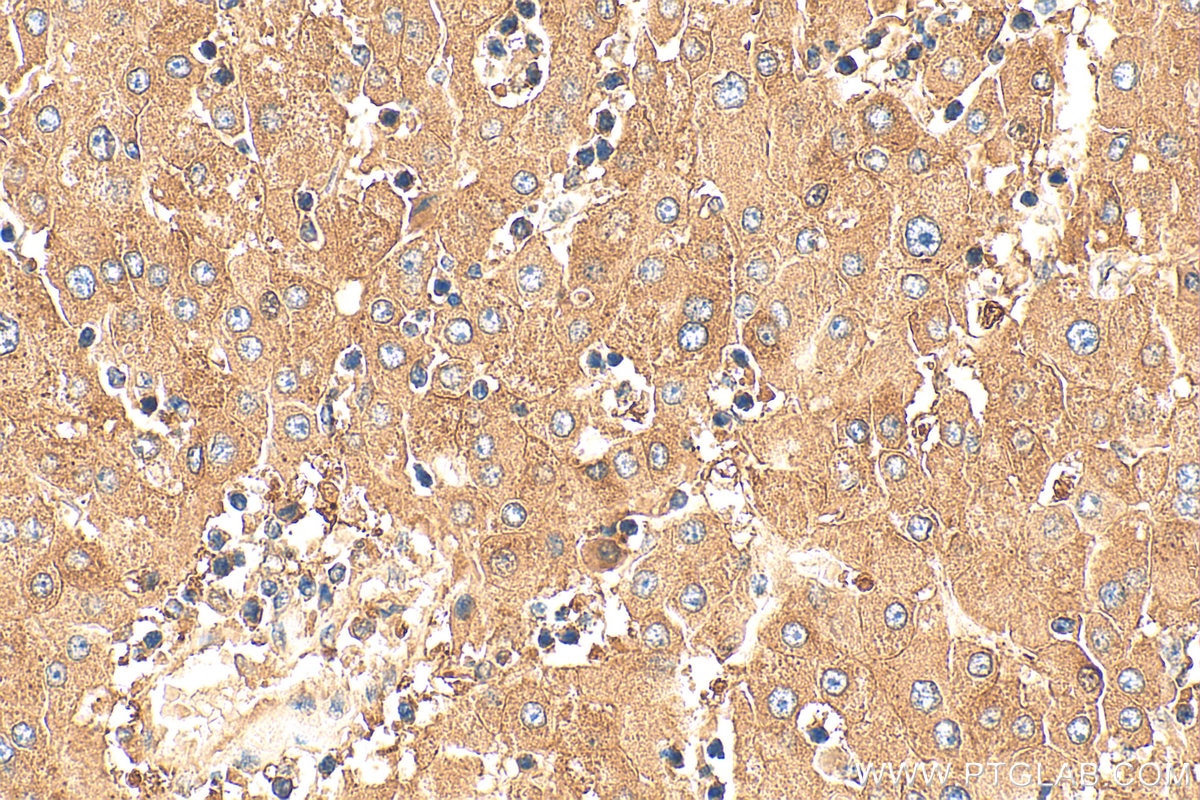

Tested Applications
| Positive WB detected in | PC-3 cells, Jurkat cells |
| Positive IHC detected in | human liver cancer tissue Note: suggested antigen retrieval with TE buffer pH 9.0; (*) Alternatively, antigen retrieval may be performed with citrate buffer pH 6.0 |
Recommended dilution
| Application | Dilution |
|---|---|
| Western Blot (WB) | WB : 1:500-1:1000 |
| Immunohistochemistry (IHC) | IHC : 1:50-1:500 |
| It is recommended that this reagent should be titrated in each testing system to obtain optimal results. | |
| Sample-dependent, Check data in validation data gallery. | |
Product Information
24299-1-AP targets GRAMD4 in WB, IHC, IF, IP, ELISA applications and shows reactivity with human samples.
| Tested Reactivity | human |
| Cited Reactivity | human |
| Host / Isotype | Rabbit / IgG |
| Class | Polyclonal |
| Type | Antibody |
| Immunogen |
CatNo: Ag19140 Product name: Recombinant human GRAMD4 protein Source: e coli.-derived, PET28a Tag: 6*His Domain: 479-578 aa of BC129837 Sequence: PTDYIRNGVLYVTENYLCFESSKSGSSKRNKVIKLVDITDIQKYKVLSVLPGSGMGIAVSTPSTQKPLVFGAMVHRDEAFETILSQYIKITSAAASGGDS Predict reactive species |
| Full Name | GRAM domain containing 4 |
| Calculated Molecular Weight | 578 aa, 66 kDa |
| Observed Molecular Weight | 56, 60 kDa |
| GenBank Accession Number | BC129837 |
| Gene Symbol | GRAMD4 |
| Gene ID (NCBI) | 23151 |
| RRID | AB_2879482 |
| Conjugate | Unconjugated |
| Form | Liquid |
| Purification Method | Antigen affinity purification |
| UNIPROT ID | Q6IC98 |
| Storage Buffer | PBS with 0.02% sodium azide and 50% glycerol, pH 7.3. |
| Storage Conditions | Store at -20°C. Stable for one year after shipment. Aliquoting is unnecessary for -20oC storage. 20ul sizes contain 0.1% BSA. |
Background Information
GRAMD4 also termed as Death inducing protein is a 578 amino-acid protein, which contains 1 GRAM domain. GRAMD4 as a multi-pass membrane protein localizes in the Mitochondrion membrane. Overexpression of GRAMD4 results in a strong apoptotic response involving caspase-3 activation and cleavage of poly(ADP-ribose)-polymerase. GRAMD4 is expressed in lung and in primary lung squamous cell carcinoma (LSCC) and shows up-regulation in mitochondria by E2F-1 after addition of 4-hydroxytamoxifen. This evidence suggests that GRAMD4 may be a potential target for cancer therapies. Full-length GRAMD4 expresses a protein of 66 kDa, whereas the 255 bp-deletion mutant expresses a protein of 56 kDa (PMID: 21127500).
Protocols
| Product Specific Protocols | |
|---|---|
| IHC protocol for GRAMD4 antibody 24299-1-AP | Download protocol |
| IP protocol for GRAMD4 antibody 24299-1-AP | Download protocol |
| WB protocol for GRAMD4 antibody 24299-1-AP | Download protocol |
| Standard Protocols | |
|---|---|
| Click here to view our Standard Protocols |
Publications
What published studies show
The GRAMD4 Polyclonal antibody (Cat# 24299-1-AP) has 2 citations. One appears in Cell Death Discovery (2025), investigating SUCLG2 knockdown in glioblastoma via LMNA acetylation and histone lactylation, using WB. The other is in Clinical and Translational Medicine (2021), demonstrating GRAMD4's role in inhibiting tumour metastasis in hepatocellular carcinoma through ITCH-mediated TAK1 degradation, validated by WB, IP, IHC, and IF. Both studies focus on human cancer biology, spanning neuro-oncology and liver cancer research.
| Species | Application | Title |
|---|---|---|
Cell Death Discov Knockdown of SUCLG2 inhibits glioblastoma proliferation and promotes apoptosis through LMNA acetylation and the mediation of H4K16la lactylation. | ||
Clin Transl Med GRAMD4 inhibits tumour metastasis by recruiting the E3 ligase ITCH to target TAK1 for degradation in hepatocellular carcinoma.
|




