
Human CCL5 ELISA Kit
Cat no : KE00093
Synonyms
C C motif chemokine 5, CCL5, chemokine (C C motif) ligand 5, D17S136E, EoCP, RANTES, SCYA5, SIS delta, SISd, Small inducible cytokine A5, T cell specific protein P228, TCP228
Validation Data Gallery
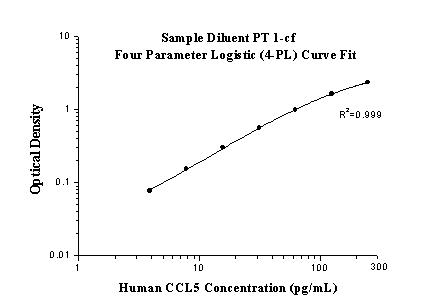
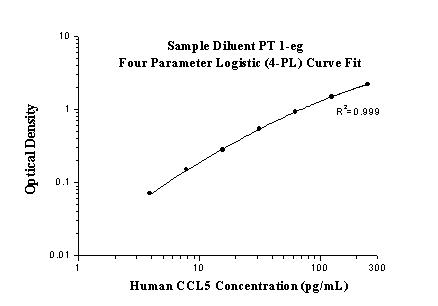
Product Information
KE00093 is a solid phase sandwich Enzyme Linked-Immuno-Sorbent Assay (Sandwich ELISA). The human CCL5 ELISA kit is to be used to detect and quantify protein levels of endogenous human CCL5. The assay recognizes human CCL5. An antibody specific for human CCL5 has been pre-coated onto the microwells. The human CCL5 protein in samples is captured by the coated antibody after incubation. Following extensive washing, another antibody of biotinylated specific for human CCL5 is added to detect the captured human CCL5 protein. For signal development, Streptavidin-HRP is added, followed by Tetramethyl-benzidine (TMB) reagent. Solution containing sulfuric acid is used to stop color development and the color intensity which is proportional to the quantity of bound protein is measurable at 450 nm with the correction wavelength set at 630 nm.
| Product name | Human CCL5 ELISA Kit |
| Tests | 1 X 96 well plate |
| Sample type | Serum, Plasma, Cell culture supernatants, Urine |
| Assay type | Sandwich |
| Sensitivity | 0.3 pg/mL |
| Range | 3.9 - 250 pg/mL |
| Reactivity | Human |
| Tested applications | Sandwich ELISA |
| Gene ID (NCBI) | 6352 |
Recovery
| Sample Type | Average | Range |
|---|---|---|
| Urine | 86% | 69%-107% |
| Human plasma | 94% | 80%-111% |
| Cell culture supernatants | 105% | 85%-121% |
IntraAssay
| Sample | n | mean ( pg/mL) | SD | CV% |
|---|---|---|---|---|
| 1 | 20 | 24.5 | 1.2 | 5.1 |
| 2 | 20 | 60.7 | 2.1 | 3.5 |
| 3 | 20 | 227.5 | 19.0 | 8.3 |
InterAssay
| Sample | n | mean ( pg/mL) | SD | CV% |
|---|---|---|---|---|
| 1 | 24 | 24.6 | 1.8 | 7.2 |
| 2 | 24 | 61.1 | 4.0 | 6.6 |
| 3 | 24 | 236.0 | 18.6 | 7.9 |
Background Information
CCL5, also known as RANTES, belongs to the CC chemokine family. It is strongly expressed in the human and murine liver upon injury. CCL5 has been found to be produced by numerous cell types, including platelets, macrophages, endothelial, and stellate cells. CCL5 recruits T cells, dendritic cells, eosinophils, NK cells, mast cells, and basophils to sites of inflammation by interacting with 3 specific G protein-coupled receptors: CCR1, CCR3, and CCR5. While CCL5 may promote efficient anti-tumour immune responses, it has also been associated with cancer progression and metastasis.
Properties
| Storage Instructions | All the reagents are stored at 2-8℃ for 6 months or -20℃ for 12 months. Refer to the protocol for further storage instructions. |
| Synonyms | C C motif chemokine 5, CCL5, chemokine (C C motif) ligand 5, D17S136E, EoCP, RANTES, SCYA5, SIS delta, SISd, Small inducible cytokine A5, T cell specific protein P228, TCP228 |
FAQ
1、I have limited sample diluent. How should I handle samples requiring high dilution factors?
Answer: We recommend performing a serial dilution. For example, if human serum requires a 1,000,000-fold dilution, you can use a three-step 100× dilution method as follows:
Step 1: Take 2 uL of human serum and add it to 198 uL of sample diluent, mix thoroughly to obtain a 100-fold diluted sample.
Step 2: Take 2 uL of the 100-fold diluted sample and add it to 198 uL of sample diluent, mix thoroughly to obtain a 10,000-fold diluted sample.
Step 3: Take 2 uL of the 10,000-fold diluted sample and add it to 198 uL of sample diluent, mix thoroughly to obtain a 1,000,000-fold diluted sample.
If further dilution is required, additional serial steps can be used. We do not recommend using any other solutions or water for dilution, except for the sample diluent we suggest. If your sample diluent is still insufficient, please contact our customer service for more sample diluent.
Publications
| Species | Sample Type | Title |
|---|---|---|
Adv Sci (Weinh) S100A5 Attenuates Efficiency of Anti-PD-L1/PD-1 Immunotherapy by Inhibiting CD8+ T Cell-Mediated Anti-Cancer Immunity in Bladder Carcinoma | ||
Adv Sci (Weinh) The CXCL10-CXCR3 Axis Induces Tumor-Associated Neutrophils to Interfere with CTLs-Mediated Antitumor Activity in EBV-Associated Epithelial Cancers | ||
Adv Sci (Weinh) H3K36me3-Guided m6A Modification of Oncogenic L1CAM-AS1 Drives Macrophage Polarization and Immunotherapy Resistance in Hepatocellular Carcinoma | ||
Sci China Life Sci Targeting LTA4H facilitates the reshaping of the immune microenvironment mediated by CCL5 and sensitizes ovarian cancer to Cisplatin | ||
JCI Insight Mutant RB1 enhances therapeutic efficacy of PARPis in lung adenocarcinoma by triggering the cGAS/STING pathway | ||
Inflamm Res Interleukin-19 enhances eosinophil infiltration through upregulation of epithelium-derived RANTES expression via the ERK/NF-κB signalling pathway in patients with eosinophilic CRSwNP |