
Recombinant Human LILRA1 protein (His Tag)
Species
Human
Purity
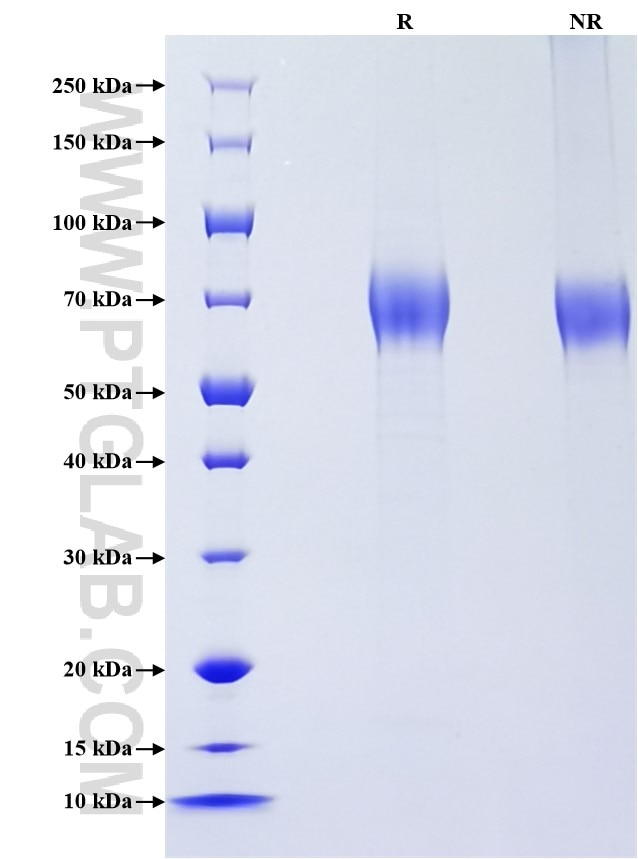
>90 %, SDS-PAGE
Tag
His Tag
Activity
not tested
Cat no : Eg4704
Validation Data Gallery
Product Information
| Purity | >90 %, SDS-PAGE |
| Endotoxin | <0.1 EU/μg protein, LAL method |
| Activity |
Not tested |
| Expression | HEK293-derived Human LILRA1 protein Pro17-Asn461 (Accession# O75019-1) with a His tag at the C-terminus. |
| GeneID | 11024 |
| Accession | O75019-1 |
| PredictedSize | 49.6 kDa |
| SDS-PAGE | 60-75kDa, reducing (R) conditions |
| Formulation | Lyophilized from 0.22 μm filtered solution in PBS, pH 7.4. Normally 5% trehalose and 5% mannitol are added as protectants before lyophilization. |
| Reconstitution | Briefly centrifuge the tube before opening. Reconstitute at 0.1-0.5 mg/mL in sterile water. |
| Storage Conditions |
It is recommended that the protein be aliquoted for optimal storage. Avoid repeated freeze-thaw cycles.
|
| Shipping | The product is shipped at ambient temperature. Upon receipt, store it immediately at the recommended temperature. |
Background
Leukocyte immunoglobulin-like receptor A1 (LILRA1) plays a significant role in the immune system. It is part of the leukocyte immunoglobulin-like receptor (LIR) family. The LILRA1 is predominantly expressed in B cells, where it interacts with major histocompatibility complex class I ligands and contributes to the regulation of immune responses. LILRA1 is involved in various pathways, including the innate immune system and Class I MHC-mediated antigen processing and presentation. It is known to have multiple functions, such as acting as a receptor for class I MHC antigens and potentially playing a role in the recognition and modulation of immune responses.
References:
1. Tedla N. et al. (2011). Tissue Antigens. 77(4):305–316.
2. Hogan LE. et al.(2016). Sci Rep. 6(1):21780.
3. Hirayasu K. et al. (2015). J Hum Genet. 60(11):703–708.
4. An H. et al. (2010). J Rheumatol.37(8):1596–1606.