
Recombinant Human SELPLG/CD162 protein (rFc Tag)
Species
Human
Purity
>90 %, SDS-PAGE
Tag
rFc Tag
Activity
not tested
Cat no : Eg1692
Validation Data Gallery
Product Information
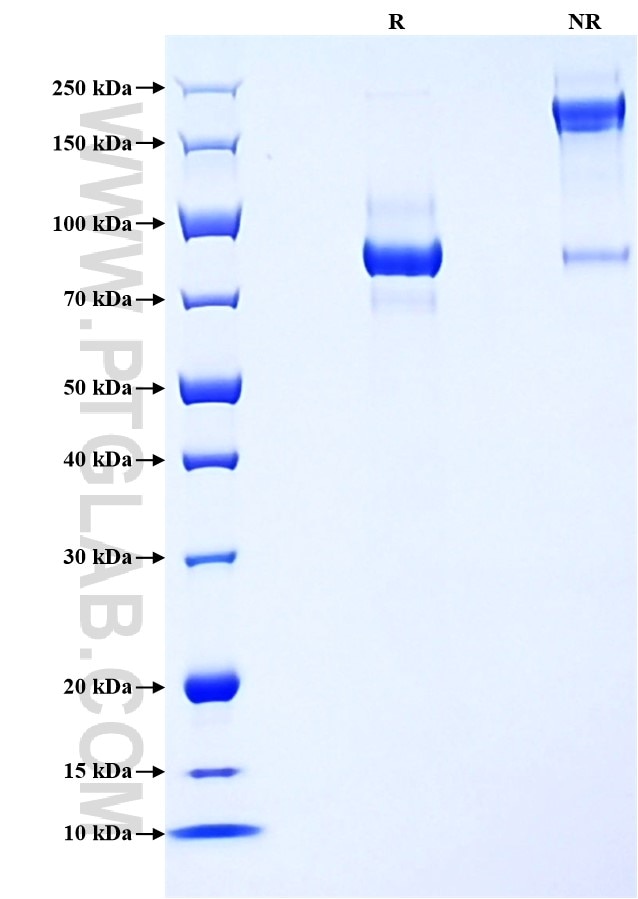
| Purity | >90 %, SDS-PAGE |
| Endotoxin | <0.1 EU/μg protein, LAL method |
| Activity |
Not tested |
| Expression | HEK293-derived Human SELPLG protein Gln42-Cys320 (Accession# Q14242-1) with a rabbit IgG Fc tag at the C-terminus. |
| GeneID | 6404 |
| Accession | Q14242-1 |
| PredictedSize | 55.1 kDa |
| SDS-PAGE | 80-90 kDa, reducing (R) conditions |
| Formulation | Lyophilized from 0.22 μm filtered solution in PBS, pH 7.4. Normally 5% trehalose and 5% mannitol are added as protectants before lyophilization. |
| Reconstitution | Briefly centrifuge the tube before opening. Reconstitute at 0.1-0.5 mg/mL in sterile water. |
| Storage Conditions |
It is recommended that the protein be aliquoted for optimal storage. Avoid repeated freeze-thaw cycles.
|
| Shipping | The product is shipped at ambient temperature. Upon receipt, store it immediately at the recommended temperature. |
Background
SELPLG (selectin P ligand), also known as CD162 or PSGL-1, is a type I transmembrane mucin-like glycoprotein. It is an adhesion molecule expressed on the surface of neutrophils, monocytes, and most lymphocytes as a homodimer of approximately 230-250 kDa (PMID: 7545173; 1378449; 9353350). SELPLG plays a critical role in the early stages of inflammation due to its ability to bind E-selectin (CD62E), L-selectin (CD62L), and P-selectin (CD62P) (PMID: 35597982).
References:
1. Vachino G. et al. (1995). J Biol Chem. 270(37):21966-21974.
2. Moore KL. et al. (1992). J Cell Biol. 118(2):445-456.
3. Borges E. et al. (1997). J Biol Chem. 272(45):28786-28792.
4. Burnie J. et al. (2022). Retrovirology. 19(1):9.