
Human KIM-1/HAVCR1 ELISA Kit
Cat no : KE00136
Synonyms
CD365, HAVCR, HAVCR 1, HAVCR1, Kidney injury molecule 1, KIM 1, KIM1, KIM-1, T cell membrane protein 1, TIM, TIM 1, TIM1, TIM-1, TIMD 1, TIMD1
Validation Data Gallery
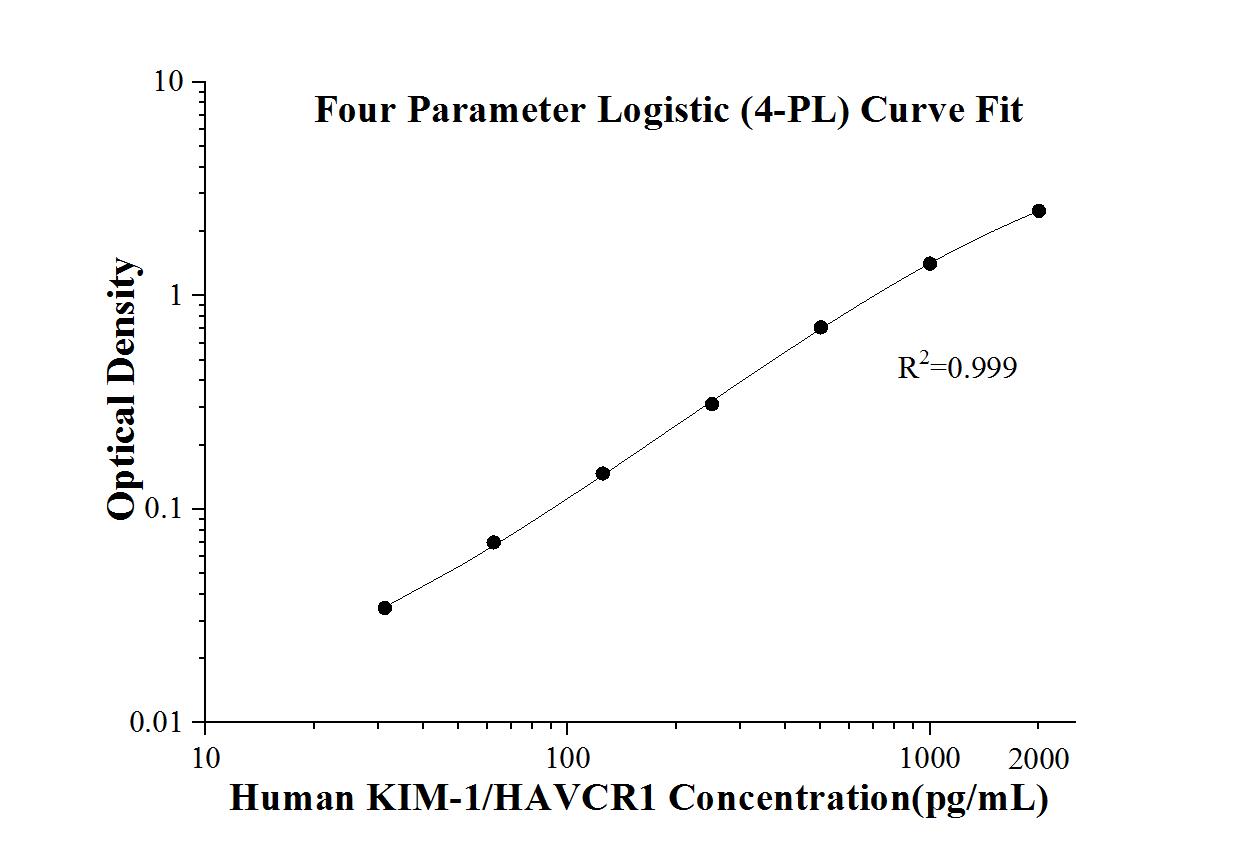
Product Information
KE00136 is a solid phase sandwich Enzyme Linked-Immuno-Sorbent Assay (Sandwich ELISA). The KIM-1 ELISA kit is to be used to detect and quantify protein levels of endogenous KIM-1. The assay recognizes human KIM-1. An antibody specific for KIM-1 has been pre-coated onto the microwells. The KIM-1 protein in samples is captured by the coated antibody after incubation. Following extensive washing, another antibody of biotinylated specific for KIM-1 is added to detect the captured KIM-1 protein. For signal development, Streptavidin-HRP is added, followed by Tetramethyl-benzidine (TMB) reagent. Solution containing sulfuric acid is used to stop color development and the color intensity which is proportional to the quantity of bound protein is measurable at 450 nm with the correction wavelength set at 630 nm.
| Product name | Human KIM-1/HAVCR1 ELISA Kit |
| Tests | 1 X 96 well plate |
| Sample type | Serum, Plasma, Cell culture supernatants, Urine |
| Assay type | Sandwich |
| Sensitivity | 1.1 pg/mL |
| Range | 31.25-2000 pg/mL |
| Reactivity | Human |
| Tested applications | Sandwich ELISA |
| Gene ID (NCBI) | 26762 |
Recovery
| Sample Type | Average | Range |
|---|---|---|
| Cell culture supernatants | 102% | 85%-123% |
| Urine | 99% | 77%-121% |
| Human plasma | 92% | 71%-111% |
IntraAssay
| Sample | n | mean ( pg/mL) | SD | CV% |
|---|---|---|---|---|
| 1 | 20 | 629.9 | 20.5 | 3.3 |
| 2 | 20 | 141.8 | 3.2 | 2.2 |
| 3 | 20 | 29.2 | 1.8 | 6.1 |
InterAssay
| Sample | n | mean ( pg/mL) | SD | CV% |
|---|---|---|---|---|
| 1 | 24 | 635.9 | 30.1 | 4.7 |
| 2 | 24 | 145.9 | 6.3 | 4.3 |
| 3 | 24 | 33.5 | 2.4 | 7.2 |
Background Information
Kidney injury molecule 1 (KIM-1), also known as Hepatitis A virus cellular receptor 1 (HAVCR1) or T-cell immunoglobulin and mucin domain 1 (TIM-1), is a class I integral membrane glycoprotein, with an ectodomain containing Ig-like domain and a mucin domain. KIM-1 acts as a membrane receptor for hepatitis A virus (HAV). KIM-1 provides a costimulatory signal for T cell activation and inhibits the development of peripheral tolerance. KIM-1 may be involved in the regulation of asthma and allergic diseases. It has been reported that KIM-1 is shed into urine after acute kidney damage and is a marker of renal tubular injury.
Properties
| Storage Instructions | All the reagents are stored at 2-8℃ for 6 months or -20℃ for 12 months. Refer to the protocol for further storage instructions. |
| Synonyms | CD365, HAVCR, HAVCR 1, HAVCR1, Kidney injury molecule 1, KIM 1, KIM1, KIM-1, T cell membrane protein 1, TIM, TIM 1, TIM1, TIM-1, TIMD 1, TIMD1 |
FAQ
1、I have limited sample diluent. How should I handle samples requiring high dilution factors?
Answer: We recommend performing a serial dilution. For example, if human serum requires a 1,000,000-fold dilution, you can use a three-step 100× dilution method as follows:
Step 1: Take 2 uL of human serum and add it to 198 uL of sample diluent, mix thoroughly to obtain a 100-fold diluted sample.
Step 2: Take 2 uL of the 100-fold diluted sample and add it to 198 uL of sample diluent, mix thoroughly to obtain a 10,000-fold diluted sample.
Step 3: Take 2 uL of the 10,000-fold diluted sample and add it to 198 uL of sample diluent, mix thoroughly to obtain a 1,000,000-fold diluted sample.
If further dilution is required, additional serial steps can be used. We do not recommend using any other solutions or water for dilution, except for the sample diluent we suggest. If your sample diluent is still insufficient, please contact our customer service for more sample diluent.
Publications
| Species | Sample Type | Title |
|---|---|---|
iScience Wnt5b/FZD1/LRP6 signaling drives renal fibrosis by triggering cytoplasmic stabilization and nuclear translocation of β-catenin under hypoxia. | ||
J Crit Care A translational study of Galectin-3 as an early biomarker and potential therapeutic target for ischemic-reperfusion induced acute kidney injury. | ||
BMJ Open Association between elevated serum REG Iα levels and eGFR decline in patients with chronic kidney disease: a cross-sectional study in eastern China | ||