

Tested Applications
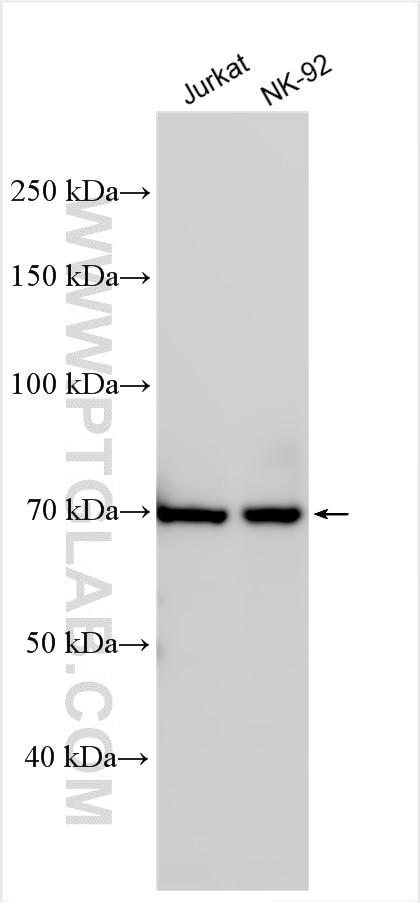
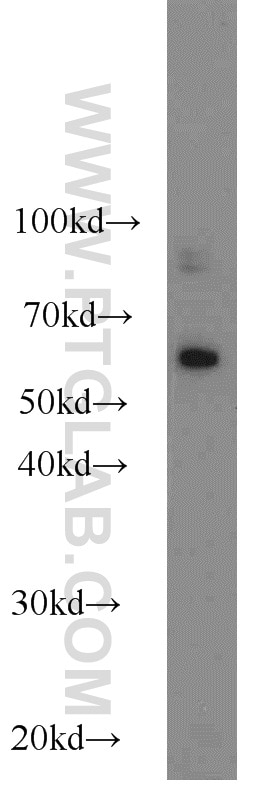
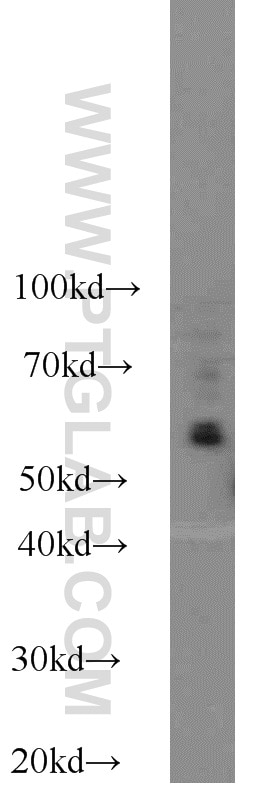
| Positive WB detected in | Jurkat cells, Raji cells, human peripheral blood leukocyte, NK-92 cells |
Recommended dilution
| Application | Dilution |
|---|---|
| Western Blot (WB) | WB : 1:200-1:1000 |
| It is recommended that this reagent should be titrated in each testing system to obtain optimal results. | |
| Sample-dependent, Check data in validation data gallery. | |
Product Information
10974-1-AP targets KLRG1 in WB, IF, ELISA applications and shows reactivity with human samples.
| Tested Reactivity | human |
| Cited Reactivity | human |
| Host / Isotype | Rabbit / IgG |
| Class | Polyclonal |
| Type | Antibody |
| Immunogen |
CatNo: Ag1407 Product name: Recombinant human KLRG1 protein Source: e coli.-derived, PKG Tag: GST Domain: 1-195 aa of BC012621 Sequence: MTDSVIYSMLELPTATQAQNDYGPQQKSSSSRPSCSCLVAIALGLLTAVLLSVLLYQWILCQGSNYSTCASCPSCPDRWMKYGNHCYYFSVEEKDWNSSLEFCLARDSHLLVITDNQEMSLLQVFLSEAFCWIGLRNNSGWRWEDGSPLNFSRISSNSFVQTCGAINKNGLQASSCEVPLHWVCKKCPFADQALF Predict reactive species |
| Full Name | killer cell lectin-like receptor subfamily G, member 1 |
| Calculated Molecular Weight | 22 kDa |
| Observed Molecular Weight | 60-70 kDa |
| GenBank Accession Number | BC012621 |
| Gene Symbol | KLRG1 |
| Gene ID (NCBI) | 10219 |
| RRID | AB_2234383 |
| Conjugate | Unconjugated |
| Form | Liquid |
| Purification Method | Antigen affinity purification |
| UNIPROT ID | Q96E93 |
| Storage Buffer | PBS with 0.02% sodium azide and 50% glycerol, pH 7.3. |
| Storage Conditions | Store at -20°C. Stable for one year after shipment. Aliquoting is unnecessary for -20oC storage. 20ul sizes contain 0.1% BSA. |
Background Information
KLRG1 (killer cell lectin-like receptor subfamily G, member 1) is a C-type lectin inhibitory receptor that contains an immunoreceptor tyrosine-based inhibitory motif (ITIM) in its cytoplasmic domain. KLRG1 is expressed by subsets of NK and T cells, existing both as a monomer and as a disulfide-linked homodimer (PMID: 10741410; 19604491). It is considered to be a cell differentiation marker for NK and T cells and is strongly induced by viral and other infections (PMID: 20373518). Through interactions with members of the cadherin family, KLRG1 plays an inhibitory role in NK- and T-cell function (PMID: 19009530; 20373518). Because of the glycosylation and disulfide bonds of the KLRG1 proteins, the observed molecular weights are typically 30-38 kDa (PMID: 17404256).
Publications
What published studies show
The KLRG1 Polyclonal antibody (Cat# 10974-1-AP) has 3 total citations, appearing in Brain (2 papers) and Journal of Neurology (1 paper). The cited studies focus on inclusion body myositis, examining mitochondrial damage and early immune responses, highly differentiated cytotoxic T cells, and morphological/molecular comparisons between HIV-associated and sporadic inclusion body myositis. The associated research fields span neuromuscular disorders and immunology.
| Species | Application | Title |
|---|---|---|
Brain Mitochondrial damage is associated with an early immune response in inclusion body myositis. | ||
J Neurol Morphological and molecular comparison of HIV-associated and sporadic inclusion body myositis |






