
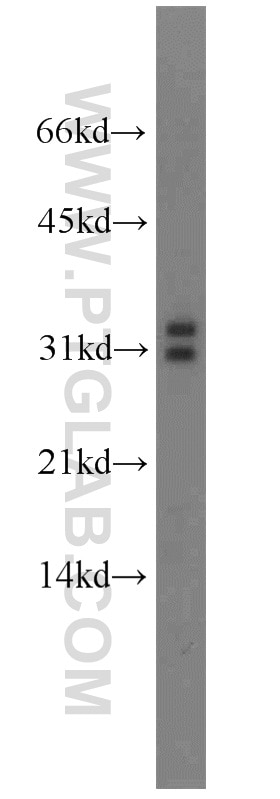
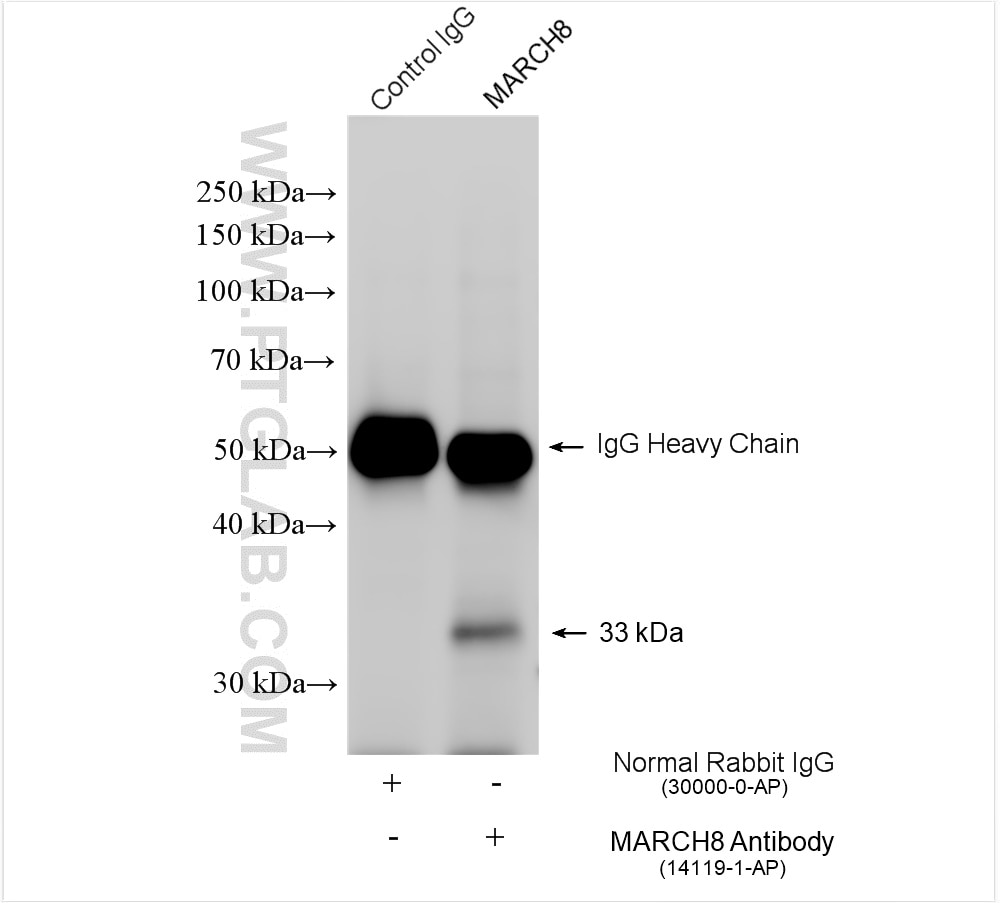

Tested Applications
| Positive WB detected in | mouse testis tissue |
| Positive IP detected in | mouse testis tissue |
Recommended dilution
| Application | Dilution |
|---|---|
| Western Blot (WB) | WB : 1:500-1:1000 |
| Immunoprecipitation (IP) | IP : 0.5-4.0 ug for 1.0-3.0 mg of total protein lysate |
| It is recommended that this reagent should be titrated in each testing system to obtain optimal results. | |
| Sample-dependent, Check data in validation data gallery. | |
Product Information
14119-1-AP targets MARCH8 in WB, IHC, IF, IP, CoIP, ELISA applications and shows reactivity with human, mouse samples.
| Tested Reactivity | human, mouse |
| Cited Reactivity | human, mouse, pig, monkey, zebrafish |
| Host / Isotype | Rabbit / IgG |
| Class | Polyclonal |
| Type | Antibody |
| Immunogen |
CatNo: Ag5268 Product name: Recombinant human MARCH8 protein Source: e coli.-derived, PGEX-4T Tag: GST Domain: 1-158 aa of BC066988 Sequence: MSMPLHQISAIPSQDAISARVYRSKTKEKEREEQNEKTLGHFMSHSSNISKAGSPPSASAPAPVSSFSRTSITPSSQDICRICHCEGDDESPLITPCHCTGSLHFVHQACLQQWIKSSDTRCCELCKYEFIMETKLKPLRKWEKLQMTSSERRKIMCS Predict reactive species |
| Full Name | membrane-associated ring finger (C3HC4) 8 |
| Calculated Molecular Weight | 33 kDa |
| Observed Molecular Weight | 30-33 kDa |
| GenBank Accession Number | BC066988 |
| Gene Symbol | MARCH8 |
| Gene ID (NCBI) | 220972 |
| RRID | AB_2140168 |
| Conjugate | Unconjugated |
| Form | Liquid |
| Purification Method | Antigen affinity purification |
| UNIPROT ID | Q5T0T0 |
| Storage Buffer | PBS with 0.02% sodium azide and 50% glycerol, pH 7.3. |
| Storage Conditions | Store at -20°C. Stable for one year after shipment. Aliquoting is unnecessary for -20oC storage. 20ul sizes contain 0.1% BSA. |
Background Information
MARCH8 (Membrane-associated RING finger protein 8) is also named as MIR, RNF178 and belongs to the RING zinc finger protein family. It functions as an E3 ubiquitin ligase for immune recognition-related molecules (e.g. major histocompatibility complex class I, B7-2, and ICAM-1). It plays a key role in controlling MHC class II surface expression by regulated ubiquitination of a lysine residue in the beta-chain (PMID:22761441).
Protocols
| Product Specific Protocols | |
|---|---|
| IP protocol for MARCH8 antibody 14119-1-AP | Download protocol |
| WB protocol for MARCH8 antibody 14119-1-AP | Download protocol |
| Standard Protocols | |
|---|---|
| Click here to view our Standard Protocols |
Publications
What published studies show
Anti-MARCH8 antibody (Cat# 14119-1-AP) has accumulated 37 citations across high-impact journals including Nature Communications, Autophagy, Molecular Cell, PNAS, Developmental Cell, Journal of Virology, Oncogenesis, mBio, and Journal of Biological Chemistry. Key research fields encompass virology and antiviral defense mechanisms, selective autophagy, cancer biology and tumor suppression, innate and adaptive immunology, ferroptosis regulation, and tissue fibrosis.
| Species | Application | Title |
|---|---|---|
Signal Transduct Target Ther MARCH3 negatively regulates IL-3-triggered inflammatory response by mediating K48-linked polyubiquitination and degradation of IL-3Rα.
| ||
Autophagy 2AB protein of Senecavirus A antagonizes selective autophagy and type I interferon production by degrading LC3 and MARCHF8.
| ||
Autophagy N protein of PEDV plays chess game with host proteins by selective autophagy
| ||
Autophagy BST2 suppresses porcine epidemic diarrhea virus replication by targeting and degrading virus nucleocapsid protein with selective autophagy.
| ||
Autophagy Macrophage autophagy protects against acute kidney injury by inhibiting renal inflammation through the degradation of TARM1 | ||
Nat Commun MARCH8 inhibits influenza A virus infection by targeting viral M2 protein for ubiquitination-dependent degradation in lysosomes. |



