
Recombinant Mouse CCL1 protein (rFc Tag)
Species
Mouse
Purity
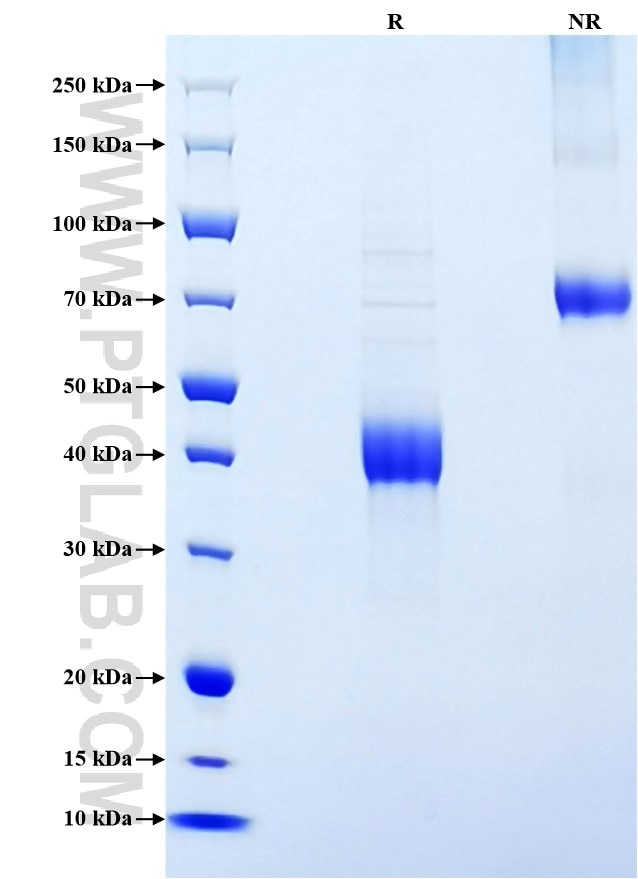
>90 %, SDS-PAGE
Tag
rFc Tag
Activity
not tested
Cat no : Eg3293
Validation Data Gallery
Product Information
| Purity | >90 %, SDS-PAGE |
| Endotoxin | <0.1 EU/μg protein, LAL method |
| Activity |
Not tested |
| Expression | HEK293-derived Mouse CCL1 protein Lys24-Cys92 (Accession# P10146-1) with a rabbit IgG Fc tag at the N-terminus. |
| GeneID | 20290 |
| Accession | P10146-1 |
| PredictedSize | 35.0 kDa |
| SDS-PAGE | 37-45 kDa, reducing (R) conditions |
| Formulation | Lyophilized from 0.22 μm filtered solution in PBS, pH 7.4. Normally 5% trehalose and 5% mannitol are added as protectants before lyophilization. |
| Reconstitution | Briefly centrifuge the tube before opening. Reconstitute at 0.1-0.5 mg/mL in sterile water. |
| Storage Conditions |
It is recommended that the protein be aliquoted for optimal storage. Avoid repeated freeze-thaw cycles.
|
| Shipping | The product is shipped at ambient temperature. Upon receipt, store it immediately at the recommended temperature. |
Background
CCL1, also known as I-309 in human or TCA-3 in mice, is a small glycoprotein belonging to the CC chemokine family. It is predominantly expressed by activated T cells, monocytes, and endothelial cells, and primarily acts as a chemoattractant for monocytes and T cells . CCL1 binds to the receptor CCR8, which is expressed on monocytes, neutrophils, and T cells, including within the thymus . This chemokine may perform dual functions: as an inflammatory chemokine during leukocyte migration into inflammatory sites and as a constitutive chemokine during T cell selection in the thymus . Furthermore, CCL1 has been associated with allergic inflammation and the recruitment of Th2 cells, suggesting a role in allergic diseases such as asthma.
References:
1.Miller MD,Krangel MS. (1992). Proc Natl Acad Sci U S A. 89 (7).
2.Kuehnemuth B, et al. (2018) BMC Cancer. 18 (1):1278.