
Recombinant Mouse IGF2 protein (rFc Tag)
Species
Mouse
Purity
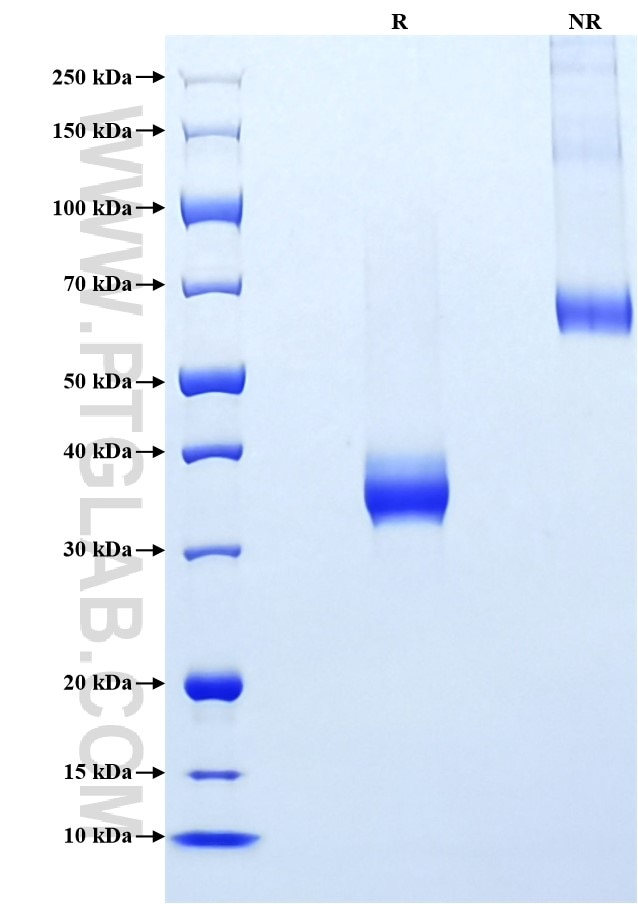
>90 %, SDS-PAGE
Tag
rFc Tag
Activity
not tested
Cat no : Eg4527
Validation Data Gallery
Product Information
| Purity | >90 %, SDS-PAGE |
| Endotoxin | <0.1 EU/μg protein, LAL method |
| Activity |
Not tested |
| Expression | HEK293-derived Mouse IGF2 protein Ala25-Glu91 (Accession# P09535-1) with a rabbit IgG Fc tag at the N-terminus. |
| GeneID | 16002 |
| Accession | P09535-1 |
| PredictedSize | 34.6 kDa |
| SDS-PAGE | 33-38 kDa, reducing (R) conditions |
| Formulation | Lyophilized from 0.22 μm filtered solution in PBS, pH 7.4. Normally 5% trehalose and 5% mannitol are added as protectants before lyophilization. |
| Reconstitution | Briefly centrifuge the tube before opening. Reconstitute at 0.1-0.5 mg/mL in sterile water. |
| Storage Conditions |
It is recommended that the protein be aliquoted for optimal storage. Avoid repeated freeze-thaw cycles.
|
| Shipping | The product is shipped at ambient temperature. Upon receipt, store it immediately at the recommended temperature. |
Background
Insulin-like growth factor 2 (IGF2) is a crucial protein that plays a significant role in regulating growth, particularly during normal fetal development, and is also often dysregulated during tumorigenesis. IGF2 is one of the main ligands of the type 1 IGF receptor (IGF-1R), a tyrosine kinase receptor that transmits signals upon binding with IGF-II. IGF2 is predominantly secreted via the placenta during pregnancy and, after birth, primarily by hepatocytes, with its secretion being independent of growth hormone (GH) secretion, unlike IGF-I.
References:
1. Benyoucef, S. et al. (2007). Biochem. J. 403, 603-613.
2.Frasca, F. et al. (1999). Mol. Cell. Biol. 19, 3278-3288.
3.Pandini, G. et al. (2002). J. Biol. Chem. 277, 39684-39695.
4. Vella, V. et al. (2019). Cells. 8, 1017.
5.Sciacca, L. et al.(1999). Oncogene.18, 2471-2479.